The flashlight beam cut through the darkness, landing on a pristine, plastic-wrapped crib.
Next to it sat a rocking chair, a stack of sealed diapers from a brand that went out of business in the nineties, and a box labeled “Baby Leo.”
I felt like the air had been sucked out of the unit.
Mark and I had spent fifteen years trying to conceive.
Multiple rounds of IVF. Thousands of dollars. Hundreds of tears.
He had always been the “strong” one, telling me it was okay, that maybe it just wasn’t meant to be.
I opened the box labeled “Baby Leo” with trembling fingers.
Inside was a birth certificate.
It wasn’t for a child we had lost.
It was a birth certificate for a boy born three years before Mark and I ever met.
The father listed was Mark. The mother was a woman named Sarah Jenkins.
Underneath the certificate was a stack of letters, all returned to sender, unopened.
Online reactions were a mixture of shock and support, with many calling it a wake-up call for how a single forgotten item can dismantle a decades-long facade. One commenter wrote, “You think you sleep next to a person, but you’re sleeping next to a stranger’s curated history.”
I dug deeper into the box. I found a newspaper clipping from a small-town gazette.
“Local Woman and Toddler Disappear After Witness Testimony.”
The realization hit me like a physical blow to the stomach.
Mark wasn’t a liar in the way I thought. He wasn’t a cheater.
He was a man who had been erased.
I found a secondary folder hidden in the bottom of a filing cabinet at the back of the unit.
It contained legal documents from a federal protection program dated 1998.
Mark’s real name wasn’t Mark.
He had witnessed a high-level crime in his twenties and had been forced to leave everything behind.
His “dead” mother. His first wife. His infant son.
He had spent twenty years pretending to be a man with no past to keep us safe.
But then I saw the most recent document.
It was a private investigator’s report from only six months ago.
Mark had been tracking them. He had found his son.
The “bowling league” nights weren’t for sports.
He had been driving to the next state over, watching a twenty-three-year-old man walk to work.
I sat on the dusty floor of unit 412 and cried for the life he lost, and the one he built on a foundation of silence.
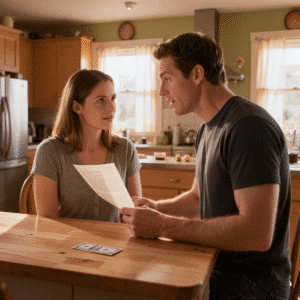
When I drove home, Mark was sitting at the kitchen table.
The framed photo of his mother was sitting in front of him.
He didn’t look angry. He looked relieved.
“I saw the backing was loose,” he said quietly. “I knew you’d find it eventually.”
We didn’t divorce. We didn’t even yell.
We sat in the quiet of our kitchen and he told me his real name for the very first time.