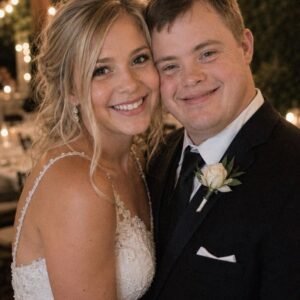
The song they had chosen was one she had loved for years.
I know this because Julian told me about it afterward, sitting at his kitchen table with his hands wrapped around a cup of coffee that had gone cold an hour before. He told me the name of the song, what it meant to her, why she had insisted on it. He told me how she had hummed it in the car on the way to the venue that morning, not nervously but happily, the way you hum something that belongs to you.
I am telling you this because I want you to understand that this was not an ordinary wedding. No wedding is, of course. But this one had the particular quality of something long and carefully wanted. They had been together for six years. They had talked about this day the way people talk about something they are almost afraid to believe in — carefully, with one hand held back, just in case.
That morning, everything they had been afraid to believe in was finally real.
The reception hall was warm with the kind of light that photographers spend careers chasing. Ivory and gold. Candles on every table. The smell of flowers that had been arranged and rearranged a dozen times over the preceding week until they were exactly right. Guests in their finest clothes, glasses raised, voices filling the room with the particular noise of people who are genuinely happy and not trying to hide it.
When the first dance began, the room quieted in that instinctive way — everyone turning, everyone watching, everyone wanting to witness the moment.
She moved beautifully. Julian has said this and so have the people who were standing closest to the dance floor. Her dress caught the light as she turned. She was smiling the smile that people who knew her well would have recognized immediately — not the posed smile of photographs, but the real one, the one that started in her eyes before her mouth knew what was happening.
He had his hand at her waist. She had her hand on his shoulder. They were close enough that he could feel her breathing.
And then she wasn’t.
The sound she made when she fell is something Julian has not been able to fully describe. Not a cry. Not a word. Something involuntary, something the body produces when the body is failing and the mind has not yet caught up. Then the floor. Then stillness.
The music did not stop immediately. There were two or three more seconds of it playing — the song she had hummed in the car that morning — before someone reached the speakers and the room went silent.
What followed was the specific chaos of people confronting something they have no framework for. A bride had just fallen on her wedding day. The sentence made no sense. The image in front of them made no sense. Guests who had been laughing thirty seconds earlier stood frozen, caught between the instinct to help and the inability to process what helping would even mean in this situation.
Julian was on his knees beside her before anyone else moved. He was saying her name. He said it many times, with the increasing urgency of someone who is asking a question and not getting an answer, and each repetition of her name was a little different from the last — first confused, then frightened, then something beyond frightened that has no clean word for it.
Someone called emergency services. Someone else cleared a space. Two guests who turned out to have medical training moved through the crowd with the focused calm of people who have been trained to override panic, and their presence helped contain the chaos even as it confirmed that what was happening was serious.
The sirens came fast. The responders moved faster. And the room watched with the collective held breath of people who were hoping desperately for the kind of outcome that was not going to come.
The doctor’s words, when they came, were quiet.
That is the detail that stays with everyone who was present. Not loud. Not dramatic. Quiet — the way news of this particular weight tends to arrive, as though it is too heavy for volume, as though the only register that can carry it is barely above a whisper.
She was gone.
The woman who had hummed her wedding song in the car that morning. The woman whose dress was still spread across the floor of the reception hall. The woman Julian had stood beside at an altar two hours earlier and promised to love for the rest of his life.
Gone. On her wedding day. During the first dance.
The room did not react the way rooms react in films. There was no collective cry, no dramatic outpouring. There was silence — the kind that is not empty but full, packed tight with grief and disbelief and the specific horror of something that cannot be made to make sense no matter how many times you try.
Julian remained on his knees for a long time.
The days that followed were the cruelest kind of practical.
Grief has two phases, and the second one — the quiet administrative one — is in some ways harder than the first, because it requires functioning in the world as though you are a person who can make phone calls and answer questions and explain what happened to strangers who answer the phone at catering companies and florists and honeymoon resorts.
The honeymoon had to be canceled. Julian has described making that call as one of the most surreal experiences of his life — listening to the hold music, waiting for someone to pick up, trying to find the words that would explain why two people who had been planning this trip for months would not be coming.
The vendors were called one by one. Each conversation required the same explanation. Each explanation required saying the words again. And the words did not get easier with repetition. They got harder, because each time he said them, they became a little more real.
The guest list — the same names, the same phone numbers, the same addresses that had received wedding invitations six months earlier — was used again. This time the calls were not about celebrating. This time the message was different, and the people receiving it had to find a way to absorb something that made no sense to them either, because they had been there, because they had seen her smiling on the dance floor, because for them too the distance between that moment and this one felt impossible to cross.
The church held a different gathering.
The same building. Different flowers. The same faces, but arranged differently now — shoulders turned inward, eyes cast down, the particular posture of people carrying something heavy. They wore subdued colors. They spoke quietly, in the careful tones of people choosing words with more than usual care, aware that the wrong ones could break something that was already close to breaking.
Julian stood at the front as he had stood at the front five days before. The same room. The same people watching him. An entirely different reason for being there.
He was present and he was not present. People who spoke to him described the sensation of talking to someone who was hearing the words but receiving them from very far away — a man still inside the event, still trying to understand what had happened, still reaching for the version of that day where the story went differently.
The wedding band on his finger had not been removed. He has said he did not know what removing it would mean, and so it stayed where she had placed it, heavier now than it had been in the moment she slid it on, carrying a different kind of weight than the one it was designed for.
Afterward, the apartment was full of things that had not yet been told.
Wedding gifts still in their boxes, some of them. Cards with messages written in the confident assumption that a long life together lay ahead of the people they were addressed to. Photographs from the ceremony — professional ones that arrived in the weeks following, images of a day that had started one way and ended another, both truths somehow contained in the same pictures.
Her half of the closet. Her handwriting on a list she had made of things to remember to pack for the honeymoon, stuck to the refrigerator with a magnet shaped like a pineapple.
The small, impossible objects of a life that had been present and then was not.
Friends came. Family came. People brought food and sat with him and said the things that people say, and Julian was grateful for all of it and could not fully receive any of it, because grief of this particular kind does not leave room for much else in the early weeks. It occupies everything.
He has said that the support helped. Not in the sense of filling the space she left — nothing fills that — but in the sense of making the empty space a little less silent.
There is no resolution to a story like this one. No lesson that makes the weight of it feel purposeful. No ending that redeems the loss or explains why a woman in a beautiful dress, dancing with the person she loved, on the day she had waited years for, was not given more time.
What remains is what always remains in the absence of resolution: the memory of what was, and the fact that it was real.
She was real. The song she hummed in the car was real. The way she smiled — the one that started in her eyes — was real. The six years they had together were real. The day itself, all of it, the light and the flowers and the first dance and everything that came after, was real.
Julian carries all of it. The band on his finger. The photographs on the shelf. The song that he cannot hear without being returned immediately to the dance floor and to her, moving in the light, smiling her real smile, alive in the last moment before everything changed.
Love does not guarantee time.
He knows this now in the way that only certain people are made to know it — suddenly, completely, on what was supposed to be the happiest day of his life.
And still, he says, he would not undo a single day of the six years they had. Not one.
That is the part of the story that stays with me most. Not the tragedy of the ending. The stubbornness of the love that survived it.