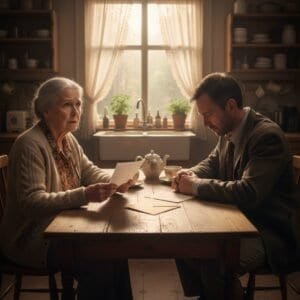
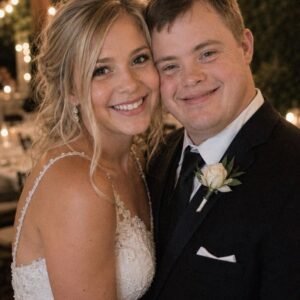
I used to tell Owen that the two of us were a complete sentence.
Not a fragment, not something waiting to be finished by a third person who never showed up — a complete sentence, with a subject and a verb and everything it needed already inside it. His father had made his position clear before Owen was even born, and I had spent exactly two weeks grieving that before I decided it was information rather than a wound. Some people aren’t built for the weight of a family. Better to know early.
So it was us. From the first moment I held him in that hospital room — small and impossibly real, his face scrunched against the light — it was just us, and I built my entire life around the fact of that without ever feeling it as a limitation.
He grew up easy, in the way that some children are easy not because they’re passive but because they’re genuinely good — interested in things, kind to people, the kind of boy who made friends without trying and remembered the names of everyone in the room. He played soccer badly and loved it anyway. He read more than most of his friends and wasn’t self-conscious about it. When he was sixteen he started cooking dinner twice a week without being asked, and when I told him it was the best thing anyone had ever done for me, he laughed and said it was purely selfish because he was tired of my pasta.
He turned nineteen in March.
The call came in June.
A cab, a drunk driver, a Tuesday night intersection that he had crossed a hundred times before on the way home from his friend Marcus’s apartment. The officer who came to my door was young and visibly distressed, which I remember noticing with the strange peripheral clarity that shock produces — the way it lets you observe details with perfect precision while the central information simply refuses to land.
The paramedics said it was instant, he told me. He wouldn’t have felt anything.
I have held that sentence like a stone for five years. Turned it over and over, worn it smooth. Some days it helps. Some days the word instant is the worst part — the idea that there was no transition, no moment where he knew, no last thought I could imagine him having that might have been of me.
Seven days later, I stood at his grave in the June heat and watched them lower my son into the ground, and I thought: the world has no right to keep spinning.
But it did. It kept spinning with the complete indifference that the world brings to private catastrophe, and eventually — not soon, not easily — I spun with it.
I went back to my kindergarten classroom in September.
People told me to take more time, and I understood why they said it, and I also knew that time without structure was not something I could afford. The grief was large enough to fill any space I gave it. The classroom gave it boundaries — not healing, not yet, but containment. Five-year-olds do not allow you to disappear inside yourself. They need things constantly, specifically, without apology, and I found that I was grateful for the needing.
I learned to be present in a room full of other people’s children. I learned to braid hair and tie shoes and adjudicate crayon disputes and read picture books aloud with the voices that made them lean forward. I learned to love them in the specific, professional, genuine way that good teachers love students — fully within the hour, released at the bell, the love that doesn’t diminish because it has an ending built into it.
Five years of Septembers.
Five years of small faces and primary colors and the particular smell of a classroom — glue and pencil shavings and the industrial cleaner the janitors used on the floors each evening. Five years of doing the thing that kept me from falling apart, one Tuesday at a time.
The Tuesday Theo arrived was ordinary in every way until it wasn’t.
Our principal, Mrs. Garrett, appeared in my classroom doorway at nine-fifteen with the particular expression she wore when something required extra care — a smile that was also a warning. Beside her was a small boy in a striped shirt, his backpack slightly too large for him, his posture the careful posture of a child who has been told to make a good impression and is taking the instruction seriously.
“This is Theo,” Mrs. Garrett said. “He’s joining us today. His family just moved to the district.”
“Hi, Theo,” I said, and crouched down to his level the way I always did with new students, to make the size differential less intimidating. “We’re really happy you’re here.”
He took one small step forward, out from behind Mrs. Garrett’s arm, and looked at me with the assessing seriousness of a five-year-old who is deciding whether a room is safe.
That was when I saw it.
Under his right eye. A small crescent-shaped mark, pale against his skin, sitting in the exact position that Owen’s had occupied for nineteen years. I had kissed that mark ten thousand times. I had looked at it in every photograph I had ever taken of my son. I knew its precise location and shape the way I knew my own hands.
The sound I made was involuntary — not quite a gasp, something smaller and sharper than a gasp, the sound of air being taken from you suddenly. I gripped the edge of the nearest table and held on.
Theo looked at me with polite concern. Mrs. Garrett gave me a quick, quiet look. I made myself smile.
“Why don’t you come find a seat,” I said. My voice came out mostly even. “We’re about to do something really fun.”
I got through the rest of that morning on a mechanism I couldn’t have named — not instinct exactly, more like the trained automaticity of a person who has learned to perform function during crisis. I called on children. I read aloud. I moved around the room with the normal rhythms of a normal Tuesday. I laughed at the right moments.
And I watched Theo.
It was not just the birthmark.
When he was listening carefully, he tilted his head slightly to the left. Not dramatically — just a small, habitual tilt, like the angle helped him hear better or think more clearly. Owen had done that. I had a photograph of Owen at seven, sitting at the kitchen table doing homework, his head at that same precise angle. I had looked at that photograph so many times that I could have drawn it from memory.
When Theo didn’t know the answer to something and felt uncertain about admitting it, his mouth did a specific thing — a small, sideways smile that was half apology, half attempt at charm, the smile of someone who has discovered early that their personality is their best asset in moments of vulnerability. Owen had smiled like that at me across the car at seventeen when he had forgotten to tell me about a school event until forty minutes before it started.
I sat at my desk during the brief independent work period and breathed carefully.
It’s a birthmark, I told myself. Birthmarks are common. Mannerisms are not genetic. Children tilt their heads. Children smile sideways. You are looking for him because you always look for him. This is grief, not a message.
I believed all of that. I also could not stop watching him.
When the school day ended and the other children had been collected, Theo stayed seated at the reading corner, organizing his things with a neatness that seemed characteristic rather than instructed. I walked over and crouched beside him.
“Did you have a good first day?” I asked.
He considered this genuinely, which I noticed — children who give real consideration to questions rather than automatic answers.
“The blocks are good,” he said. “And I liked the story about the bear.” A small pause. “Some of the kids are loud.”
“Some of them are,” I agreed. “You’ll get used to it.”
“My mom says I can be quiet enough for ten people,” he said, with a tone that suggested he had heard this said with affection many times.
I smiled. “She sounds smart.”
“She’s a doctor,” he said, matter-of-factly. “Not the kind with sick people. The kind with bones.”
“An orthopedic surgeon?”
He shrugged with the profound indifference of a five-year-old who has not yet developed interest in professional classifications. “She fixes broken things,” he said.
“That’s an important job,” I said.
“Both my parents are coming today,” he offered. “They said they’d both come the first day.”
I volunteered for pickup duty.
The teacher covering the door gave me a slightly puzzled look — I was technically done for the day — and I explained I wanted to make sure the new student’s transition went smoothly. Which was true, in its way.
I stood near the entrance with my lanyard on and watched the familiar chaos of end-of-day pickup organize itself. Parents arriving in cars and on foot, children spotting their people across the yard with that specific, full-body recognition that small children have — the way they locate their parents before they’ve fully processed what they’re seeing, some animal certainty that bypasses cognition entirely.
Theo was beside me, his backpack on properly, watching the entrance with a calm patience that seemed unusual for his age.
Then his face changed.
It changed the way faces change when the exact right person appears in a room — the particular illumination of a child who has spotted their parent, except magnified by having been in a new place all day, by the accumulated effort of making a good impression in an unfamiliar room, by the relief of being retrieved by someone who simply, completely loved him.
“Mama!” he shouted, and the backpack went sideways and he ran with the full-body commitment of a five-year-old who is not thinking about anything except the destination.
The woman waiting at the entrance caught him — stepped forward and caught him in the practiced way of someone who has caught this particular child many times, who knew exactly how much force was coming and at what angle, who folded around him with the ease of long familiarity.
She was about my age. Dark hair pulled back from her face. A coat she hadn’t bothered to button against the autumn afternoon. She was laughing at something Theo was already saying into her shoulder, her face bent toward his, and when she looked up from him to scan the yard — the automatic parental scan, checking the environment, locating the teacher, noting exits — her eyes met mine.
I had stopped breathing somewhere between him shouting Mama and this moment.
Because the woman holding Theo was someone I recognized.
Not from the school. Not from the neighborhood. Not from any of the ordinary places you recognize people.
I recognized her from a hospital waiting room, five years ago. From a conversation I had had in a corridor at two in the morning with a woman whose son had also been in the accident. Not the drunk driver’s car. The other car. The car that had been hit from behind and pushed into the intersection. A woman who had sat beside me on a row of plastic chairs while we both waited for news that came differently for each of us. Whose son had survived with a traumatic brain injury, who had spent months in rehabilitation, who I had exchanged numbers with in that corridor and never called, because grief is not a thing that easily reaches toward other grief.
Her name was Patricia.
Her son had survived.
He had been nineteen. Severely injured. He had recovered, against probability, against the early prognosis — recovered in the long, slow, difficult way that some people recover from the things that should have ended them. He had been told, eventually, that the brain injury had affected his ability to have biological children. He and his wife, who had stayed beside him through every month of rehabilitation, had eventually adopted.
They had adopted Theo at two years old.
I knew all of this because Patricia and I had exchanged exactly four messages in the year after the accident, before the silence that grief eventually imposes — before I stopped being able to reach toward anything outside my own loss, and she had been too deep in her son’s recovery to reach outward either.
She recognized me in the same moment I recognized her.
Her face went through something I recognized because I was feeling it myself — the collision of past and present, the disorientation of encountering someone from the worst moment of your life in a context that had nothing to do with it.
Then she looked at Theo in her arms. Then back at me.
And I understood that she had not known. When she enrolled him in this school, she had not known I taught here. There was no design in this. There was only the world, spinning indifferently, carrying people through its rotations and occasionally depositing them in the same place at the same time without explanation or intention.
She walked toward me. Theo riding her hip, already explaining something about the blocks.
“Sarah,” she said. Her voice was careful. Wondering.
“Patricia,” I said.
We looked at each other across the ordinary chaos of end-of-day pickup, two women connected by a night five years ago that had ended differently for each of us and the same for both of us.
“I didn’t know,” she said.
“I know,” I said.
Theo looked between us with the alert curiosity of a child who has detected that something is happening between the adults that they don’t fully have access to.
“Do you know my teacher?” he asked his mother.
Patricia looked at me. Her eyes were bright with something she was holding carefully in place.
“We met a long time ago,” she said to him. Then, to me: “He loves school. He’s been talking about kindergarten since July.”
“He had a very good first day,” I said.
“He tilts his head when he’s thinking,” she said, quietly, just for me. “He’s done it since he was small. I have no idea where he got it.”
I looked at Theo, who had lost interest in the adult conversation and was now examining something on the strap of his backpack with great concentration — head tilted slightly to the left.
“His birthmark,” I said, and stopped.
“Yes,” Patricia said, very softly. “I noticed it too. In the photographs.” She had a photograph of Owen. I had sent it to her, that first year, in one of our four messages — I couldn’t remember why, some impulse toward connection, some need to show her who he had been.
We stood in the school yard in the autumn afternoon and there was nothing to say that was adequate to the moment, so we said nothing, and it was not uncomfortable — it was the silence of two people who had survived something enormous and found themselves standing, improbably, in the same place.
“Can I walk you to your car?” I said finally.
“Yes,” she said.
Theo reached up and took my hand as we walked — the unreflective, trusting gesture of a five-year-old who has decided that a person is safe, the gesture that five-year-olds deploy without strategy or calculation, purely on instinct.
His hand was small in mine. Warm. Real.
I walked with them across the yard in the late afternoon light, and I did not try to make it mean something specific, did not try to name what it was or wasn’t. I just walked, and held the small hand, and let the world keep spinning.
It had no right to. But I was grateful that it had.