I had been awake since five, the way I always was.
Sleep and I had reached an arrangement over the years — it would take me as far as five in the morning, and after that I was on my own. I’d learned to stop fighting it. I made coffee, I stood at the kitchen window, I watched the yard go from black to grey to the particular flat blue of early morning, and I waited for the day to begin without me having anything to do with it.
It was just past six when the doorbell rang.
One ring. Quick and sharp — the kind that says I was here without waiting for an answer. I wrapped my robe tighter and padded to the front door with my coffee still in my hand.
I opened it.
There was a baby on my porch.
My mind did something strange in that first second — it simply refused. It offered me alternative explanations. A bag. A bundle of something left by a neighbor. Anything other than what it clearly was. And then the baby moved, one small fist uncurling in the morning air, and there was no more refusing.
She was wrapped in a denim jacket.
My coffee hit the floorboards before I’d made any decision to set it down.
I knew that jacket. I had bought it for my daughter Jen when she was fifteen, on a Saturday afternoon at a market stall when she was going through the phase where everything had to look worn-in and lived-in and found. She had rolled her eyes when I paid for it and said it still smelled like someone else’s perfume. She wore it for the next year so consistently that it became part of how I pictured her — that jacket, her dark hair, the way she moved through a room like she had somewhere important to be.
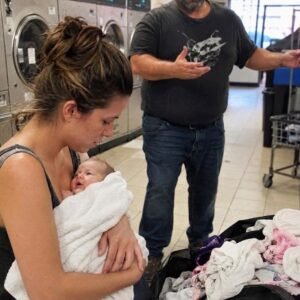
I crouched down. I touched the baby’s cheek with two fingers, then pressed my palm gently to her chest and felt it rise.
“Okay,” I whispered — to her, to myself, to whoever was listening. “Okay. I’ve got you.”
I lifted the basket and brought her inside.
Jen disappeared when she was sixteen.
There was no buildup I recognized at the time, though I have spent five years rebuilding that last week in my head, looking for the thing I missed. What I remember is a Tuesday evening, cabinet doors slamming, her voice raised about a boy named Andy that her father had forbidden her from seeing. My husband Paul, standing in the kitchen doorway with his arms crossed and that look on his face — the one that said the conversation was over because he had decided it was over.
And then she was gone.
The police searched. Neighbors walked the fields. Her photograph went up in every window in town — the grocery store, the gas station, the church bulletin boards. People left casseroles on my porch for the first month, and then the casseroles stopped, and the searches stopped, and one by one people settled back into their lives while I stayed frozen in mine.
Paul blamed me. First quietly, in the way that hides itself as concern, and then openly, in the way that wants an audience. He said I should have known. He said I never paid attention to the right things. He said worse than that, enough that I eventually stopped arguing and started believing him.
By the third year he had moved in with a woman named Amber and I was alone in the house with Jen’s bedroom door closed at the end of the hall. We were still married on paper. I never had the energy to do anything about it. Some things you leave unfinished because finishing them means accepting what they mean.
And now there was a baby in my kitchen wearing my daughter’s jacket.
I forced myself to move. There was a bag beside the basket — diapers, formula, two small sleepers, a soft cloth. Whoever had left her hadn’t panicked. They had packed carefully, thought it through, planned for the hours ahead. That steadied me somehow.
The baby watched me with the solemn, unblinking attention of someone taking notes.
I touched the jacket again. The left cuff was frayed in the way it had always been frayed — Jen used to chew it when she was anxious, a habit she’d had since childhood that she never fully outgrew. I had told her a hundred times to stop. I would have given anything, in that moment, to tell her one more time.
My hand found the pocket.
There was a folded piece of paper inside. I pulled it out slowly, smoothed it flat on the table with both palms, and read it.
Jodi. My name is Andy. I know this is a terrible way to do this, but I don’t know what else to do. This is Hope. She’s Jen’s daughter. She’s mine too. Jen always said that if anything ever happened to her, Hope should be with you. She kept this jacket all these years. She said it was the last piece of home she never let go of. I’m sorry. There are things you don’t know — things Paul kept from you. I’ll come back and explain everything. Please take care of Hope. — Andy.
I read it twice. Then I pressed it against my mouth with both hands and stood there in my kitchen in my robe and my bare feet while the morning light came through the window and the baby watched me fall apart.
I called Paul before I called anyone else. I don’t know why — habit, maybe, or some part of me that still believed he was owed the truth even when he hadn’t extended me the same courtesy.
He answered the way he always answered my calls. “What is it, Jodi.”
“Come over,” I said. “Now.”
“I have work. I have a—”
“You have a granddaughter on my kitchen table.”
The line went quiet.
“Come now, Paul.”
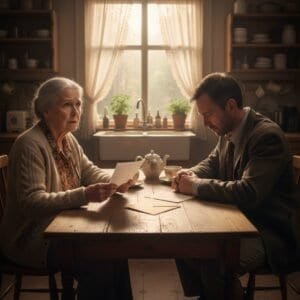
He arrived twenty minutes later. Amber stayed in the car. He walked into my kitchen complaining about the traffic, about the short notice, about something else I stopped listening to — and then he saw the jacket on the table and stopped talking entirely.
The color left his face so completely that for a moment he looked like a different person.
“Where did you get that,” he said. It wasn’t a question.
“That’s what I’m asking you.” I picked up Hope before I continued, because I needed something real to hold onto. “Sit down, Paul.”
His eyes moved to the note still on the table and slid away from it too quickly.
“You knew,” I said. “Tell me how much you knew.”
“Jodi. Don’t.”
“Did you know she was alive? That she left to be with someone she chose? That she built a life?”
He rubbed his jaw. When Paul was cornered, he always got angry — I had learned that early and forgotten it somewhere in the middle and was remembering it now.
“She called me,” he said finally. “Once. A few months after she left. She said she was with Andy. She said she was fine.”
I couldn’t locate my voice for a moment.
“She what?”
“She was sixteen, Jodi. She’d run off with a boy who had no job and no prospects and no plan. What did you want me to do?”
“I wanted you,” I said, very quietly, “to tell me my daughter was alive.”
“She made her choice.”
“She was sixteen years old and she made a phone call to her father, and her father decided she wasn’t worth telling me about.” I swayed gently with Hope against my shoulder, rubbing slow circles on her back the way my body seemed to know to do without instruction. “You let me mourn her, Paul. For five years. You let me think—”
“I told her if she came back, she came back alone,” he said. “Without him. She chose him.”
“You gave a grieving child an ultimatum and then told her mother nothing.” I looked at him. “That is what you did.”
Hope made a thin, tired sound. I turned toward the door.
“I’m taking her to the clinic. When I come back, I need you to be gone.” I picked up the diaper bag. “I called you here to see if you had any decency left. I have my answer.”
He said my name twice. I didn’t turn around.
Andy came to the diner at four o’clock.
He was young — mid-twenties, maybe, but grief had done something to him that made him look older and unfinished at the same time. He stood just inside the door holding his cap in both hands, and his eyes went to Hope in the carrier beside the pie case before they came to me.
My boss Lena took the coffee pot from my hand without a word. I pointed to the back booth.
He sat like a man who had already accepted whatever sentence was coming.
I sat across from him. “Start talking.”
He looked down at the table. When he looked up again, his eyes were full.
“She wanted to come home,” he said. “More times than I can count. In the end it was always the same reason she didn’t.”
“Her father.”
“After that first phone call, she cried for hours. He told her that if she came back with me, she’d be throwing her life away. He told her that if she really loved you, she’d stay gone and let you move on.” Andy said it without bitterness, which somehow made it land harder. “She believed him. She thought she was protecting you.”
I pressed my hands flat on the table.
“What happened to my daughter, Andy.”
He put one hand over his mouth. His shoulders moved once. Then he steadied himself.
“Hope was born three weeks ago,” he said. “There was a bleed after delivery. They said they’d stopped it. They said she was stable.” He stopped. “She wasn’t.”
Behind me, Hope made a small, drowsy sound.
“Before the end,” Andy said, “she made me promise. She said if anything happened, Hope came to you. She was specific about it. She said she’d always known, no matter how much time had passed, that you were the one person she could trust with her.”
I looked at my granddaughter. At the tiny face, the curl of her fist against her cheek, the easy rise and fall of her breathing. Jen’s baby. Five years of silence and distance and grief, and this was what remained — this small, living, breathing answer.
“What was she like?” I asked. “At the end. When she was happy.”
Andy’s face changed completely.
“She laughed with her whole face,” he said. “Like she couldn’t contain it. She used to talk about you when she was tired — little things, the kind you don’t think you remember until they come out of you at two in the morning. She said you always knew when she was lying. She said you hummed when you baked. She said she could always tell what kind of day you’d had just by how you closed the front door.”
I stopped trying to hold it together.
I cried in the back booth of the diner where I had worked for eleven years, and Andy cried too, quietly, with his head down, and Lena kept everyone away from us without being asked.
When I could speak again, I asked him if he wanted to be in Hope’s life.
He looked up fast. “Yes. More than anything. I just — I need help. I haven’t slept. Every time she cries I hear—” He stopped. “I’m not in a good place. But I want to be there for her. I just needed to know she was safe first.”
“She’s safe,” I said. “And you don’t have to disappear, Andy. Don’t disappear on her.”
“I won’t,” he said. “I promise I won’t.”
Paul was in the driveway when we got home.
He saw Andy get out of the truck and pointed at him like an accusation.
I stepped between them with Hope in my arms. “This is done, Paul.”
“He took her from us—”
“She left,” I said. “She left because you made her feel like a problem to be managed instead of a daughter to be loved. And then she spent five years staying away because you told her that was the kindest thing she could do for me.”
Paul opened his mouth.
“She believed you,” I said. “That’s the part I can’t forgive. She believed you, and she died thinking she’d done the right thing.”
He stood there in the driveway, and for the first time in five years he looked like a man who understood the size of what he’d done. It didn’t help. Understanding doesn’t undo things.
“Go home, Paul.”
He went.
Inside, Andy stood in the kitchen not quite knowing where to put himself while I warmed a bottle. I handed it to him and watched him take Hope with the careful terror of someone who loves something too much to trust themselves with it.
She settled against him immediately. The way babies do when they recognize something.
I turned to the stove and started making dinner — something simple, something warm — and for the first time in five years, my kitchen felt like it had people in it again.
Jen was gone. That was true and it would always be true, and there would be ordinary moments for the rest of my life when it would hit me sideways and take my breath away.
But she had left me something.
She had left me Hope. And she had left me Andy — this wrecked, exhausted, faithful young man who had driven through the night to put her daughter on my porch in her favorite jacket, because Jen had trusted him to, and he had loved her enough to keep that promise.
That was something.
That was more than something.
That was everything left of her, asking me not to stop.