My mother died on a Thursday in October, and the house still smelled like her when we buried her.
That’s the thing nobody tells you about losing someone — how long their smell stays. Her lavender lotion in the bathroom cabinet. The particular warmth of her coat still hanging by the front door. Her slippers tucked under the couch, toes pointing out, like she’d just stepped out of them and would be back for them shortly. I couldn’t move any of it. I’d walk past and look at those slippers and feel the absence of her so completely that I’d have to stop and hold onto the wall.
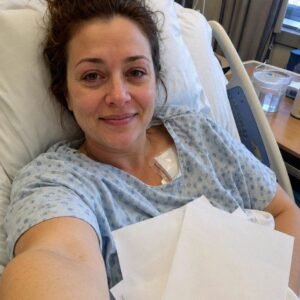
She had fought for almost three years. Breast cancer, caught late, treated hard, beaten back twice before it stopped being beatable. Even at the end, when sitting up took everything she had, she wanted to know if I’d eaten, if my brother Daniel had paid his rent on time, if Dad was remembering his blood pressure medication. She parented us from her deathbed. That was the kind of woman she was — the kind who loves people more than she loves her own comfort, right up until the very last moment she’s capable of it.
I thought losing her was the worst thing that would ever happen to me.
I was wrong.
Three months after the funeral, Dad called and asked Daniel and me to come to the house. His voice on the phone was careful in the way voices get when someone has rehearsed what they’re about to say and is hoping the rehearsal holds.
Everything inside the house was the same. Mom’s coat. Mom’s slippers. The indentation in her chair. I stood in the living room and felt like I was standing inside a held breath.
My aunt Rosalie was sitting beside my father on the couch.
Rosalie was my mother’s younger sister — three years younger, different in almost every way, the kind of woman who filled a room with noise where my mother filled one with warmth. She sat with her hands folded in her lap and her eyes a little red and her posture carrying the particular tension of someone waiting for a bomb to go off.
I remember thinking: why is she here for this?
Dad cleared his throat. “I want to be honest with both of you. I don’t want secrets in this family.”
That sentence. I have thought about that sentence so many times since.
“Laura and I have found something in each other,” he said. “Through the grief. We didn’t plan it. We didn’t look for it.”
Daniel said: “What are you talking about?”
Dad said: “We’re together.”
The room didn’t move. The clock on the mantle kept ticking. Outside, a car passed. Everything continued, and inside I was completely still, waiting for some version of this that made sense.
“We’re getting married,” Rosalie added. She said it quickly, like ripping something off.
Daniel stood up and left the room without a word. I heard the back door open and close.
I sat there alone with my father and my mother’s sister, nodding at things I wasn’t processing, and when I finally stood to leave, Dad touched my arm and said: “You understand, don’t you? Life is short. Losing your mother taught me that.”
I smiled at him. I don’t know how. I drove home and sat in my parked car for forty minutes before I could go inside.
The wedding was six weeks later. Small ceremony, close family, a venue my mother had never been to and therefore couldn’t haunt. The invitation arrived in the mail and I held it for a long time and noticed that there was no acknowledgment on it — no small line, no quiet nod — nothing that suggested any of us had spent the last five months in grief. It read like a beginning with no before.
I went because I told myself it was the mature thing. The loving thing. The thing a good daughter does when her surviving parent tries to rebuild. I dressed carefully and drove there and stood among the flowers and soft music and champagne and repeated this to myself like a prayer.
Grief does strange things. Two broken people finding comfort. This is not what it looks like.
Then Daniel arrived.
He came in through the side entrance, late, jacket half-on, moving with the urgency of someone who had been running and was trying not to look like it. He found me in the crowd and grabbed my arm without stopping.
“We need to talk,” he said. “Right now. Outside.”
“You missed the ceremony—”
“I know. Come outside.”
We stood near the coat racks in the hallway, half-hidden by a row of tall plants. Laughter floated through the open reception doors. Someone clinked a glass.
“What is going on?” I said. “You look like you’ve been—”
“A lawyer called me this morning.” Daniel’s hand was trembling. I had never seen my brother’s hand tremble before. “I almost didn’t answer. I thought it was spam.”
“A lawyer.”
“He knew Mom’s name. Her illness. The exact date she died.” He glanced back toward the reception. “He said she had left instructions. He was to contact me specifically when Dad remarried — and specifically, he said, if the woman Dad married was Rosalie.”
The cold moved through me slowly, starting at the back of my neck.
“She knew,” I said.
“She knew.”
“How long?”
“Read it yourself.” He reached inside his jacket and pulled out an envelope. Thick, cream-colored, sealed. Her handwriting on the front — my name and Daniel’s, written together the way she always wrote us together, like we were one unit, one thing she was responsible for.
I stared at it. “What’s inside?”
“The truth,” he said. “About Dad. About Rosalie. About things that go back further than three months.”
“How far back?”
Daniel pressed his lips together. “Years.”
My legs felt uncertain beneath me. “Tell me.”
“Not here. There’s a side room at the end of the hall. Empty.” He looked at me steadily. “But I need you to promise me something first.”
“What?”
“Let me finish before you react. Because once you know, there’s no going back to not knowing. And I need you to hear all of it before you do anything.”
The room was small — a few chairs, a coat rack, a window cracked open to the cold November air. Daniel closed the door. The music was muffled but still audible, something soft and celebratory from another world.
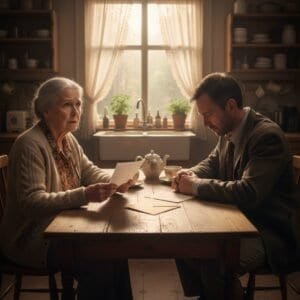
He broke the seal and unfolded the letter. Three pages, both sides, her handwriting — neat and careful, the same handwriting that had signed my permission slips and birthday cards and the notes she used to leave in my lunch box until I was embarrassingly old.
He read it to me.
She had begun it like a goodbye, because that’s what it was. She wrote it knowing she wouldn’t be there to say it herself, and she apologized for that — for leaving us to read it without her there to hold our hands through it.
She wrote that she hadn’t told us while she was alive because she didn’t want her last months filled with anger and lawyers and the particular devastation of watching a family come apart. She was tired and in pain and she wanted her final days to be about love. She had made a choice, and she wanted us to understand it was a choice, not a failure.
She found out by accident.
Messages, she wrote. Dates that didn’t line up with stories she’d been told. Money moved carefully, quietly, in the way money moves when someone is trying not to be noticed.
She had asked him once. Calmly, she wrote — she had asked him calmly because she loved him and she wanted to believe there was an explanation she could survive. He told her she was imagining it. That her illness was making her anxious and suspicious. That she needed rest.
And she had believed him, she wrote, because when you love someone for twenty-six years, you learn to doubt yourself before you doubt them.
But she had kept watching. Quietly, from her bed, from her chair, from the diminishing radius of her world. And eventually she understood.
Daniel’s voice was steady when he read the next part. I don’t know how. Mine wouldn’t have been.
It wasn’t a stranger, she wrote. It was her sister. And it hadn’t started recently. It had been going on for years — long years, comfortable years, years when she had no reason to look because she trusted both of them completely.
There was more.
A child — a child everyone understood to belong to someone else entirely — was not who everyone thought. She had done the quiet math, she wrote. She had looked at dates and faces and the particular way certain silences landed in certain rooms, and she had understood.
She wrote: I know why he stayed. It wasn’t love, or not only love. It was what he would lose if he left. What I had built. What I owned. He was waiting, my darling children. They both were. And I understood that I was the obstacle they were waiting to be finished with.
Daniel stopped reading.
The music from the reception swelled faintly through the wall.
“She rewrote her will,” he said. “Months before she died. Quietly, with a different lawyer than the one they knew about. Everything — the house, the savings, the investments — goes to us. He inherits nothing. Rosalie inherits nothing.”
I heard a sound and realized it came from me.
“They think they’ve won,” Daniel said. “They went through all of this — all of it — and they have no idea.”
I stood up. The chair scraped. I pressed both hands against my mouth and breathed.
“What do we do?” I asked.
“We go back in,” he said. “And we let them know.”
We walked into the reception together. Dad saw us across the room and his face opened with relief. He crossed toward us smiling, champagne in hand, the picture of a man who had gotten everything he wanted.
“There you are. I was starting to worry.”
“We need to talk,” I said.
The smile held for a moment, then softened at the edges. “Can it wait until after—”
“No.”
People nearby went quiet. Rosalie looked up from across the room and something moved behind her eyes — recognition, or fear, or the beginning of understanding.
I held up the envelope.
“Mom knew,” I said. “She knew about you and her sister. She knew how long it had been going on. She knew about the child.” I watched his face. “And she knew exactly why you stayed.”
The champagne glass lowered slowly in his hand.
“She didn’t confront you,” Daniel said. “She didn’t fight. She planned.”
“The will has been rewritten,” I continued. “Legally. Completely. The house, everything she built — it goes to us. You get nothing. She gets nothing.”
Rosalie had crossed the room without my noticing. She stood beside my father now and said his name in a voice I had never heard from her before — small, and frightened, and suddenly uncertain of the ground beneath her.
“You told me it was handled,” she said.
He didn’t answer her.
I looked at them both — my father in his wedding suit and my aunt in her white dress, standing in the middle of the celebration they had waited years to have — and I felt something settle in my chest. Not rage. Not satisfaction. Something quieter than both of those things.
“She won,” I said. “She did it from her deathbed, without any of us knowing, without one moment of it showing on her face.” I looked at my father. “She loved you until the end. She just stopped trusting you long before that.”
We walked out.
Rosalie left him four months later.
I heard this through a cousin, the way you hear things you didn’t go looking for. Apparently the discovery that there was nothing to inherit had a clarifying effect on whatever she had convinced herself she felt. Dad is in the house now — her house, which is no longer his — waiting for lawyers to finish the work my mother set in motion.
I visit her grave on Thursdays, which was the day she died. I bring lavender, because that’s what she would have wanted.
I talk to her. I tell her about the ordinary things — work, Daniel, what I’m cooking, whether I’m remembering to eat. The same things she always asked about.
And sometimes I tell her: You did it, Mom. You didn’t fight. You just made sure that when the time came, the truth was already waiting.
She always knew the difference between making noise and making something that lasts.
Even at the end — especially at the end — she was the strongest person in the room.