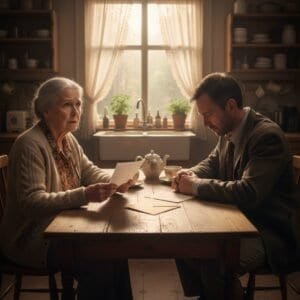
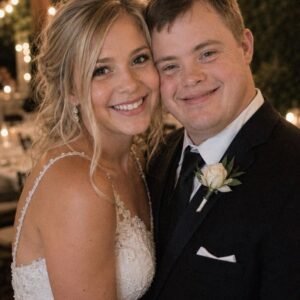
People in Nashville have always had opinions about me and Gerald.
I heard them at the grocery store. I heard them at church. I heard them at his company Christmas party, standing in corners with their wine glasses, wondering out loud what a thirty-four-year-old woman could possibly want with a man of sixty-five.
Gerald never seemed to notice. Or maybe he just never let on that he did.
We met seven years ago at a bookshop on 12th Avenue South. He was reaching for the same worn copy of a Steinbeck novel I’d been hunting for weeks. We both laughed. He bought it, and then he handed it to me right there at the register.
I told him I couldn’t accept that.
He said, “You clearly need it more than I do. You had that look in your eyes.”
I didn’t know what that meant then. I do now.
We were married fourteen months later in his back garden, just twelve people and a borrowed string quartet. My mother cried the whole way through. Not happy tears.
She pulled me aside during the reception and said, “Diane, you are throwing your life away on an old man. When you’re fifty, he’ll be eighty-one. Have you thought about that?”
I had thought about it. I thought about it constantly.
But I also thought about the way Gerald listened to me. The way he never once interrupted. The way he remembered every small thing I’d ever mentioned, and would bring it back weeks later like a gift he’d been saving.
I married him anyway.
His circle of friends accepted me, eventually. Most of them.
But there was one woman who never did.
Margaret Holloway lived two houses down from us on Elmwood Drive. She was seventy-three, widowed, and she had known Gerald for over thirty years. They had been close friends, the kind of close that people who’ve known each other through funerals and illnesses become.
From the beginning, Margaret was polite to my face and something else entirely behind my back.
I knew because Gerald’s daughter, Rosanne, told me what Margaret had said at a dinner party before our wedding. That I was after Gerald’s money. That someone like me didn’t fall in love with someone like him without a reason.
Gerald never brought it up, and I never asked him to confront her. I just kept my distance and smiled when I had to.
Last spring, Margaret had a stroke.
She was in the hospital for three weeks, then in a care facility across town. Gerald visited her twice. I drove him both times and waited in the car without being asked.
She passed away six weeks ago.
I sent flowers to her family. I thought that was the end of it.
This morning, I was in the kitchen when the doorbell rang.
It was her neighbor, a quiet man named Philip who I’d only ever exchanged a few words with over the years. He was holding a shoebox under his arm, and he looked uncomfortable standing there on our porch.
He said, “Is Gerald home?”
I told him Gerald was at his cardiologist appointment. He’d been having some rhythm issues and they were monitoring him closely.
Philip nodded slowly, then looked down at the box.
“Margaret left specific instructions,” he said. “She asked me to hold onto this until she passed, and then bring it here. She said to give it to you, Diane. Not Gerald. Just you.” He paused. “She said you should open it alone.”
I stood there for a moment not saying anything.
Of all the things I had expected this morning, this was not one of them.
I took the box from him. It was a plain shoebox, sealed with a strip of brown packing tape. My name was written on the top in careful, slanted handwriting I didn’t recognize.
Philip said, “I don’t know what’s in it. She didn’t tell me. But she was very clear about who it was for and when it should be delivered.”
Then he turned and walked back down the path.
I stood at the kitchen table with the box in front of me for a long time.
Margaret had spent seven years making me feel like an intruder in Gerald’s life. She had smiled through birthday dinners while I knew what she really thought. She had watched me love her old friend and decided I wasn’t worthy of it.
And now she had left me a box.
I peeled back the tape slowly.
Inside, there were letters. A stack of them, bound with a rubber band that had gone brittle and snapped the moment I lifted them out. Beneath the letters was a small photograph, face down, and a folded piece of notepaper on top of everything with my name written on it again.
I unfolded the note first.
The handwriting was shaky, clearly written during her illness, but the words were deliberate.
*Diane. I owe you an apology I was too proud to give you while I was living. These letters are not mine to keep any longer. Gerald wrote them to someone a long time ago. Before you. Before most things. I held onto them because I thought I was protecting him. I understand now that I was protecting myself. You should know who he was before you met him. And you should know that what you have with him is not what I told people it was. I was wrong about you. I am sorry. — Margaret*
I set the note down.
I picked up the letters.
The top one was dated thirty-eight years ago. The handwriting was Gerald’s, younger and looser than it is now, but unmistakably his.
I recognized the opening line immediately — not because I had read it before, but because it was the same way he spoke to me every single morning.
It started with: *You had that look in your eyes today.*
My hands were shaking.
I heard Gerald’s car pulling into the driveway.
I looked at the stack of letters, the photograph still face down on the table, and the note from a woman who had spent seven years as my quiet enemy and had chosen her last act on this earth to be something else entirely.
The front door opened.
Gerald called out my name from the hallway.
And I realized I had no idea what I was about to learn about the man I had built my life around.