We got married on a Tuesday in November, 1991, in a hospital chapel in Sheffield with no flowers, no guests, and a ring that belonged to the chaplain’s wife.
Robert was twenty-four. I was twenty-two. We had been together for fourteen months, and we had nothing — no savings, no furniture worth keeping, no family willing to show up.
But we had each other, and at the time, that felt like enough.
The chaplain’s name was Father Donnelly. He was a small, quiet man who smelled like peppermint and never once made us feel ashamed for what we were — two young people making a permanent promise in a borrowed room with borrowed everything.
I wore a cream blouse I’d bought from a charity shop on Ecclesall Road. Robert wore the only suit he owned, which was slightly too short in the sleeves and had a button missing on the left cuff.
We didn’t take photographs. We couldn’t afford a camera, and neither of us had thought to ask anyone to bring one.
For thirty-two years, that day existed only in our memories.
We moved to Atlanta in 1997 — Robert got a transfer through his engineering firm, and I followed with two suitcases and a toddler on my hip. Our son Daniel was eighteen months old and had no idea he was crossing an ocean.
We built a life there. Slowly. Carefully. The way you build something when you know it could fall apart if you’re not paying attention.
Robert worked long hours. I worked part-time at a dental practice and raised Daniel and, later, our daughter Claire. We fought about money and tiredness and the way he went quiet when things got hard and the way I talked too much when I was scared.
There were years when I wasn’t sure we were going to make it.
Not because we didn’t love each other. But because love, as it turns out, is not a static thing. It moves. It shrinks and expands. Sometimes it goes underground for months at a time and you have to trust it’s still there.
When our 30th anniversary came around, the children — Daniel was thirty-one by then, Claire twenty-eight — insisted on a vow renewal. A proper one, they said. With guests and flowers and a cake.
I resisted. It felt like showing off. Like we were asking people to applaud us for something we were supposed to do anyway.
But Daniel was relentless, the way he’s always been relentless, and eventually I said yes.
We held it at a small event space in Decatur, about twenty minutes outside Atlanta — a converted warehouse with exposed brick and Edison lights and tables draped in white linen. It was a Saturday in October, warm enough to open the side doors to the courtyard.
Sixty-three people came. Friends from the neighborhood. Colleagues. The couple from down the street who’d moved in the same year we did and had somehow become the closest things we had to family outside of blood.
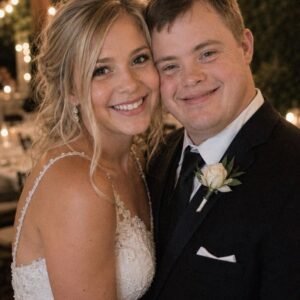
I wore a dress I’d chosen myself, pale ivory, nothing extravagant. Robert wore a suit that actually fit him.
It was, in every way, the wedding we never had.
The ceremony was short and honest. The officiant — a woman named Patricia who’d known us for years through church — spoke about endurance without making it sound grim. She talked about the Tuesday in Sheffield that nobody saw. She had asked us beforehand to describe it, and she described it back to us in front of everyone, and I heard a few people go quiet in the way people go quiet when something lands.
Afterward, during the dinner, I expected Daniel to make a toast. He’d been working on something — I’d seen him at the kitchen table the week before with a notepad, and when I’d asked what he was doing he’d said, “Nothing, Mum, go away.”
But when he stood up, he wasn’t holding a notepad.
He was holding a small cardboard box.
The room quieted without him asking it to.
“Before Mum and Dad say anything,” he said, “I need everyone to hear what I found in a box under their bed.”
Robert looked at me. I looked at Robert. Neither of us knew what was coming.
Daniel put the box on the table in front of him and opened it slowly. He reached in and held something up.
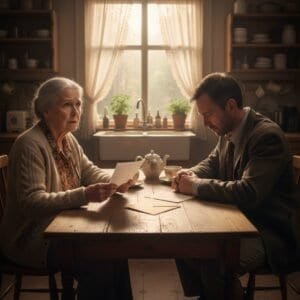
It was a letter. A single page, folded in thirds, the paper slightly yellowed at the edges.
I knew what it was before he said another word.
I had written it in February of 1993, eighteen months after our wedding, during the worst stretch of our first years together. Robert had been made redundant. We were behind on rent. Daniel wasn’t sleeping, and neither were we, and one night Robert had looked at me across the kitchen table and said, very quietly, “I don’t know how to fix this.”
And it was the most honest thing he’d ever said to me, and I’d loved him more in that moment than I had on the day we married.
I’d written the letter that same night, after he’d fallen asleep. I wrote down everything I wanted him to know in case I never found the right words out loud. I told him that I wasn’t staying because I had to. I told him that I was staying because I had watched him try, every single day, even when trying looked like sitting still. I told him that the ring borrowed from Father Donnelly’s wife and the blouse from the charity shop and the chapel that smelled like disinfectant — none of it had felt like less than. It had felt like ours.
I sealed it. I wrote his name on the front. And then I told myself I would give it to him when the time was right, and the time was never right, and somehow thirty years passed.
Daniel’s voice was steady, but only just.
“I found this when I was looking for the old insurance documents last month,” he said. “I wasn’t going to read it. But it was open, and I saw Dad’s name, and —” He stopped. Cleared his throat. “I read it. And I’m sorry, Mum. I know I shouldn’t have. But I’m glad I did.”
He looked around the room.
“Because I’ve spent my whole life watching these two people and wondering what the secret was. How they stayed. How they kept going through all the things I watched them go through and never actually saw them give up on each other.”
He held the letter up.
“And it’s in here. It’s all in here. And I think Dad should finally read it. In front of everyone. Tonight.”
The room was completely silent.
Robert hadn’t moved. He was looking at me with an expression I had not seen in years — the same expression he’d worn on that Tuesday in November when Father Donnelly had asked him to say his vows and his voice had broken on the word “cherish.”
Daniel held the letter out across the table.
And Robert reached for it.