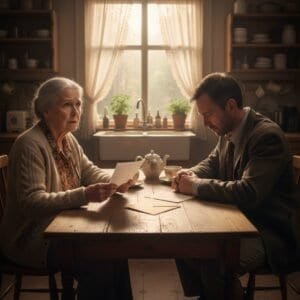
The morning they told Mercy Aldred she had three hours to leave Harlan’s Crossing, she was standing at the graves.
Not her husband’s grave. His was back in Nebraska, three years gone now, taken by a fever that came fast and left slow. She was standing at the graves of two children she had nursed through a winter sickness that had swept Harlan’s Crossing like a hand wiping a table clean.
Eleven children sick. Nine recovered.
Two did not.
And because Mercy had been the one to make the broth and mix the willow bark and press cool cloths to small burning foreheads, it fell to her to receive the blame for the two who never opened their eyes again.
Fletcher Dane had made sure of that.
He was the first to call her a poisoner. Not openly, not with witnesses who would swear to it in a court. Fletcher Dane was not a man who made obvious mistakes. He was the town’s grain agent, the man who sat at the table when deeds changed hands, the man whose opinion moved through Harlan’s Crossing the way water moved through clay — invisible until the damage was done.
He stood on the mercantile steps now, thumbs in his vest pockets, watching her at the graves.
“We gave you till noon,” he called.
Mercy did not turn around.
“My husband’s tools are still in the smithy.”
“What tools remain belong to the estate. Your husband owed debts to this town, Mrs. Aldred. We’ve been patient.”
She turned then.
Fletcher Dane had a face built for trust — wide jaw, steady eyes, the careful calm of a man who had never once been hungry. He wore it the way a man wore a good coat. You had to look close to see the buttons weren’t real.
“I want the medicine chest,” Mercy said.
“That is not your chest to take.”
“My husband built it. I filled it. I carried it on my back from Dodge City.”
“There’s a ledger entry that says otherwise.”
Of course there was.
Mercy looked past him to the small crowd that had formed in the morning dust — the storekeeper’s wife with her arms folded, two men from the livery watching with the flat expressions of people who had already decided to agree with whoever seemed strongest.
She looked for the faces she expected to find. Cora Hensley, whose daughter Ruth had survived the sickness. Amos Bird, whose son she had carried from a burning barn two winters back. Jacob Frey, who had eaten at her table every Thursday for a year after his wife passed.
None of them stepped forward.
Mercy nodded once.
She picked up her bundle from the grass beside the graves, slung it over her shoulder, and walked.
Fletcher Dane’s voice followed her down the road.
“The Badlands swallow foolish women, Mrs. Aldred. Come back to beg before the cold sets in.”
Mercy did not answer.
She had no intention of begging.
She had something else in mind.
Three miles south of Harlan’s Crossing, the broken country began.
Most people called it the Badlands because the word did the work of warning them away. The soil fractured there, cracked into a maze of pale gullies and knife-edged ridges that looked, in the wrong light, like something that had given up on being land and started becoming something else entirely. The few who had gone in to look for water had come back talking about passages that closed behind them and distances that didn’t match what they’d walked.
Mercy had been in before.
Not far. Just far enough, months ago, to know there was a place worth going back to.
Her husband Reuben had been a practical man, but he had also loved maps the way some men loved scripture. He had kept every survey he could find, trading for them at posts from here to the territorial line, and the one he had spread across the kitchen table three weeks before the sickness broke over the town had shown her something no one in Harlan’s Crossing seemed to know.
An old seep spring. Marked by a surveyor in 1871. Half a mile inside the badland formation, sheltered by an overhang of pale chalky stone.
On that same map, Reuben had circled something else.
A claim filed in 1869. Relinquished in 1872.
In the name of Fletcher Dane.
Mercy had asked Reuben about it the night before he died, when his voice had gone thin and the lamp was low.
“He filed on that spring,” Reuben had said. “Then let it go when the railroad changed its route. But he knows what’s under that land, Mercy. He has always known.”
“What’s under it?”
Reuben’s hand had found hers in the dark.
“Enough,” he had said. “Enough that a woman with the right paper could make a life. Maybe more than one life.”
Now Mercy walked south through cracked pale earth with that map folded inside her dress, against her ribs, next to her skin.
She found the seep spring on the second day.
The overhang was better than the map had promised. The chalky stone curved outward at an angle that turned the worst of the wind and threw afternoon light inward to warm the floor. The spring seeped steadily from a dark crack, filling a natural hollow in the rock no bigger than a washbasin, then spilling into a channel of grey mud that she could shape.
She worked for six days without stopping more than she had to.
She cut brush and wove it into panels. She packed clay into the cracks of the overhang until the wind no longer found ways in. She fashioned a narrow shelf from three flat stones and arranged on it what she had carried in her bundle — the small tin of medicines she had hidden inside her skirt before they stripped her room, a folded paper packet of seed, a fire steel, a folding knife, four strips of dried meat, and Reuben’s surveyor map.
On the seventh morning, she sat at the mouth of her shelter and watched the sun come up over the Badlands and felt, for the first time since the graves, something that was not entirely grief.
She also felt eyes.
Mercy turned slowly.
Twenty feet away, standing at the top of a pale ridge with his hat in his hands, was a boy she did not recognize. Twelve, perhaps thirteen. Thin as wire, with the particular stillness of a child who had learned that being noticed could go badly.
He held a folded piece of paper.
Mercy’s hand went still on her knee.
“Who sent you?”
The boy looked down at the paper. Then at her. His voice came careful and low.
“Man in town. Told me to bring this to you alone. Told me not to let Mr. Dane see me go.”
Mercy stood.
She crossed the pale cracked earth and took the paper from him. He stepped back immediately, watching her face with the eyes of someone who expected the world to be a harder place than it should be.
She unfolded it.
The handwriting was small and cramped, as if the person writing had been afraid of using too much space.
She read the first line.
Then she read it again.
The boy was still watching her.
“Ma’am?” he said quietly. “Are you all right?”
Mercy looked up from the paper and out across the pale gullies toward the distant brown smear of Harlan’s Crossing on the horizon.
Her hands were not shaking.
That surprised her.
She looked down at the paper one more time. Four lines. Cramped and careful. But the last line was the one that stopped her breathing entirely.
Because the last line was not about her at all.
It was about the two children in the graves.
And what Fletcher Dane had put in their broth.