I watched my grandmother run her fingers across the folded business class blanket the way you’d touch something you never expected to be allowed near.
“This is nice,” she whispered.
“It is,” I said.
She held up her fork. “They gave me real silverware.”
I kissed her cheek and went back to my seat in economy, feeling lighter than I had in months. We had saved for this. My mom and I had quietly set money aside for the better part of a year to make this trip happen — to get Eleanor, who turned eighty-five in March, on a plane to California to meet her first great-grandbaby. The business class upgrade was the one indulgence we’d allowed ourselves. We knew the extra space and early boarding would help with her Parkinson’s. Mostly, we knew she deserved to be treated gently for once in her life.
She’d barely slept the night before. When I came downstairs that morning, she was already dressed in a lavender sweater and her pearl earrings, sitting at the kitchen table with her hands folded.
“Our flight isn’t for hours,” I told her.
“I know. I just didn’t want to be rushed.” She smoothed her sweater. “Do I look all right? I don’t want to seem out of place.”
She asked me that four more times before we boarded.
Before I went back to my seat, I stopped by the galley and found one of the flight attendants.
“My grandmother is in 2C,” I said quietly. “She has Parkinson’s. She’s completely fine, but sometimes she has trouble opening things or holding a drink. I just didn’t want her to feel embarrassed asking for help.”
The attendant glanced toward Grandma, then back at me. “Thank you for telling me. Don’t worry — I’ll keep an eye on her.”
For the first twenty minutes, everything was fine. From where I sat, I could see Grandma watching the clouds out the window with the expression of someone receiving a gift they’d been told wasn’t for them.
Then a voice cut through the cabin.
“Excuse me. I need you to move that woman.”
The passenger in seat 2A had stood up. She was polished, expensive-looking — a Gucci coat, hair that suggested a professional who handled it — and she was pointing at my grandmother.
The flight attendant stepped toward her. “I’m sorry, ma’am?”
“Her hands won’t stop shaking, and it’s deeply unsettling. I paid for a peaceful business class experience, not—” She made a small, dismissive gesture in my grandmother’s direction. “Whatever this is. Either move her somewhere else or upgrade me away from her.”
The cabin went quiet.
My grandmother had tucked both hands beneath the blanket. Her face had drained of color. She was staring straight ahead, trying to make herself smaller, trying to disappear inside a seat she had every right to occupy.
Then, in a voice so soft I almost wished I hadn’t heard it, she said, “I can move if I’m bothering people.”
It felt like something hit me in the chest. I was already halfway out of my seat when the flight attendant moved first.
She set down the tray she’d been carrying. Her professional smile stayed in place, but something shifted behind her eyes — something that had made a decision.
“Ma’am,” she said to the woman in the Gucci coat, “I cannot move a passenger because her medical condition makes you uncomfortable.”
The woman stared. “But the trembling—”
“I can, however, move someone whose behavior is disturbing the cabin.”
“Excuse me? What exactly are you implying?”
“You’re harassing another passenger over symptoms of a neurological disease,” the attendant said evenly. “That behavior violates airline policy.”
The woman laughed, a short, disdainful sound. “So now I’m being punished for expecting a certain standard? I don’t care what condition she has. I should not have to spend six hours watching someone shake beside me while I’m trying to relax.”
A man across the aisle said, quietly, “Oh my God.”
A teenager a few rows back stared at her like she’d grown horns.
The attendant pressed the call button overhead. Another crew member appeared, then the senior purser. The first attendant explained everything in a low, measured voice — the kind of voice that makes things worse for the person being discussed precisely because there’s no room for drama to hide in. Just facts.
The purser nodded once and turned to the woman.
“Ma’am, discriminatory harassment toward another passenger is unacceptable. We’ll be reseating you in economy for the remainder of the flight.”
The woman’s face went from red to white. “That’s preposterous. You cannot be serious.”
“Oh, I think they can,” someone said behind her.
“At least put me in first class!” She looked around, clearly expecting the kind of ambient support that had probably always appeared when she made a scene in public. She found nothing. Just faces looking back at her without a trace of sympathy.
She yanked her designer bag from beneath the seat and followed the purser up the aisle, radiating the theatrical fury of someone who had never once lost in a public confrontation and did not yet understand that she had lost this one completely.
The purser seated her two rows behind me.
That should have been the end of it. But the other passengers had apparently decided otherwise.
The woman across the aisle from her new seat said immediately, “I don’t want this horrible woman sitting near me.”
A man in his thirties leaned over from the next row. “Imagine speaking to an elderly woman like that. You should be ashamed.”
Then, from somewhere farther back, in the clear, carrying voice of a child with no filter and perfect instincts:
“Mommy, is that lady a villain?”
Before his mother could respond, at least five people answered at once.
“Yes.”
The woman sank into her seat and said nothing more for the rest of the flight.
I went straight to Grandma.
I crouched beside her seat and looked up at her face. She looked like someone who’d been caught doing something wrong.
“I didn’t mean to cause trouble,” she said.
I took her hands out from under the blanket and held them in mine. They were trembling hard.
“You are not trouble,” I said, and my voice shook too. “Do you hear me? You are not trouble. You spent your whole life making everyone else comfortable. You deserve one flight where nobody asks you to disappear.”
Her mouth trembled. “I hate this,” she whispered. “I hate when people stare.”
“I know.”
“I used to pour coffee without spilling a drop. I used to write beautifully. Crochet. Pipe icing on cakes so it looked like flowers.”
She looked so ashamed that I had to look away for a second.
The flight attendant touched my shoulder. “You’re welcome to stay up here with her for the rest of the flight.”
“Really?”
She smiled. “Really.”
They moved me into the empty seat beside Grandma, and something quiet and extraordinary happened in the cabin after that. The passengers who had been politely looking away before — the way strangers do when they’re uncomfortable — seemed to collectively decide that Eleanor belonged to all of them now.
The man across the aisle offered her his wrapped chocolate dessert. “They gave me two,” he said. “And my wife says I need supervision.”
Grandma laughed. Actually laughed.
The mother traveling with the teenager leaned over. “My father has Parkinson’s too. Flying is hard for him. You’re doing great.”
Grandma pressed a hand to her chest. “That’s kind of you.”
The flight attendant brought her tea with the lid already loosened. “No rush,” she said. “I’ve got you.”
My grandmother looked at her the way people look at unexpected mercy.
We sat together for a while, talking softly about Gina and baby Noah. Then Grandma stared past me out the window and said, “I almost asked them to take me back.”
“Why?”
She was quiet long enough that I thought she wouldn’t answer.
“Because when someone looks at you like that,” she said finally, “for a second you start seeing yourself the way they do.”
I didn’t know what to say. I just reached over and covered her hand with mine.
She looked at me and smiled. “I’m glad you came up here.”
“There was nowhere else I was going to be.”
We started our descent into California with the sky outside turning gold. Grandma had dozed a little, her head tipped against the seat. The tremor never stopped, even in sleep.
When the seatbelt sign clicked off after landing, nobody in business class moved. Usually that moment turns people into a quiet, contained version of chaos — everyone surging for the overhead bins, calculating their position in the exit line. This time, the passengers simply stayed seated and looked toward Grandma first.
“Take your time, ma’am,” somebody said.
I helped her up, and we made our way toward the exit. As we passed the teenager and his mother, she said something I don’t think I’ll ever stop hearing.
“You have beautiful hands, ma’am.”
Grandma blinked fast. Her eyes filled immediately.
“Thank you,” she managed.
As we reached the flight attendant at the door, Grandma stopped and turned to her. Tears were gathered in her eyes but not falling — the kind of composure that costs something.
“Thank you for not making me feel like a problem,” she said.
The attendant squeezed her hand.
“Ma’am, you never were.”
That did it. I had held myself together the entire flight, but I had to turn away then, because I was crying and I didn’t want Grandma to see.
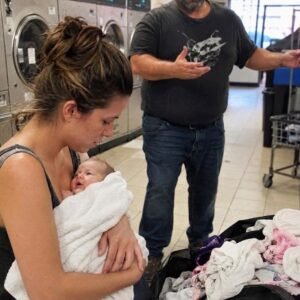
In California, three days later, my grandmother sat in a chair by the window with baby Noah in her arms. Her hands were shaking. They never stopped shaking anymore. But they held him — carefully, completely — and Noah looked up at her with the unfocused, searching gaze of a brand-new person encountering the world.
Grandma Eleanor looked down at him and smiled.
Those hands have kneaded bread every Sunday for sixty years. They’ve written birthday cards in elegant cursive and crocheted blankets and piped icing on cakes so it looked like flowers. They raised four children alone. They’ve done more in their trembling than most hands do in stillness.
One cruel stranger on a plane tried to make her believe otherwise.
The rest of the cabin — a flight attendant who stood firm, a man with an extra chocolate, a teenager’s mother who understood, a child who asked exactly the right question — gently, collectively, made sure she didn’t.