The lilies were white, which felt right for someone I had never quite known how to love.
I had told myself on the drive over that people change. That sixty years on this earth softens even the sharpest edges. That showing up with flowers on someone’s birthday, even someone who had made childhood feel like an obligation she was barely meeting, was what decent people did.
Noah had laughed when I told him my plan that morning.
“You’re really going over there? On her birthday?”
“She’s still our mother, Noah.”
“She’s the woman who adopted us, Eric. There’s a difference.”
I didn’t argue with him. He wasn’t wrong.
We were three years old when Clara and Josh took us in. They told us our biological mother had abandoned us — packed up her life and walked away from two toddlers without looking back. For years, I carried that sentence inside my chest like a small, cold stone. I turned it over constantly, trying to understand what kind of woman does that, trying not to let it mean something about me.
Josh tried to make up for whatever was missing. He sat in the front row at every school play and clapped louder than the other fathers. He filled our room with toy trucks and bought us matching bikes one Christmas, and he used to say, you boys are my world, don’t you ever forget that, in a way that made me believe him completely.
Clara was a different kind of weather.
You should be grateful we even took you in, she’d snap when we left a dish in the sink. Don’t forget you’d be rotting in an orphanage if it weren’t for us. Noah learned to go quiet when she got like that. I learned to apologize.
When we were ten, Josh died, and the house lost whatever color it had left. No birthday cakes. No front-row seats at school events. When Noah and I graduated high school, I asked Clara if she’d come.
You’re adults now, Eric. It isn’t my responsibility anymore.
So we packed our bags and built lives from nothing. Noah became an engineer. I went into design. Clara called twice a year, mostly to remind us how much she’d given up.
And yet, there I was at sixty-three, pulling into her driveway with white lilies and a wrapped gift box, telling myself that people change.
The front door was unlocked. I stepped inside without making a sound, slipping off my shoes the way Clara had drilled into us when we were small. I lifted the bouquet, ready to call out and surprise her.
Then I heard voices from the kitchen.
Clara’s, and someone else’s — Grandma Ruth, Clara’s mother. I hadn’t known she would be there.
I stayed still.
“They still don’t suspect a thing, Mom. Twenty years, and they always believed everything I told them.”
I pressed my back against the wall beside the doorway.
“They were children, Clara,” Ruth said softly. “You shouldn’t talk about them like that.”
“Children grow up,” Clara went on. “They never asked a single real question. Everything went exactly according to my plan.”
I heard the soft scrape of a knife through cake.
“Clara, you promised me you’d stop,” Ruth said.
“Stop what? Enjoying my birthday? Elena’s boys turned out fine. Better than she deserved.”
The name landed in the center of my chest and sat there.
Elena.
I didn’t know an Elena.
“She was your sister, Clara.”
“She was a burden, Mom. Showing up at my door with twin toddlers, begging me to take them for just a few months while she did her treatment. Like I was running a daycare.” Clara’s voice was almost cheerful. “And then the accident. Her car went into the river. No body, so it was easy to say she’d run off. Widowed, sick, with two children she could barely manage — my sister fit the story people were willing to believe. Even Josh believed it, at first.”
My knees went soft. I gripped the edge of the side table to stay standing.
“What was I supposed to do, Mom? Tell the boys their mother was dying in hospice the whole time? Tell them she was gone before the cancer even finished with her? Hand over the money she left?” She laughed, short and satisfied. “That money paid for this house. For my car. For the life I deserved after years of being the invisible sister. Elena always got everything — the looks, the husband, the babies everyone fawned over. For once, I got to keep something of hers. And those boys never knew the difference.”
I don’t remember walking out.
I made it to my car and sat there for a long time before my hand could find the key.
Our mother had a name. Her name was Elena. She hadn’t abandoned us. She had been sick, and she had trusted her sister, and her sister had taken everything.
I drove home with the windows down because I couldn’t get enough air.
When I got inside, I sat on the floor of my living room and called Noah. He picked up on the second ring, half-laughing at something on the television.
“Eric? Did Clara like the flowers?”
“I need you at Grandma Ruth’s house first thing tomorrow morning,” I said. “Don’t tell her anything.”
He went quiet. Then, slowly: “Eric. What happened.”
“Our mother didn’t abandon us,” I said. “Clara lied. And I think Josh knew something too.”
The silence stretched so long I thought the call had dropped.
Then Noah let out one stunned breath.
“I’ll be there,” he said.
The next morning, I found him outside Ruth’s house. He looked like he hadn’t slept either.
Grandma Ruth was sitting on the porch steps in her gray coat, rosary in her hands. When she saw us, her expression collapsed.
“Eric? Noah?”
“We need you to tell us the truth,” I said. “About our mother.”
She looked at us for a long moment, and I could see twenty years of something shifting behind her eyes.
“You found out,” she whispered.
“Tell us,” Noah said.
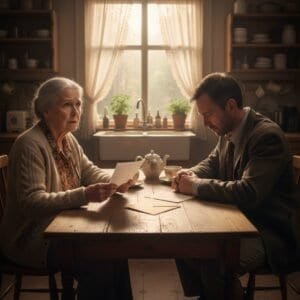
She brought us inside. Sat across the kitchen table from us with her hands folded around her rosary beads, and finally spoke.
Elena had been diagnosed with cancer. She had begged Clara to take us for a few months while she went through treatment, just until she was strong enough to come back for us. Then, one evening on the way home from an appointment, her car went off a bridge in a storm. They never found her body in the river. Clara told everyone she had faked the accident. Ran off. Started over somewhere. Said what people were willing to believe about a sick, widowed woman with two young children she could barely manage.
Clara had taken the guardianship money. Clara had taken the house. Clara had taken twenty years.
“I should have spoken,” Ruth said, her voice barely holding. “God forgive me, I should have spoken a long time ago.”
I reached across and held her hand.
“Come with us,” I said. “To Clara’s. Just sit in the car while we talk to her.”
She nodded slowly, as if she had been waiting two decades for someone to ask.
Clara wasn’t home when we arrived. Ruth called her from the car, and Clara told her to use the spare key under the flowerpot.
I went straight to Josh’s old study.
Clara had always kept us out of that room — strictly, persistently, in a way I had never questioned as a child. The room still smelled faintly of his pipe tobacco. I went to the bottom drawer of his desk, the one Clara always dismissed as junk, and found a wooden box I had seen once as a boy but never opened.
Noah pulled out the folder inside.
Trust documents. Our names on every page. A bank account opened in our names with monthly deposits going back years — deposits that had been sitting, accumulating, waiting for us to be old enough to claim them.
And beneath the folder, letters. Dozens of them. Some in Josh’s handwriting. Some in a woman’s careful script I had never seen before.
“He knew,” I said, reading Josh’s words. “He overheard Clara talking to Ruth years ago. He knew our mother hadn’t abandoned us.”
Noah looked up from the page. “Then why didn’t he tell us?”
“He was afraid. He said he was afraid of how Clara would treat us if we knew. He wanted to wait until we were eighteen and give us the trust and the truth together.” I set the letter down. “And then he died first.”
Noah sat back in the chair and didn’t speak for a moment.
I turned to the other letters — our mother’s handwriting on hospice letterhead, written to Clara from the hospital. I unfolded them one by one until I found the one at the bottom of the stack.
The envelope wasn’t addressed to Clara.
It was addressed, in shaking pen, to My beautiful boys.
My hands trembled so badly Noah had to reach over and steady them.
I broke the seal. I read the first line.
My beautiful boys, if you’re reading this, I am so sorry I couldn’t stay. Aunt Clara is going to take care of you for a little while, and I need you to be brave for me. When my treatment is over and I’m well again, I will come back for both of you. I love you more than anything in this world.
Clara’s keys jingled at the front door.
She stepped inside, saw Grandma Ruth at the table, saw Noah and me holding the letters and the trust papers, and stopped. Her purse slid off her shoulder and hung against her hip.
“Eric? Noah? What are you doing here?”
“We know about our mother,” I said. “Grandma told us everything.”
She tried, for just a moment, to hold her ground. “I don’t know what she’s been telling you, but she’s old and—”
“Clara.” Noah’s voice was flat.
She stopped.
I lifted one of our mother’s letters and read aloud: Clara, please love my boys until I can hold them again. The treatment is hard, but I will come back. Tell them I never wanted to leave.
Clara lowered herself into the chair across from us. One hand pressed flat against the table, as if she needed something solid.
“You had no right,” I said. “She trusted you.”
“I know.”
Noah slid the trust papers toward her without a word.
For a long moment, nobody spoke.
Then Clara’s eyes filled, and I watched something give way in her face — something I had never seen in twenty years of birthdays and silence and careful distance. Not the armor. Not the performance. Just a woman sitting with the weight of what she had chosen.
“Elena was always the one everyone loved,” she said. “Even Josh loved you boys more than he ever loved me. If you knew the truth, what was I? Just the woman who couldn’t measure up to a dead sister.”
“So you let us believe our mother threw us away.”
A single tear traced the line of her jaw. She didn’t wipe it away.
I folded my hands over our mother’s letter.
“I forgive you, Clara,” I said. “But I won’t pretend anymore. We won’t be calling. We won’t be visiting. You’ll live with what you did, and that’s enough.”
She nodded, her shoulders folding inward.
Grandma Ruth reached across the table and laid one trembling hand over her daughter’s wrist. Clara didn’t pull away. She just sat there and watched us walk out.
Next week, Noah and I are claiming the trust legally. We have decided to donate half to the hospice where our mother spent her last months — where she wrote us letters that were never delivered, and waited for a day that didn’t come.
The rest we’ll keep, the way Josh had always intended.
We are still learning how to carry this. Twenty years of a story we believed without question, dismantled in an afternoon — that kind of thing doesn’t settle quickly. Some mornings it sits heavy. Some evenings it feels almost manageable.
But we know the truth now.
Our mother’s name was Elena. She was sick and frightened and she trusted the wrong person. She wrote to us from a hospital bed and told us she was coming back.
She never got to come back.
And if she can see us from wherever she is, I hope she knows we’re sorry for the years we spent believing she didn’t want us. I hope she knows we found her letters. I hope she knows we read every word.
I hope she knows we never stopped being her beautiful boys.