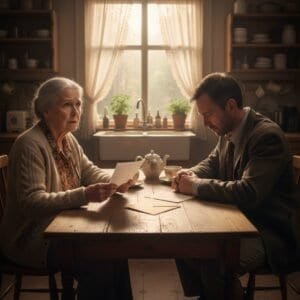
I didn’t want to move to Maple Street. I didn’t want to move anywhere. But when you’re a single mother with a six-year-old and a lease that expired two weeks ago, you stop having preferences and start making decisions.
The house was fine. The street was quiet. The park across the road was the kind of place that looked like it belonged on a calendar — tall oaks, a little duck pond, a wooden bench that had clearly been there since before I was born.
And on that bench, every single morning at nine o’clock, sat an old man holding two cups of coffee.
My neighbor Mrs. Higgins introduced herself on our second day. She was the kind of woman who delivered warnings wrapped in pleasantries.
“The man on the bench,” she said, leaning across my front fence like she was passing classified information. “Walter. Don’t let your little one go near him.”
“He looks harmless enough,” I said.
“He never speaks. Never nods. Just sits there with those two coffees like he’s waiting for someone who isn’t coming.” She shook her head. “Something’s not right about him, Sarah. I’m telling you.”
I thanked her and went inside.
I told myself I’d keep Sophie close. I genuinely believed I could.
Sophie noticed him by the end of our first week.
“Mommy, why does that man look like he swallowed something sad?”
“I don’t know, bug. Stay on the swings.”
“But he has two coffees.” She scrunched her nose. “Nobody needs two coffees. That’s just wasteful.”
Before I could respond, she was off the swing and halfway across the park. I sprinted after her, heart in my throat, arriving at the bench just as she climbed up beside him like she’d been invited.
“Hello,” she said.
The old man turned and looked at her. He didn’t look irritated. He didn’t look threatening. He looked like a man who had just heard a sound he’d forgotten existed.
“Sophie, we’re leaving,” I said, breathless. “I’m so sorry, sir—”
“Why do you have two coffees?” Sophie asked, completely ignoring me.
“I…” He blinked. “I always have two.”
“Why?”
He was quiet for a moment. His hands tightened slightly around the cups. “Because my wife hated drinking alone,” he said finally. “So I bring hers anyway.”
Sophie tilted her head. “Where is she?”
“Sophie—”
“She went away,” he said softly. “A long time ago.”
Sophie was quiet for exactly three seconds — the longest she was ever quiet — and then she patted the bench beside her. “I can sit with you. I don’t like coffee, but I’m very good at sitting.”
He laughed. It was a rusty sound, like a door that hadn’t been opened in years. But it was real.
His name was Walter. Mine was Sarah. And just like that, we had a park bench arrangement.
Over the weeks that followed, Walter slowly reappeared. That’s the only way I can describe it — like someone had turned a dial up on him. He started nodding to neighbors. He brought Sophie wildflowers he picked along the path. He taught her the names of every duck in the pond and let her name the ones that didn’t already have names.
My sister Claire did not share my enthusiasm.
“You don’t know a single thing about this man,” she said one afternoon, her voice clipped. We were in my kitchen. She’d dropped by unannounced, which was always a sign she was gearing up for something.
“I know he’s kind to Sophie,” I said. “I know he’s lonely and he’s been carrying something heavy for a long time.”
“You know what he tells you,” Claire said. “That’s different.”
“He’s a widower, Claire. Not a threat.”
“Other mothers at the park have noticed. They think it’s strange. A grown man fixating on a little girl—”
“He doesn’t fixate on her. They feed the ducks together.”
“Sarah.” She stepped closer. “If you won’t protect her, I will.”
I told her she was being paranoid. I told her to go home. She left, but the way she left — that particular set of her jaw — should have told me something.
It was a Tuesday evening when it happened.
Sophie and Walter were at the pond, tossing bread to the ducks, laughing about something I couldn’t hear from where I stood. Walter reached into his coat pocket for a napkin and something fluttered out — a small, faded square of paper that spun gently to the ground.
“You dropped something,” I said, stepping forward.
I picked it up before he could.
And I stopped breathing.
It was a photograph. Old, worn at the edges, the colors gone soft with age. A little girl, maybe five or six, laughing at something off-camera. Blonde curls. A gap-toothed smile.
She looked exactly like my daughter.
“Walter.” My voice came out strange. Thin. “Who is this?”
His expression changed entirely. The warmth drained out of it and something ancient and raw took its place.
“Please,” he said quietly. “Just give it back.”
“Who is this little girl?” My hands had started shaking. “Why do you have a picture that looks like Sophie?”
“That isn’t Sophie,” he said.
“Then who is she?”
He closed his eyes. When he opened them, they were wet.
“Her name was Lily,” he said. “She was my daughter.”
I made Sophie stand behind me. I wasn’t thinking clearly — I know that now — but my body had switched into a mode it didn’t know how to switch back from. Walter stood very still, both hands open at his sides, like a man who understood he had no right to defend himself.
“She died thirty years ago,” he said. “Her and her mother both. Car accident. A delivery truck ran a red light.”
Claire emerged from the tree line at exactly the wrong moment.
She’d followed us. She’d already called the police.
What happened next was loud and ugly. Claire screamed. Walter shrank. Sophie started to cry. I stood in the middle of it trying to hold all the pieces together while sirens started wailing somewhere in the distance.
Walter picked up his coat and said he would go. He said Claire was right. He said he was sorry.
I watched him walk out of the park and I stood there for three full seconds before something in me cracked open.
“Sophie, come on,” I said. “We’re going after him.”
He answered the door with a suitcase beside him.
Of course he did.
“Walter.” I stepped forward. “Put the suitcase down.”
“Your sister is right,” he said, and his voice was so tired. “I don’t bring anything good.”
Sophie pushed past me and wrapped both arms around his legs.
“You can’t leave,” she said into his coat. “You haven’t finished teaching me chess.”
He made a sound I don’t have a word for. Something between a laugh and a sob.
I told him what I’d been putting together since the moment I saw that photograph — the two cups of coffee, the bench he never left, the thirty years of sitting with an empty seat beside him. He’d been punishing himself every single day. For being late. For the two cups he’d promised to bring that started the chain of events he’d spent three decades replaying.
And then a six-year-old had climbed up next to him and drunk the second cup without thinking twice.
“You didn’t hurt us,” I told him. “You never were going to. And you can’t keep doing this to yourself.”
“What if I’m wrong?” he whispered. “What if I carry all of this into your life?”
“You already did,” I said. “And look. We’re still here.”
He stayed.
Claire and I didn’t speak for two months. When we finally did, I told her I understood why she’d been scared. I told her I didn’t forgive what she’d done. She said she thought she was protecting Sophie. I said I knew. We left it there, the way you sometimes have to leave things.
Walter spent Christmas with us. He carved the turkey badly and apologized for it four times and Sophie told him it tasted like the best turkey she’d ever eaten, which was a generous lie for a six-year-old.
The following spring, I came to the park to find him already on his bench.
He was holding three cups.
“One for me,” he said, handing me the middle one. “One for you. And one for Sophie, though I got her hot chocolate because apparently coffee is still wasteful.”
I sat down beside him.
The ducks moved across the water. Sophie ran ahead on the path, her curls catching the morning light.
For the first time in as long as I could remember, the bench felt exactly full enough.