I knew it was over the moment the lawyer closed the folder.
That sound — just paper against paper — hit me harder than anything had in years. Across the conference table, Mrs. Rhode’s niece adjusted her bracelet and looked at me the way people look at something they expect someone else to deal with.
The house on Willow Street was going to charity. The savings were going to the church. The jewelry was going to the niece.
My name was never read.
“That concludes the reading,” the lawyer said.
I waited, because there had to be more. There had to be one line — one sentence — that proved the woman I had spent two years carrying groceries for, cooking badly with, arguing game show answers beside, had not lied to my face.
The room stayed silent.
“But she promised me,” I said, and I hated how small my voice sounded.
The niece’s mouth curved like she’d been waiting for that. “Elderly people say things,” she replied. “You shouldn’t have built your life around it.”
I stood before she could watch me break.
My name is James. I grew up in foster care — the kind of childhood where you learn not to unpack completely, because the bag gets repacked soon enough anyway. By eight, I understood that love usually came with an expiration date. By eighteen, when I aged out of the system, nobody asked where I planned to sleep.
I ended up in that town because the rent was cheap and because nobody there knew enough about me to pity me. I washed dishes, unloaded trucks, mopped floors. Then one morning I walked into Joe’s Diner during a breakfast rush and Joe shoved an apron at me and said I had ten minutes to learn how to carry three plates at once.
That was my interview. I took the job.
Mrs. Rhode came in on a Tuesday morning at exactly eight o’clock. Small, sharp-eyed, dressed like she had no interest in impressing anyone alive. When I poured her coffee, she squinted at my name tag and told me I looked tired enough to collapse into her waffle.
She came back the following Thursday and requested my section. Then the week after that. She complained about the coffee, the toast, the government, and the way I refilled creamers like a man with no future.
Somehow, I started looking forward to her insults.
When you grow up invisible, even criticism can feel like proof that someone sees you.
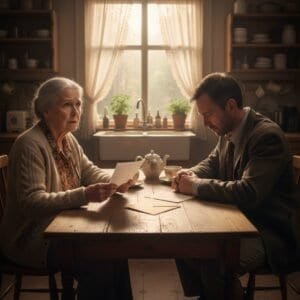
One afternoon she called me over to her fence on Willow Street and asked if I wanted to make decent money. Inside, over tea that tasted like boiled grass clippings, she told me she was dying as calmly as someone discussing a leaky faucet.
“Help me through what time I have left,” she said, “and when I’m gone, what’s mine becomes yours.”
I should have walked out. Instead I looked around that warm, cluttered kitchen and felt something I hadn’t felt in years — the dangerous possibility that life might be offering me something better than survival.
“All right,” I said.
She nodded once, like a deal had been struck in court. “Start tomorrow. Don’t be late.”
I wasn’t.
For two years, I showed up.
I bought her groceries, drove her to appointments, changed lightbulbs, sorted her medications into the weekly pill case, and read the tiny print on labels when her eyes were too tired. She paid me in cash every Friday, folded in an envelope with my name in shaky blue ink. Then one Friday she pointed at the stove instead and told me to sit down.
The meatloaf looked like it had survived a disaster. I took one bite and reached for water with the calm desperation of a man trying not to die in front of a woman who was already dying.
“This is awful,” I said, before I could stop myself.
She pointed her fork at me. “Then die hungry.”
That was the first time I laughed in her house. Not polite laughter — real laughter, the kind I’d forgotten I had. The corner of her mouth twitched, and that almost-smile felt like something I’d earned.
Dinner became part of the routine after that. Game shows too. Mrs. Rhode watched them with a fury that bordered on personal grievance. When a contestant guessed Boston as the capital of Vermont, she threw a napkin at the screen and announced the country was finished.
I sat beside her on the sagging couch and laughed into my coffee while rain tapped the windows, and for the first time in a long time I didn’t feel like I was waiting for something bad to happen.
That scared me more than I wanted to admit.
That winter, she shoved a grocery bag at me containing the ugliest pair of socks ever produced by human hands. Bright green, unevenly knitted, thick enough to guide aircraft through fog.
“I made these,” she muttered. “Your feet are always freezing.”
I held them up, made a comment about the fog. She told me to give them back.
I hugged them to my chest. “Absolutely not.”
She looked toward the window before I could see her eyes shine.
I wore those socks every cold day after. Told myself it was because they were warm. The truth was simpler and more terrifying: someone had made something for me, not because a caseworker told them to, not because it came with paperwork — but because she’d noticed I was cold.
Her health declined slowly, then faster. She got tired walking from the kitchen to the living room. Sometimes she stared at old photographs with an expression so distant I felt she was already standing halfway in another world.
I started staying later. Some nights, after she fell asleep in her chair, I cleaned the kitchen quietly, tucked a blanket over her knees, checked the locks twice, and stood there a moment before leaving — just listening to her breathe.
I never said I loved her. Neither did she. People like us don’t reach easily for words that big. We show up instead, again and again, pretending consistency isn’t a confession.
Then came the Tuesday morning she wasn’t at her table.
I waited until eight-forty-five. Joe looked at me from behind the grill and stopped pretending not to worry. “Go check,” he said.
I don’t remember taking off my apron. I just remember running.
Her porch was quiet. The curtains still drawn. My hand shook so badly it took three tries to fit the spare key into the lock.
The house smelled too still.
She was in her chair with the blanket tucked around her knees and the remote near her hand, and for one desperate second I thought she’d fallen asleep watching her shows. I called her name. She didn’t move.
I dropped to my knees beside her chair and cried in a way I hadn’t since I was a child begging the world to change its mind.
The funeral happened beneath a sky the color of wet ash. The niece sat in front wearing black pearls and a grief-stricken expression that looked practiced. People spoke about Mrs. Rhode as if they had known her.
I stood in the back. My grief felt too large for a place where nobody understood it.
Afterward, the niece found me on the church steps. “You were the helper, right?” she asked.
Not James. Just the helper — like I’d been a paid service listed between medicine refills and grocery runs.
“Thank you for keeping her comfortable,” she said, with the tone of a dismissal wrapped in courtesy.
The will reading was the following afternoon. I didn’t sleep that night. I sat on my bed wearing those green socks, holding the last envelope of cash Mrs. Rhode had given me, turning it over until the paper softened.
I told myself not to hope. Hope had always been the most dangerous thing in my life.
I went anyway.
I listened for my name the way a starving man listens for footsteps outside a locked door. Each sentence that passed without it made something inside me shrink smaller.
When it ended, I whispered, “But she promised me,” and the niece smiled and said elderly people get attached to whoever is around.
Whoever is around.
Maybe I hadn’t been special at all. Maybe I had only been convenient — a warm body filling pill cases, sitting beside her because no one else wanted the job.
I walked home. I spent the night on top of my bed with the lights off. At some point I pulled the green socks off and threw them across the room. Then I got up in the dark, crossed the room, picked them up, and held them against my chest.
The knock came the next morning.
I opened the door half-dressed, ready to snap at whoever had come to collect another piece of me.
The lawyer stood on my porch holding a dented metal lunchbox in both hands. His expression was different than it had been in the office — less polished, almost uncomfortable.
“Mrs. Rhode left additional instructions,” he said. “For you alone.”
I recognized the lunchbox from the top shelf of her pantry. She’d kept old coupons in it, rubber bands, spare buttons — things she claimed were useful even though most hadn’t been touched in years.
Inside was a sealed envelope with my name in her handwriting, and beneath it, a plain metal key.
I sat on the floor and opened the letter slowly.
James, you’re probably angry with me right now.
The first line blurred before I could finish it.
She wrote that she had known from the beginning why I’d agreed to help her. That survival wasn’t greed. That somewhere between grocery runs, terrible dinners, and television arguments, I had become the son she’d found too late in life.
I bent over the letter and made a sound I’m not sure I can describe. Too broken for a sob, too deep for a cry. Something that had been sealed for thirty years finally giving way.
She had loved me. Not loudly. Not perfectly. But she had loved me in blankets over knees, ugly green socks, sharp advice, and the quiet expectation that I would come back tomorrow.
She wrote that she remembered what I’d said about wanting to move up at the diner someday. That she had heard the part I was too afraid to say — that I wanted a place that couldn’t be taken from me.
So now part of it belongs to you. Months ago, I privately purchased ownership shares from Joe. He agreed to mentor you and teach you how to run the business. The key belongs to the diner.
I stared at those words until they became real.
Joe’s Diner. Cracked red booths, stubborn coffee stains, the grill that smoked when it felt like it. The place that had handed me an apron instead of a rejection on the worst morning of a very bad year.
The final lines of the letter read:
Money disappears. Houses fall apart. But a skill, a purpose, and someone stubborn enough to teach you — those carry a man farther than charity ever could. Walk into tomorrow like you have a right to be there.
I ran through town with the key in my fist.
Joe was behind the counter refilling sugar dispensers when I burst through the door. He froze when he saw my face.
I held up the key. “Is it true?”
He reached under the counter and set a thick folder between us without a word. Inside were legal documents with official seals and printed clearly where no one could dismiss it or laugh it away — my name.
James. Owner. Partner.
I started laughing, and the laugh broke apart into tears, and I didn’t even care that it was in front of Joe.
He cleared his throat and looked toward the grill. “She was proud of you, kid.”
I shook my head because I hadn’t known. Not really. I’d suspected, hoped, feared, and doubted. But knowing settled somewhere deep, filling a space that had been empty so long I’d mistaken it for who I was.
Joe told me she’d come in months ago, sat at table four, and told him he was old, stubborn, and not nearly as immortal as he pretended. Then she said I needed someone to force me to believe I could be more than I thought.
He tossed me an apron.
“Partners don’t stand around crying in my diner,” he said. “Partners learn inventory, payroll, vendor calls, repairs, and why the coffee machine makes that death rattle every third Wednesday.”
That evening I walked to Willow Street one last time.
Her house sat quiet in the orange light, windows glowing softly. Soon it would belong to the charity, filled with new voices and new stories that had nothing to do with me.
For a moment, that hurt.
Then I felt the diner key in my pocket and understood: she had never meant for me to live inside her past. She had wanted me inside my own future, even if she’d had to trick me, anger me, and break my heart open to make sure I’d finally see it.
The next morning I unlocked Joe’s Diner at four-thirty with my own key. The lights came on. The coffee started brewing. The empty booths waited in the quiet like witnesses.
Joe arrived ten minutes later and told me I’d already done the coffee wrong.
I smiled.
Not because everything was fixed. Not because the grief was gone or the old fear had finally left me alone. I smiled because for the first time I understood that love doesn’t always arrive the way we expect, and that inheritance isn’t always measured in houses or money.
Sometimes it looks like ugly green socks.
Sometimes it looks like a key in a dented lunchbox — and a future you’re finally brave enough to claim.