The morning started the way every morning did.
Lunchboxes lined up on the counter. Someone’s shoe missing. My youngest trying to climb onto my hip even though she was six and well past the age where that made any physical sense. Sarah humming in the kitchen while the whole house came apart around her in the usual pleasant chaos, somehow keeping all of it running the way she always had.
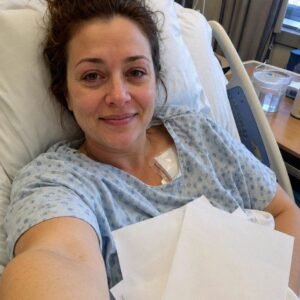
On the fridge, held up by a fire truck magnet one of the kids had picked out years ago, was a photo I had looked at a thousand times. Me, skinny and bald from chemo, sitting in a hospital bed. My brother Mark beside me with his arm around my shoulders — taken the day after his bone marrow transplant saved my life.
Sarah caught me looking at it.
“You’re still here because of him,” she said. “Don’t forget to call your brother this weekend.”
I told her I wouldn’t.
I had a follow-up appointment that morning. Nothing dramatic — I had been having a dull ache in my chest on and off, some fatigue and dizziness. Probably nothing. I had booked the full panel just to be thorough, the kind of responsible thing you do when you have five kids depending on you and you want to stop having excuses to put it off.
Sarah asked if I had filled out the new patient history.
I told her I had checked no on everything, that there was nothing recent worth noting.
She paused at that for just a half-second, then zipped a lunchbox shut and went back to packing.
I kissed her and the kids goodbye and headed out.
“Love you,” she called after me.
“Love you more.”
I had no idea those words were the last ones I would say before my entire understanding of my life stopped making sense.
Dr. Patel did not come in making small talk.
He walked in slowly, set a folder on the counter, and pulled up a stool without smiling. He told me to take a breath before we went through the results. I laughed a little — nervous, though I didn’t know why yet.
He slid a page toward me and tapped a line of numbers.
The hormonal and fertility panel, he said, had shown something unusual. I had a rare genetic condition that had made me sterile from birth. Zero percent chance of natural conception. He was very sorry.
I stared at him.
Then I laughed. Not because it was funny. Because it was impossible.
I pulled out my phone and pushed the screen toward him — Lily on the swing set, the boys covered in mud, the twins with popsicle running down their faces. I told him those were my kids. All five of them. That was my whole life.
He didn’t look at the photos. He looked at me with the particular expression doctors get when they know something is about to split a person’s life into before and after.
He said he would not be telling me this if the markers were unclear. We could run another panel if I wanted, but the result would be the same.
I don’t remember leaving his office.
I remember the parking lot. The heat off the pavement. My keys slipping twice before I got the door open. Sitting behind the wheel trying to make the arithmetic work.
Fifteen years. Five children. If I had been sterile from birth, what did that make everything else?
I could not go home. I could not look at Sarah and pretend I hadn’t just been handed something that made my whole marriage feel like a question I didn’t know how to ask.
So I drove to Mark’s.
He had been my safe place since we were kids, since the leukemia, since all those hospital nights when he sat beside my bed reading comics out loud because he knew I was scared and didn’t want me to feel it alone. He had given part of his own body so I could stay alive. If there was anyone I could fall apart in front of, it was him.
He opened the door, took one look at my face, and his whole expression changed.
I walked past him into his living room and broke down on his couch before I could get half the words out.
I told him what the doctor had said. Zero chance. Since birth.
Mark went pale. His hand drifted to his hip the way it always did when something shook him — that old scar still registering things before the rest of him caught up.
He sat down hard on the coffee table across from me and told me not to do anything that night. Not to talk to Sarah until he made a few calls.
I asked calls to whom.
He stood up too fast, walked me toward the door with one hand on my back, muttered something about being late, and shut the door behind me before I had finished processing what had just happened.
It felt less like being comforted and more like being removed.
I sat in my car at his curb watching his living room light go off too quickly.
Whatever my brother knew, he was not telling me.
I went to work the next day and left early, unable to concentrate on anything. I took the long way home hoping the drive would settle something inside me.
It didn’t.
When I turned onto our street, I saw Mark’s gray sedan parked two blocks from the house, tucked behind a hedge like he didn’t want it noticed.
My hands went cold on the wheel.
I parked down the block, cut through the neighbor’s yard, slipped through our back gate, and made my way toward the patio. The sliding door was cracked open an inch. Voices drifted out.
Sarah. Then Mark.
I crouched behind the planter where Sarah kept her basil and pressed myself against the brick. Then I pulled out my phone, opened the recorder, pressed record, and tucked it behind the pot with the microphone facing the door.
“You have to tell him, Mark. Today.” Sarah’s voice, and she was crying.
“I know how it looked,” Mark was saying.
“He came to you sobbing and you let him leave thinking what?”
“It was never supposed to come up like this. Nobody thought it would.”
I gripped the edge of the planter hard enough that a chip of clay came off in my hand. For one moment I almost stood up and walked straight in. But I stepped back instead, heart hammering.
Behind me on the gate, chalk hearts the kids had drawn caught my eye. Under the bench sat my oldest son’s half-flat soccer ball that he had been asking me to pump up for a week.
That was what kept me still.
I waited until I heard Sarah say “just go before the kids get home.” Then I slipped back out the way I came, drove two miles to a grocery store parking lot, parked under a tree, and sat there with the windows up.
I plugged in my earbuds and held my thumb over the play button.
“Listen first,” I told myself. “Decide after.”
Then I pressed play.
Mark’s voice came through first, tight and quick.
Sarah, it was a mistake. The whole diagnosis is a mistake.
What are you talking about?
Twenty years ago I gave Eric bone marrow. His blood carries my DNA. The hospital only ran a blood panel — they never checked his transplant history. He probably didn’t even think to write it down on the intake form because it was so long ago.
I heard Sarah pull in a breath.
So the sterility markers…
Were mine. Not his. The kids are his, Sarah. They’ve always been his.
Then Sarah started sobbing. Why didn’t you tell him yesterday?
Because I panicked. He was crying on my couch. I needed to call the hospital first and get it confirmed.
I stopped the recording.
I sat in that parking lot with my eyes closed and felt every accusation I had been building in my head come down on top of me.
For two days I had been imagining my wife in someone else’s arms. I had stared at photographs of my children searching for a stranger’s face in their features. I had let myself believe that the two people I trusted most in the world had been lying to me for fifteen years.
And the answer had been a scar on Mark’s hip. A checkbox I had left blank on a clinic form. A transplant I hadn’t thought about in years.
I thought about Mark at sixteen, signing forms he barely understood, giving up part of his own body so I could have a chance at staying alive. Carrying that for two decades without ever making me feel like I owed him anything. And then when this whole thing came apart, his first instinct had still been to call the hospital and get confirmation before he said a word — to protect me from being wrong about something before he told me I was right.
I didn’t deserve a brother like that.
But I had one.
I wiped my face, started the car, and drove home.
I went through the back gate, past the chalk hearts, and into the kitchen where they were both still standing.
Sarah saw me first and went still.
I told her I had heard it. All of it.
Mark’s shoulders dropped like he had been bracing since yesterday.
I didn’t let either of them explain. I walked across the kitchen and put my arms around both of them.
“I’m sorry,” I said. “I thought — I almost believed —”
“You were scared,” Mark said quietly. “Anyone would have been.”
I held onto him tighter. “Brothers protect each other. In blood. In life. In everything.”
Sarah pressed her face into my shoulder. Outside, through the back door, I could hear the kids laughing in the yard, completely unaware that the world had nearly cracked in half and then sealed itself back together in the time it took them to get home from school.
I closed my eyes and held on.
The two people I had come closest to losing were the ones who had been working hardest, the whole time, to keep me from falling apart.