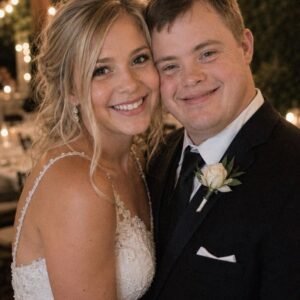
My sister Deanna was the last person I saw before I walked down the aisle.
She straightened my veil. She pressed her forehead against mine the way she had done since we were little girls sharing a bedroom in our parents’ house in Nashville.
“You look like a painting,” she whispered.
Then she slipped out the side door of the bridal suite to take her place among the guests.
And that was it.
That was the last time I ever saw her.
By the time the ceremony ended and Marcus and I turned to face everyone, her seat in the second row was empty.
I told myself she’d stepped outside for air. Deanna had always run a little anxious in crowds. It wasn’t unusual.
But she wasn’t outside.
She wasn’t at the reception.
She wasn’t answering her phone.
Her car was still in the parking lot of the venue.
Her clutch purse was sitting on the chair she’d abandoned, lipstick and phone and hotel keycard tucked inside, like she’d simply evaporated into the air.
The police called it a voluntary disappearance. She was thirty-one years old. She had the right to leave.
They said some people walk away from their lives.
I said that wasn’t Deanna.
Nobody believed me.
Not fully. Not enough.
Marcus tried. He held me every night that first year while I cried in a way that didn’t sound like me — deep and animal and inconsolable. He sat beside me while I filed missing persons reports and posted flyers and called every friend she’d ever had.
But the trail was ice cold before it even began.
Deanna had no debt. No enemies anyone would admit to. No history of mental illness beyond a bout of depression seven years earlier that she’d pulled herself out of with therapy and running and sheer stubborn willpower.
She was a pediatric occupational therapist. Her patients’ parents sent her Christmas cards. Her colleagues described her as the kind of person who remembered everyone’s birthdays.
She did not simply vanish.
Except she did.
Six years passed.
I won’t pretend they passed easily. I won’t dress up the truth of what losing someone to disappearance actually does to you. It’s not like grief. It has no shape. There’s no grave to visit, no funeral to mark the moment your life split in two.
You just keep waking up every morning not knowing.
I had two daughters. I named the first one Rennie, a quiet nod to her aunt. I taught preschool in East Nashville. I baked things when the anxiety got loud — banana bread, cinnamon rolls, anything with enough steps to keep my hands too busy to shake.
I kept Deanna’s number in my phone.
I know how that sounds.
I know.
But deleting it felt like agreeing she was gone.
Then last Tuesday, a woman sat down across from me in the waiting area of my daughters’ pediatric clinic.
I’d never seen her before.
She was maybe sixty, silver-haired, wearing a pale yellow cardigan. She had the kind of face that looked like it had held a lot of other people’s sorrow and learned to carry it quietly.
She looked at me for a long moment.
Then she said, “Are you Laurie? Deanna Marsh’s younger sister?”
The room tilted.
I couldn’t speak.
I just nodded.
The woman reached into her handbag.
She pulled out a hotel keycard — the cheap disposable kind with a magnetic stripe and a small paper sleeve. The sleeve had a room number written on it in blue pen.
Handwriting I recognized before I could stop myself from recognizing it.
Deanna’s handwriting. Angular capital D, the particular loop she made on her sevens.
My hands were shaking so badly I could barely take it from her.
“She asked me to wait,” the woman said carefully. “She was very specific about how long.”
“Where is she?” My voice came out like something broken. “Is she alive? Please — is she alive?”
The woman’s eyes filled.
“I can’t answer that,” she said. “She made me promise to let the room answer it for you.”
“What room? What hotel?”
She gave me an address. A motel on the outskirts of Murfreesboro, forty minutes south of the city.
“She said go alone,” the woman told me. “She was very clear about that.”
I called Marcus from the parking lot. I told him I’d explain everything later, to please pick up the girls, to please not panic.
He panicked anyway.
I drove south with both hands tight on the wheel and Deanna’s keycard in my coat pocket and six years of not knowing pressing against the inside of my chest like a fist.
The motel was a single-story L-shaped building with an ice machine by the office and a row of identical brown doors.
Room eleven.
I stood in front of it for longer than I should have.
I was terrified of what I would find.
I was more terrified of finding nothing.
I touched the keycard to the lock.
The light blinked green.
The door swung open.
The room was dim. The curtains were pulled. There was a small lamp burning on the nightstand, and in its light I could see the bed, which was made, and on top of the made bed there was a wooden box — the kind you buy at a craft store, unfinished pine — with my name written on the lid.
Laurie.
Just that. Just my name.
I crossed the room.
I sat on the edge of the bed.
I lifted the lid.
Inside there was a USB drive. A folded photograph I couldn’t yet bring myself to open. A handwritten letter on yellow legal paper, three pages long, covered in her writing front and back.
And a second envelope beneath the letter, sealed, with three words written across the front.
I read the three words.
And every single thing I thought I understood about the night my sister disappeared shattered so completely I couldn’t make a sound.
Because the three words said:
“Marcus knows everything.”
I heard a floorboard creak behind me.
And someone in the doorway said my name.