I never thought helping a blind woman cross the street would lead to anything. But the next morning, black SUVs rolled up to our trailer, and life was never the same.
People looked right through us, like we didn’t exist. That’s what happens when you grow up in a rusted-out trailer beside a highway nobody uses anymore. My name is Leo. I was 10 years old the year everything changed.
That morning started like every other one: cold floors under bare feet, the smell of instant coffee drifting through the air, and Mom humming to herself even though there wasn’t much to be cheerful about. The wallpaper had long since curled off the walls, and the refrigerator rattled like it was fighting to stay alive. But it was ours.
My little sister Tina was five back then. She was still curled up on the fold-out mattress when I slipped past her with my backpack over one shoulder and an old skateboard under my arm.
I’d dug the board out from behind the dump a few days before. The grip tape was almost gone and the wheels didn’t match, but I thought maybe someone at the flea market would hand me a few bucks for it.
Mom, Amanda, 32, kissed my forehead as I stood near the door. There was a quiet sadness behind her eyes that I’d grown used to, but she pushed through it with a smile.
‘Be safe, baby,’ she said. ‘Don’t let anyone rip you off.’
‘I won’t,’ I told her, even though I had no real idea what it was worth.
The walk to the flea market took nearly an hour. We lived past the edge of town, where the sidewalks just stopped. It was the same road my dad used to drive every day before a logging accident took his life.
After that, things fell apart fast.
The company he worked for barely helped with funeral costs. What came next was a pile of debt with nobody to help carry it. Mom lost the house, then the car. In the end, all we had left was Grandma’s old trailer — the one where something needed fixing in every single corner.
Selling stuff, picking up cans, taking odd jobs — I did whatever I could to chip in. It made me feel like I was pulling my weight, even when it wasn’t much.
That day, though, the market was slow. A few people glanced at the skateboard. One guy offered me fifty cents. I said no, because I knew it had to be worth more than that.
On the walk home, dragging my heels past cracked pavement and empty lots, I spotted her.
She was standing by herself near an intersection across from a pawnshop.
She looked to be around 65, maybe older, dressed in a long beige coat with dark sunglasses on. The way she stood — stiff and uncertain — made me stop. Something pulled me toward her, and when I got close, I could see she was frightened and confused.
So I asked if she was okay.
‘Ma’am? Do you need help?’ I said.
She didn’t react right away. She kept staring straight ahead, past me, like I wasn’t standing there.
Then she said quietly, ‘Can you help me cross the street?’
I moved closer and saw that her eyes weren’t focusing on anything. That’s when I understood — she was blind.
‘Sure,’ I said. ‘But where are you going? I can walk you there.’
She hesitated. ‘No, it’s fine. I don’t want to be a bother. Just help me cross.’
‘I’d really like to walk you,’ I said. ‘I’m not going to leave you out here alone.’
She gave in and told me the address.
I didn’t know the street, but I figured I could read signs and ask along the way, so we started moving. Her hand trembled a little as it settled on my elbow. She took small, careful steps, and I slowed down to match her.
As we walked, she asked my name and I told her. I’d never spoken to her before, but something about her made it easy to talk. I told her about Tina and Mom, and how I’d failed to sell a beat-up skateboard that day.
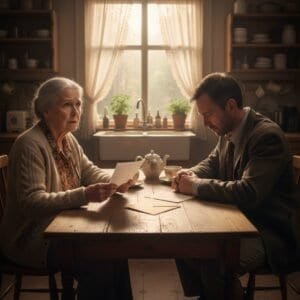
She listened without interrupting, then said, ‘I just went out for a walk. My sons were supposed to pick me up and they forgot. That’s how I got turned around. Happens more than I’d like.’
‘That’s awful,’ I said.
‘Yes, well,’ she sighed, ‘some people only show up when they need something.’
The walk to her address took what felt like more than half an hour. I didn’t mind at all. She was easy to talk to. She told me her name was Eleanor, that she had been a music teacher before her eyesight began to go.
She loved a French composer named Claude Debussy, couldn’t stand the way coffee tasted anymore, and missed the days when her boys actually paid attention to her.
When we finally got there, I stopped cold.
A massive three-story mansion stood in front of us. White stone, tall glass windows, polished brass on the front gate. It looked like something out of a movie, not something from our town.
Two men, probably in their twenties, came rushing out before we even made it to the door. Designer clothes, polished shoes, faces that had never known a hard day.
‘Who is this kid you brought with you?’ one of them snapped.
‘GET OUT OF HERE!’ the other one barked, his face twisted with disgust.
I froze. Eleanor flinched beside me. I looked at her, then at them, then back again.
‘I — sorry,’ I stammered, and I turned and ran as fast as my legs would carry me.
By the time I reached home, I was shaking. I burst into the trailer, dropped the skateboard, and started crying.
‘I didn’t sell it,’ I told Mom between sobs. ‘I didn’t make anything.’
She got down on her knees and pulled me in tight.
‘You came home in one piece. That’s worth more than any amount of money,’ she said, her own eyes filling up. ‘You did good, my Leo.’
I barely slept that night. I kept thinking about Eleanor, though I couldn’t bring myself to tell Mom the whole story. I couldn’t shake the look on those men’s faces — like I was nothing — or the image of Eleanor standing there quietly after I ran, alone again.
Sleep must have found me eventually, because the next morning I was pulled awake by Mom’s voice.
‘Leo!’ she called out. ‘Wake up! Somebody’s here for you!’
I stumbled out of bed, rubbing my eyes. Tina was already peeking out from behind the curtain.
‘Look!’ she whispered. ‘Black cars!’
Outside, a row of sleek black SUVs sat parked in front of our home. I walked out barefoot onto the dusty ground. A tall man, maybe in his thirties, dressed in a dark suit, came toward me with calm, measured steps.
He crouched down slightly so we were at eye level.
‘Leo,’ he said with a warm smile, ‘I’m here to invite you and your family to come with me.’
I blinked. ‘Why? Who are you?’
‘My name is Victor,’ he said. ‘I work for Eleanor.’
My heart jumped.
‘She asked me to find you. You helped her yesterday but never told her where you lived. She was determined to track you down, so we went through security footage and followed the direction you walked. It took a few hours and some help from your neighbors, but we found you.’
I stared at him, not knowing what to say. Mom came outside, holding a hand over her eyes against the sun.
‘What’s going on?’ she asked.
Victor turned to her with a polite nod.
‘Ma’am, Eleanor would like to have you and your children over for dinner. She has something important she’d like to share with you.’
Mom looked at me, puzzled. I just nodded.
‘Let’s go, Mom. She’s really kind. You’ll see.’
The ride over felt like something from a dream. The SUV smelled like leather and oranges, and Tina giggled every time we hit a bump. Victor sat up front, quiet and steady, while Mom and I kept exchanging glances that said, What is happening right now?
I filled Mom in on everything from the day before on the way over. But when we pulled up to that same mansion, my stomach knotted up. I hadn’t forgotten how those men had spoken to me. I held Mom’s hand as we climbed out.
But this time, it wasn’t the brothers who came to the door.
Eleanor did.
She stood between the tall columns with a wide smile, her sunglasses still on, her head tilted slightly toward us like she was reaching for us through the dark.
‘Leo,’ she said softly, opening her arms.
I stepped into the hug and she held on.
‘You actually found us,’ I said, still not quite believing it.
She laughed. ‘I have a very stubborn staff. You forgot to give me your last name, but we pulled footage from nearby shops and worked backward. The security team asked around town too. One man remembered a boy trying to sell a worn-out skateboard.’
Mom looked like she couldn’t decide whether to laugh or cry.
Eleanor turned toward her. ‘Amanda, yes?’
Mom nodded. ‘Yes, ma’am.’
‘You’ve raised a truly remarkable boy. Please come inside — all of you. Dinner is nearly ready.’
Mom smiled and put her arm around my shoulders, making me go red, and said, ‘My 10-year-old had more heart than most adults ever will.’
We stepped into a foyer that made my jaw drop.
Marble floors, golden light fixtures, and paintings bigger than our trailer walls. It didn’t feel real. Tina ran her fingers along the velvet curtains with enormous eyes.
The dining room could have fit four trailers inside it. A long table ran down the middle, covered in silverware, crystal glasses, and steaming dishes that smelled like nothing I had ever come across.
We all sat down, and for a while it was just the soft clink of forks and Tina trying to pronounce every dish on the table.
Then Eleanor set down her glass and said, ‘I didn’t bring you here just for dinner.’
Mom’s fork stopped halfway to her mouth. I put mine down too.
‘I want to make you a proposal,’ she said. ‘But first, let me explain.’
She folded her hands in her lap. ‘My sons, Marcus and Darren, have never had to work for a single thing in their lives. And because of that, they’ve become arrogant, selfish, and ungrateful. When I came home with Leo yesterday and they treated him the way they did — treated me like I was nothing — I decided it was time for things to change.’
She leaned forward. ‘I want to teach them a lesson they won’t forget. And I want your family to be part of it.’
Mom blinked. ‘Us?’
‘Yes,’ Eleanor said. ‘I want Marcus and Darren to live in your trailer for one full year. They’ll have to work, fix it up, and get by without any help from me. Not a single dollar. It’s time they learned what real life looks like.’
‘And what about us?’ I asked.
‘You’ll live here,’ she said. ‘This estate is far too large for one woman. I want you to make it your home. You’ll eat well, rest, and take proper care of yourselves. And while you do, my sons will find out what it actually means to struggle.’
Mom shook her head slowly, overwhelmed. ‘This is… I can’t even believe this.’
‘I’ve already spoken to my lawyer,’ Eleanor added. ‘If they refuse, I remove them from my will.’
Mom opened her mouth but no words came out. I looked at her and said, ‘Mom, we wouldn’t have to worry about bills or food anymore!’
Eleanor smiled. ‘Exactly. You’ve all done enough worrying to last a lifetime.’
Mom glanced over at Tina, who was building a tower out of green beans, and something in her expression softened.
‘I’ll agree to it,’ she said at last. ‘But only if your sons are genuinely on board. I won’t have anyone thinking we pushed them into this.’
‘Oh, they weren’t happy about it,’ Eleanor said with a smirk. ‘But they agreed. I told them it was either this or being cut off completely. Entitlement has a way of disappearing when money is on the line.’
That night, we slept in real beds — mattresses thick as clouds and sheets that smelled like lavender. For the first time in a long while, I didn’t hear mice scurrying around or rain dripping through a gap in the roof.
The next morning, Victor drove us back to the trailer to collect whatever sentimental things we wanted to bring along. Except this time, it wasn’t ours.
Marcus and Darren were already standing awkwardly outside. One had a backpack. The other gripped a toolbox he clearly had no idea how to use.
Marcus shot me a hard look as I walked past, but I just smiled and said, ‘Watch yourself in the shower. The water sprays sideways.’
They didn’t crack a smile.
Over the following weeks, Mom helped Eleanor settle into a new routine with us around. She cooked real meals, took slow walks through the garden, and even picked up painting again. Tina started at a better school that Eleanor paid for, and I worked alongside Victor around the property, learning to use tools I’d never touched before.
It felt like a dream we hadn’t even known to wish for.
At first, Marcus and Darren complained constantly. Eleanor’s staff kept us updated — how the brothers tried to bribe people to do their work and got turned away, how they burned their first meal, and how they eventually figured out they had to patch the leaky roof themselves or spend the night soaked.
But around month four, something quietly shifted. Marcus sent Eleanor a photo of the kitchen he and Darren had rebuilt. Darren asked if he could borrow one of her old gardening books.
By the end of the year, the trailer barely resembled what it used to be. New siding, repaired floors, and a flower box beneath the window. Marcus showed up at the estate one Saturday with a basket of vegetables they’d grown themselves.
‘Thought maybe Tina would like these,’ he said, not quite meeting my eyes.
Tina beamed. ‘Thanks! Do you know how to make carrot cake?’
Darren laughed, and I noticed something in his face I hadn’t seen before — something Mom would later call humility.
From that weekend on, they started coming by more often. They brought groceries, helped Mom mend a fence out back, and even showed me how to sand and repaint the garage door. Eleanor’s sons had landed jobs through their old connections and were finally earning for themselves.
One afternoon I asked Eleanor if she had any regrets.
She reached out, rested her hand on mine, and said, ‘Only that I didn’t do it sooner.’
That winter, while we were all decorating the enormous Christmas tree in the foyer, Marcus lifted Tina onto his shoulders so she could reach the star at the top. I stood next to Mom, who was smiling with tears running down her face.
‘You think things will stay like this?’ I whispered.
She nodded. ‘They already have.’
I looked over at Eleanor, who was settled by the fireplace, holding a cup of tea in both hands.
‘Thank you for coming to find us,’ I said.
She was quiet for a moment, and then her voice came out soft and steady.
‘I didn’t find you, Leo. You found me.’
A full year has gone by now, and Eleanor’s sons are different people. They understand what it means to live without a safety net. They finished fixing up our old trailer completely, and after that they started coming to visit every weekend, bringing whatever we needed. I think of them as older brothers now, and they look out for us.