When my fiancée disappeared, everyone expected me to move on and leave her six children behind. I couldn’t do it. I raised them as my own for ten years, until one Friday her oldest son came home from college, looked me in the eye, and said something that made my entire world stop.
I was carrying three lemonades and a bag of melted fries when my life split in two.
That moment never leaves me. Not the sirens. Not the searchlights sweeping across the water later that night. Just those fries growing cold in my hand while I stood on the sand realizing something was terribly wrong.
Margot and I had taken her six kids to Pelican Cove for one last summer weekend before school started. We weren’t married yet — we’d only been engaged four months — but that never mattered to me. Those kids already felt like mine.
The youngest still called me “Mr. Owen.” The oldest, Caleb, was nine, and watched me carefully, like he was still deciding whether I’d stay.
Around lunchtime the line at the snack stand stretched down the boardwalk. Margot smiled and kissed my cheek. “Go now, before it gets worse.”
I left. It was the last ordinary thing she ever said to me.
I was gone maybe twelve minutes. When I came back, the kids were still building sandcastles. Margot’s towel sat exactly where she’d left it. Her sunglasses rested on top of her paperback. But Margot was gone.
At first I assumed she’d gone in for a swim. I scanned the water, expecting her to wave. Instead I noticed Caleb standing perfectly still near the shoreline, face gone white.
“Where’s your mom?” I asked.
He never answered. He just stared at the ocean.
By sunset the whole beach was searching. By midnight the police were calling it a possible drowning. Divers searched for four days. They never found a body.
Eventually everyone accepted that Margot was gone.
I was twenty-eight. We’d never married. Legally I could have walked away without a single form to sign. A lot of people expected exactly that.
Instead I looked at six frightened children sitting together at her memorial, and the youngest whispered, “When is Mommy coming home?” I made my decision right there, standing at the back of a church I’d never been in before that week.
I stayed.
I sold my truck to help cover the mortgage. I took every extra shift the warehouse would give me. I learned to braid hair from grainy tutorial videos at eleven at night. I packed six lunches every single morning, argued about bedtimes, sat through school plays and stomach flus and one very memorable talent show where two of the twins tried to perform a magic act with a hamster.
Caleb didn’t trust me at first. He tested every limit, every promise, every rule I set, like he was daring me to prove everyone right and leave. But one afternoon, years in, he casually called me “Dad” while asking to borrow the car. Neither of us stopped to acknowledge it out loud. We just kept living.
There was a stretch, maybe year three, when money got tight enough that I sold my late father’s watch, the one thing of his I’d kept, to cover a semester of braces for one of the twins. I never told any of them where the money actually came from. They just knew their teeth got straighter and the lights stayed on. I think about that watch sometimes, not with regret, just with a kind of quiet accounting I keep in my head of everything those ten years actually cost, and how little I mind any of it now.
Ten years passed the way ten years do when you’re too busy to notice them passing — all at once and not at all.
The youngest had turned twelve. Two of the others were deep in the chaos of high school. Caleb had started college two states over, on a partial scholarship I still keep the acceptance letter from in my sock drawer.
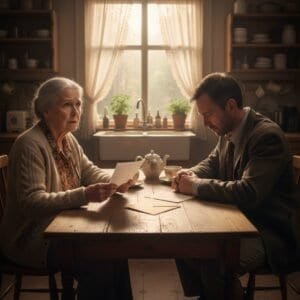
He came home one Friday afternoon in October. I was under the kitchen sink fighting a leaking pipe when he said, quietly, from the doorway, “Dad. I think you deserve to know the truth about Mom.”
I slid out from under the sink. One look at his face told me this wasn’t a joke or a college philosophy assignment he wanted to debate with me.
He explained he’d spent the weekend in a coastal town called Brackwood with some friends. Walking along the boardwalk, he’d seen a woman. At first he thought grief and exhaustion were playing tricks on him. Then she laughed.
“I’d know Mom’s laugh anywhere,” he said.
I told him, immediately, that it couldn’t be true. Grief does strange things. Memory plays cruel games, especially at twenty-two with three exams behind you and no sleep.
One of his sisters, overhearing from the hallway, burst into tears.
Caleb quietly set his phone on the kitchen table. “I knew you wouldn’t believe me. So I got proof.”
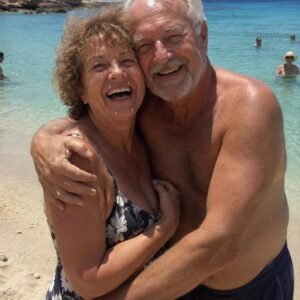
He opened a slightly blurry photo. A woman in a wide sun hat and a flowing dress, half-turned away in a crowd. Despite the distance, the angle, ten years — the face was unmistakable.
Margot.
Then a short video. Maybe five seconds. She laughed beside a man I didn’t recognize.
Completely, impossibly alive.
A terrible thought settled into my chest like a stone. If this was really Margot, she hadn’t drowned. She had left us. All of us. On purpose.
The next morning Caleb and I drove to Brackwood while my friend Franklin watched the younger kids. For most of the drive we barely spoke. I kept replaying ten years of memories — every birthday, every nightmare, every scraped knee, every promise I’d made to six children abandoned by the woman they loved most in the world.
The anger frightened me more than the grief ever had.
We found the resort where Caleb had seen her. The manager reviewed the security footage without much hesitation once we explained. And there she was, walking through the courtyard beside the same man. Relaxed. Sunlit. Alive.
“I thought I knew her completely,” I whispered, mostly to myself.
We spent the rest of the day showing the photograph around town. Most people didn’t recognize her. Then Caleb called my name from a small souvenir shop near the pier.
An elderly woman behind the counter recognized the photo instantly.
“Oh, yes,” she said, smiling. “She comes in often. Always orders the engraved seashells. Children’s names, mostly.”
Children’s names.
My heart nearly stopped. The shop owner dug through an old order book and finally handed us an address, written on the back of a faded receipt.
The house sat a few blocks from the water. Small. Yellow. Peaceful, in a way that felt almost cruel.
Caleb knocked. Footsteps approached. The door opened.
And there she stood.
For one impossible second I forgot how to breathe. Then she looked directly at us, and there was no recognition in her face at all. No guilt. No fear. Only mild, polite confusion.
“Can I help you?”
Caleb’s voice cracked. “Mom?”
She frowned gently. “I’m sorry?”
A man appeared behind her, resting a hand on her shoulder. “Who are they, honey?”
Caleb held up the photo and the video with a shaking hand. The woman stared at both for a long moment, then quietly invited us inside.
“My name is Odette,” she said, once we were seated in her small, sunlit living room.
She explained, haltingly, that she’d always known she had a twin sister somewhere. They’d been separated through the foster system as infants, placed in different homes, different states, different entire lives. She’d searched for years as an adult and eventually, painfully, given up.
“What was her name?” Odette asked quietly.
“Margot,” I said.
Odette closed her eyes.
Something clicked loose in my memory then, a piece I’d buried in grief a decade earlier. Months after Margot disappeared, I’d found old foster-care paperwork in her things mentioning the possibility of a biological sibling. At the time I could barely function, let alone chase down a lead like that. I’d filed it away and never looked at it again. Margot had mentioned, once, trying to find her birth family. She’d never succeeded, or so I’d believed.
Caleb finally spoke. “My mother had six children. They grew up without her.”
A tear slid down Odette’s face.
Two weeks later, a DNA test confirmed everything. Odette truly was Margot’s identical twin. The woman Caleb had seen laughing on that boardwalk wasn’t the mother we’d lost. She was family none of us had ever known existed.
We gathered all six kids together and explained it as gently as we could. It remains one of the hardest conversations of my life — tears, sharp questions, long silences. But underneath all of it, there was relief too, a strange and complicated kind.
A few days later, Odette and her husband visited our house. The youngest looked at her for only a few seconds before quietly crossing the room and wrapping both arms around her waist. Odette held that hug like she’d been waiting her entire life for it, which, in a way, she had.
I turned toward the kitchen window because I couldn’t stop the tears. Caleb came and stood beside me.
“You okay, Dad?”
“I’ll get there,” I said, and meant it.
We stood together in comfortable silence, the kind we’d built slowly over ten hard, ordinary years.
Odette will never replace Margot. She isn’t meant to, and she’s never once tried to. But she carries familiar pieces of the woman we lost — the same laugh, the same way of tilting her head when she listens. It helps more than I expected it to.
She and her husband come for dinner most months now. The kids have started calling her Aunt Odette, which felt strange the first few times and doesn’t anymore. Last spring she taught the youngest to make the same seashell wind chimes she sells in that little shop, and it hangs on our porch now, catching the wind every evening around the same time Margot used to call everyone in for dinner. I don’t think that’s a coincidence, though nobody’s ever said so out loud.
Most days now I’ve made peace with the fact that Margot is gone. But some nights, when the house finally goes quiet and the wind moves through the old porch screen, I still catch myself listening for the front door.
Some part of me probably always will. I’ve stopped minding that as much as I used to.