My name is Michael Ross. I’m forty years old, and two years before any of this happened, my life ended in a hospital hallway.
A doctor came toward me with that particular walk — measured, deliberate, bracing himself against what he was carrying — and said, “I’m so sorry.” And I knew.
My wife Lauren and our six-year-old son Caleb had been hit by a drunk driver. “They went quickly,” the doctor added, as though that was supposed to land somewhere useful.
After the funeral, the house felt like a stage set. Lauren’s mug sat beside the coffee maker. Caleb’s sneakers were by the door, toes pointing out the way he always left them. His drawings were still on the refrigerator. I couldn’t take them down. I couldn’t do most things.
I stopped sleeping in our bedroom. I crashed on the couch with the television running all night because silence was worse. I went to work and came home and ate takeout and stared at walls. People told me I was strong. I wasn’t. I was just still breathing, which felt like the bare minimum and some days like more than I deserved.
About a year after the accident, I was on that same couch at two in the morning, scrolling through Facebook the way you do when you can’t sleep and don’t want to think. Vacation photos. Politics. Someone’s new puppy.
Then a shared post from a local child welfare page stopped me.
Four kids, squeezed together on a bench in what looked like a waiting room. The oldest had his arm around the girl beside him. The smallest clutched a stuffed bear and leaned into her brother. They weren’t smiling for the camera. They looked like people who had learned to brace themselves.
The caption said they were ages three, five, seven, and nine. Both parents deceased. No extended family able to take all four. If no placement was found, they would be separated into different homes.
Likely be separated.
Those two words hit me somewhere physical.
I read the comments. Heartbreaking. Shared. Praying for them. Nobody saying they’d take them. I put the phone down. Picked it up again. Put it down.
I knew what it was like to walk out of a hospital alone. These four kids had already lost their parents. And the plan — the actual institutional plan — was to split them apart on top of that.
I barely slept. Every time I closed my eyes, I saw four children in some fluorescent-lit office, holding hands, waiting to hear who was leaving first.
In the morning, the post was still on my screen. There was a number at the bottom. Before I could convince myself otherwise, I called.
The caseworker’s name was Karen. She sounded surprised when I said I wanted to come in and talk about all four of them. On the drive over, I kept telling myself I was just asking questions.
I knew that wasn’t true.
She laid a file on the table and told me their names. Owen, nine. Tessa, seven. Cole, five. Ruby, three. Their parents had died in a car accident. No family member could manage all four children at once. The system was preparing to place them separately because that was what the system allowed.
“What if someone wanted all four?” I asked.
She looked at me directly. “Then they wouldn’t have to be separated.”
“I’ll take all four,” I said.
She repeated it back like she needed to make sure she’d heard correctly.
“All four,” I confirmed. “I know there’s a process. I’m not asking you to hand them over tomorrow. But if the only reason you’re splitting them up is that nobody wants four kids at once — I do.”
“Why?” she asked.
“Because they already lost their parents. They shouldn’t have to lose each other too.”
There were months of paperwork, home checks, and a therapist who asked how I was handling my grief.
“Badly,” I told her. “But I’m still here.”
She approved me anyway.
The first time I met the kids was in a visitation room with ugly chairs and fluorescent lights. All four were squeezed onto one couch, shoulders touching, knees touching — a unit that had closed itself against the world. Ruby hid her face in Owen’s shirt. Cole stared at my shoes. Tessa sat with her chin up and her arms folded, projecting pure skepticism. Owen watched me like a small adult doing an assessment.
“Are you the man who’s taking us?” he asked.
“If you want me to be.”
“All of us?” Tessa asked, like she’d been burned by this question before.
“All of you. I’m not interested in just one.”
Her mouth twitched slightly. “What if you change your mind?”
“I won’t,” I said. “You’ve had enough people do that already.”
Ruby peeked out from behind Owen’s arm. “Do you have snacks?”
Behind me, Karen laughed softly.
The day they moved in, the house stopped echoing.
Four sets of shoes by the door. Four backpacks in a pile. Four voices at dinner, four different sleep schedules, four completely different personalities all existing loudly in the same space.
Ruby woke up crying for her mother almost every night that first month. I’d sit on the floor beside her bed until she fell back asleep. Cole tested every rule I set, and when I held the line he shouted that I wasn’t his real dad. “I know,” I said. “But it’s still no.” Tessa hovered in doorways watching me, ready to intervene if she decided she needed to. Owen tried to parent all three of his siblings and wore himself out doing it.
I burned dinner. I stepped on Legos in bare feet. I hid in the bathroom occasionally just to take a breath and remember why I was doing this.
But there were the other moments too. Ruby falling asleep on my chest during a movie, her whole body going slack the way children do when they’ve finally decided to trust you. Cole bringing me a crayon drawing of stick figures holding hands — “This is us. That’s you.” Tessa sliding a school form across the table without a word, and I saw she’d written my last name after hers in the space for family.
One night Owen appeared in my doorway. “Goodnight, Dad,” he said, and then caught himself and froze.
I acted like it was the most natural thing in the world. “Goodnight, buddy.”
Inside, I was shaking.
About a year after the adoption was finalized, the house had found its rhythm. School pickups, soccer practice, homework arguments, screen time negotiations, someone always needing something. It was loud and exhausting and completely alive.
One morning after drop-off, the doorbell rang.
A woman in a dark suit stood on the porch holding a leather briefcase. She asked if I was Michael, the adoptive father of Owen, Tessa, Cole, and Ruby. My stomach immediately went tight.
“They’re fine,” she said quickly. “I should’ve led with that. My name is Susan. I was the attorney for their biological parents.”
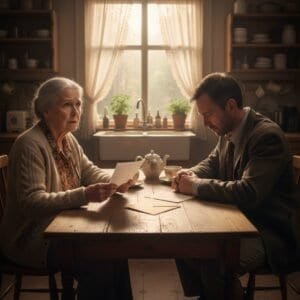
We sat at the kitchen table. I pushed cereal bowls and scattered crayons to one side.
She told me that before the accident — when they were healthy, just planning ahead the way responsible parents do — the children’s biological parents had come to her office to make a will. They’d placed certain assets into a trust in the children’s names. A small house. Some savings.
“It all belongs to them,” she said. “You’re listed as guardian and trustee. You can use it for their needs. When they’re adults, whatever remains is theirs.”
I sat with that for a moment. Then she turned a page.
“There’s one more thing,” she said. “Their parents were very specific about not wanting the children separated. They wrote that if they couldn’t raise them, they wanted all four kept together, in the same home, with one guardian.”
She looked up at me.
“You did exactly what they asked for,” she said. “Without ever knowing this existed.”
My eyes burned.
The system had been preparing to split them apart. And their parents had already put it in writing — don’t separate our children. They’d tried to protect them even from that possibility, even from beyond whatever came after.
That weekend, I loaded all four into the car.
“Is it the zoo?” Ruby asked.
“Is there ice cream?” Cole added.
“There might be ice cream after. If everyone behaves.”
We pulled up in front of a small beige bungalow with a maple tree in the front yard. The car went quiet.
“I know this house,” Tessa said softly.
“This was our house,” Owen said.
I unlocked the door with the key Susan had given me. Inside it was empty, but they moved through it like they knew it by heart. Ruby ran straight to the back door. “The swing is still there!” Cole pointed at the wall — faint pencil marks showing their heights, still visible under the paint. Tessa stood in a small bedroom and said her bed had been there, that she’d had purple curtains. Owen went to the kitchen and put his hand flat on the counter. “Dad burned pancakes here every Saturday.”
After a while Owen came back to where I was standing.
“Why are we here?” he asked.
I crouched down to his level. “Because your mom and dad took care of you. They put this house and some savings in your names. It all belongs to you four. For your future.”
“Even though they’re gone?” Tessa asked.
“Even though,” I said. “They planned for you. And they wrote that they wanted you together. Always together.”
Owen was quiet for a moment.
“Do we have to move here?” he asked. “I like our house. With you.”
“No,” I said. “We don’t have to do anything right now. This house isn’t going anywhere. When you’re older, we’ll decide together what to do with it.”
Ruby climbed into my lap and wrapped her arms around my neck.
“Can we still get ice cream?” Cole asked.
“Yeah, bud,” I said. “We can definitely still get ice cream.”
That night, after they were all asleep, I sat on the couch and tried to absorb the shape of my life.
I lost a wife and a son. I will miss Lauren and Caleb every day for the rest of my life, in the particular way that loss works — not fading, just changing form, becoming part of the texture of everything.
But now there are four toothbrushes in the bathroom. Four backpacks by the door. Four kids who shout “Dad!” when I walk in with pizza, who steal my popcorn during movies and talk over the best parts, who have made the house loud and complicated and entirely worth being in.
I didn’t call Child Services because of a trust or a house. I didn’t know any of that existed. I called because four siblings were about to lose each other and I knew what it was like to walk away from a hospital with nothing left.
Their parents’ will was their last way of saying thank you to whoever showed up.
I’m not their first dad. But I’m the one who saw a late-night post and said, all four, before I had any reason except that it was the right thing to do.
And when they pile onto me on the couch and argue about the remote and fall asleep in configurations that make no architectural sense, I think about two people who sat in an attorney’s office on an ordinary day and wrote: keep them together.
We are. We’re all together.
That’s exactly what they asked for.