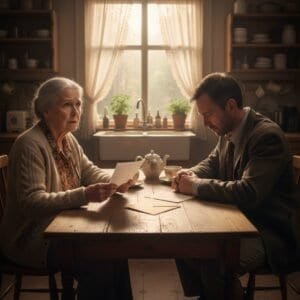
I spent years looking after my elderly neighbor, making sure she was never alone in her final chapter. So when officers showed up at my front door the morning after her funeral, the last thing I expected was to be treated like I’d done something wrong.
My name is Claire. I’m 30 years old, and I live by myself in a small house with a narrow porch and a mailbox that tilts slightly to the left.
Three years ago, I noticed my elderly neighbor’s mailbox was overflowing. It had been sitting that way for days.
Unopened envelopes. Catalogs. Folded letters.
I walked by it every morning heading to work and every evening it gnawed at me a little more. Eventually, one night, I walked up and knocked on her door.
An older woman answered slowly, wrapped in a cardigan even though the weather was warm. She looked more embarrassed than anything else.
‘Sorry to bother you. My name’s Claire. I live right next door. I couldn’t help but notice your mail…’
‘Oh.’ She glanced down. ‘It’s just been a lot lately.’
‘Would you like some help going through it?’
She paused. Then she moved aside.
‘That would be lovely, dear.’
That one evening changed everything for both of us.
Her name was Mrs. Whitmore. She was 82 and lived alone with her ginger cat, Pumpkin.
Sorting through envelopes together was just the beginning.
I started swinging by after my shifts. Picking up her prescriptions. Grabbing her groceries. Fixing little things around the house.
I learned she liked her tea steeped for exactly four minutes. That she never missed her favorite show.
We’d sit out on her porch in the evenings. Sip tea from mismatched chipped cups. Talk about everything and nothing at all.
Mrs. Whitmore shared stories about her late husband, the three children they raised together, and a life she said had treated her well. I didn’t say much about my own past.
She was standing in my kitchen one afternoon, helping me work through a pie recipe, when her gaze drifted to the child’s drawing still pinned to my refrigerator. The one I could never bring myself to take down.
It was the last thing my daughter made before illness took her from me. And not long after that, the weight of grief pulled my husband and me apart, too.
Mrs. Whitmore never asked questions.
We filled each other’s silence.
***
For the first time in years, I didn’t feel so alone.
Mrs. Whitmore mentioned she had three kids — two daughters and a son. They lived out of state and barely came around. When they did visit, everything felt loud and rushed.
They moved through her house like they were taking stock of it. Whispering about who would get what ‘when the time came.’
One of the daughters once stood in Mrs. Whitmore’s bedroom, eyes fixed on a jewelry box with a look that made my stomach turn.
They bickered openly about money, the property, belongings that weren’t even theirs yet.
I stayed in the other room, quietly sorting wool for Mrs. Whitmore, pretending I couldn’t hear a word.
When they left, the house always felt hollowed out. Mrs. Whitmore would go quiet for hours.
I never said anything. It wasn’t my place. But I saw it all.
And it made me furious.
Last month, Mrs. Whitmore’s health started slipping.
One quiet morning last week, I went over as I always did, carrying her groceries, and found the house too still. Pumpkin was pacing near the hallway. Mrs. Whitmore was in her bed, peaceful, as though she’d simply drifted off in her sleep.
Her children were notified.
Helping plan her farewell was one final way I could show up for her. I knew exactly what she would have wanted. The hymns she loved. Simple flowers. Cookies from the bakery she visited every Sunday.
Her children arrived in dark, solemn clothing, wearing grief that looked practiced.
By that evening, they were already talking about paperwork.
I went home feeling hollow and raw.
***
The morning after the funeral, I was still in the clothes I’d worn the day before when someone pounded hard on my front door. I opened it to find two police officers standing on my porch. One of Mrs. Whitmore’s daughters stood beside them, her face tight with fury.
My heart lurched.
‘Were you the one caring for Mrs. Whitmore?’ one of the officers asked.
‘Yes.’
Before he could say another word, the daughter’s voice cut through the air.
‘It was her! She’s behind all of it!’
A cold feeling crept up my spine.
‘Ma’am, we need you to come with us,’ the officer said.
‘What is this about? What’s going on?’
The daughter stepped forward. ‘You stole my mother’s diamond necklace. It’s been in our family for generations. A family heirloom.’
‘What? I never…’
‘We’d like to search your home,’ the officer said evenly.
I stepped back without hesitation. ‘Go ahead. Search anything you want. I didn’t take anything.’
My hands were trembling, but I kept myself steady. I had nothing to hide.
The officers moved through my small house, pulling open drawers, checking closets, lifting cushions off the couch.
I stood frozen, struggling to understand how grief had become an accusation overnight.
Then one of the officers opened my purse. The one I’d carried to the funeral the day before.
Inside, tucked into a small velvet pouch, was a diamond necklace. I had never laid eyes on it before in my life.
‘That’s not mine. I’ve never seen that in my life.’
The daughter’s expression shifted from anger into something darker.
‘Seems pretty clear to me, Officer. She took it from my mother.’
The officer turned toward me. ‘Ma’am, since the necklace was found in your possession, we’re going to need to bring you in for questioning.’
‘This makes no sense. I didn’t put that there,’ I said, my voice breaking.
‘You can explain everything once we’re at the station.’
I looked over at the daughter. The corner of her mouth lifted slightly.
That’s when I understood. This had nothing to do with a necklace.
It was about something else entirely.
***
Sitting in the back of that patrol car, I felt the same crushing helplessness I’d felt years before. When doctors looked at me and said there was nothing left they could do for my daughter. When my marriage crumbled under the weight of a grief too heavy to share.
Helplessness had found me again like an old, unwelcome ghost.
Neighbors peered from behind their curtains as we pulled away.
The humiliation stung more than the fear. But underneath it, something else was quietly rising.
I had spent three years caring for Mrs. Whitmore.
And this was how her family chose to repay me.
***
At the station, I walked the detective through every detail of the past few days.
He pushed gently but steadily. ‘You had access to the house.’
‘Yes, but I never touched her jewelry.’
‘You were alone with her frequently.’
‘I was taking care of her. She was like family to me.’
‘People do desperate things when money’s involved.’
My hands shook as I forced myself to think. To piece together everything I remembered from the day before.
Then one detail cut through the noise.
My purse. At the funeral home.
I had set it down on a chair while greeting people. I had stepped away multiple times — to accept condolences, to hand out programs. And I remembered one of the daughters hovering nearby, watching.
‘Wait. The funeral home has security cameras.’
The detective looked up. ‘Go on.’
‘Yesterday, during the service, I left my purse unattended more than once. Please. Check the footage.’
The daughter, who had been seated in the corner, jumped to her feet. ‘That’s completely unnecessary. The necklace was in her bag. That’s all there is to it.’
‘Actually,’ the detective said slowly, ‘that’s a reasonable thing to look into.’
I turned to the daughter. ‘If you’ve got nothing to hide, this shouldn’t bother you.’
They pulled the footage from the funeral home.
We all watched it together in a small viewing room.
On the screen, I could see myself moving among the guests. At one point, I stepped away from my purse to speak with someone near the door.
Seconds later, the daughter approached it. She glanced around carefully. Then she reached into her coat, pulled out something small, and slipped it into my bag.
The detective rewound it and watched it again.
Then he turned to the daughter. ‘You want to tell us what we just saw?’
Her face went completely white. ‘I… that’s not what it looks like.’
‘It looks like you planted evidence.’
She said nothing.
‘Why would you do this?’ I whispered.
The detective raised a hand. ‘We’ll get there.’
I stared at her. ‘Your mother deserved so much better than this.’
Her eyes flashed. ‘Don’t you dare tell me what she deserved.’
***
Back in the interrogation room, the full truth finally came out.
Mrs. Whitmore’s will had been read by her lawyer two days before the funeral. She had left a significant portion of her estate to me — a financial gift in recognition of my companionship and years of care.
Her children had been livid.
‘If we could have you charged with theft,’ the daughter finally admitted, ‘we could argue in court that you manipulated our mother. That she wasn’t in her right mind when she updated her will.’
The detective’s face hardened. ‘So you set her up.’
‘That money should have come to us. Not some stranger who inserted herself into our absence.’
‘I knocked on her door because her mail was piling up. That’s all it ever was.’
‘You took advantage of a lonely old woman.’
‘I was her friend. Something none of you ever bothered to be.’
The daughter was arrested. The necklace was logged as evidence. And I was cleared.
I walked out of that station shaken but standing.
My purse was still sitting in an evidence bag on the desk behind me.
I hadn’t lost my freedom. But I had lost something else — my quiet belief that kindness is always returned with kindness.
Later, I sat on Mrs. Whitmore’s porch. The old rocking chair creaked gently in the evening air. The house felt emptier than it ever had.
I thought about the tea. The laughter. The crossword puzzles we’d puzzle over together. About how two lonely women had stumbled into each other’s lives by accident.
The inheritance didn’t feel like money. It felt like being truly seen.
Like someone had quietly said, ‘You mattered here.’
I stayed until the sun disappeared behind the tree line. I thought about the way she smiled whenever I brought her favorite cookies. The way she would pat my hand when I looked sad. She had seen me when I felt invisible.
And in return, I had seen her. Not as a burden. As someone genuinely worth knowing.
Mrs. Whitmore’s lawyer called me and walked me through everything she had left when I went to meet him.
‘She wrote you a letter,’ he said, passing me an envelope.
I didn’t open it there. I waited until I was home.
My eyes filled before I even made it through the first line.
‘Dear Claire,
If you’re reading this, I’m gone. And I hope you’re not carrying too much sadness.
You gave me three years of real company when I thought I would spend my final days completely alone. You never once asked for anything in return. You just showed up.
This isn’t payment. It’s gratitude. Use it to build the life you deserve.
And please, don’t let my children make you feel guilty for any of it. They stopped seeing me as a person a long time ago. But you never did. Thank you for that.
With all my love, Mrs. Whitmore.’
I folded the letter carefully and tucked it into my pocket. Pumpkin curled up beside me on the porch swing, purring softly as I ran my fingers through his warm ginger fur.
‘Looks like it’s just the two of us now,’ I whispered. ‘I’m your person.’
Mrs. Whitmore didn’t just leave me an estate. She left me proof that love doesn’t need a bloodline to be real. She left me the quiet certainty that showing up for someone is never, ever wasted.