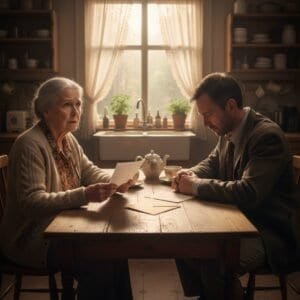
She smelled like lavender and hand cream.
That’s the first thing I always think about when I think about my mum.
Forty-three years of hugs and I can still feel it. Still smell it.
She died on a Tuesday in February. Quietly, in her sleep, in the same bed she’d slept in for fifty years.
The nurses said she went peacefully.
I told myself that was enough.
I was wrong.
—
Mum was a seamstress her whole life. Not professionally — she never took money for it. But she could make anything. Curtains, christening gowns, Halloween costumes, wedding dress alterations for half the street.
Her sewing tin sat on the same shelf in the same kitchen cupboard my entire childhood.
Old Quality Street tin. Green lid, dented on one corner.
We weren’t allowed to touch it. Not as kids, not as adults.
“That’s Mum’s tin,” my brother Kevin used to say, like it was a law of nature.
After the funeral, I went back to the house to start clearing things.
Kevin couldn’t face it. He said he’d come the following weekend.
So it was just me.
I was in the kitchen packing dishes when I opened the cupboard and saw it.
The green tin.
I almost closed the door again.
But something stopped me.
I told myself I was just checking for needles before I packed it. You know — health and safety. Practical.
I lifted the lid.
And at first, it was exactly what I expected.
Thread. Spare buttons in a tiny zip-lock bag. A thimble I’d watched her wear a thousand times.
Then I moved the felt cushion underneath the thread.
And I saw an envelope.
Not a new envelope.
Old. Cream coloured, soft at the edges like it had been handled hundreds of times.
It had my name on it.
Not Kevin’s.
Mine.
Just: *Carol.*
In her handwriting.
—
I sat down at the kitchen table.
The same table where she’d taught me to make pastry, where she’d helped me with homework, where she’d held my hand the night my marriage fell apart.
I held the envelope for a long time before I opened it.
There were two things inside.
A letter, folded three times, both sides covered in her neat small writing.
And a photograph.
I looked at the photograph first.
It showed a young woman I didn’t recognise — maybe twenty years old, dark hair, standing outside what looked like a hospital. She was holding a newborn baby wrapped in a white blanket.
She was smiling, but her eyes looked terrified.
I turned the photograph over.
On the back, in my mother’s writing: *Margaret. September 1969. The day she said goodbye.*
I didn’t know anyone called Margaret.
My mother’s name was Dorothy.
I unfolded the letter.
—
The first three lines told me something that knocked the breath out of my body.
*My darling Carol. If you’re reading this it means I finally ran out of time to tell you in person, which means I was a coward to the end and I’m sorry for that. The woman in the photograph is your mother. Your real mother. And I need you to understand why I never told you.*
I read it four times.
Four times before the words stopped moving.
I was adopted.
I was adopted and my mother — Dorothy, the woman who smelled like lavender and hand cream — had kept it from me for fifty-three years.
Not because she was ashamed.
That’s what the letter said.
Because Margaret — my birth mother — had begged her to.
—
I had to put the letter down.
I walked to the sink and stood there gripping the edge of the counter.
Outside the window, her bird feeder was still full. She’d only filled it the week before she died.
I stood there thinking about every single photograph on every single wall of this house.
Me as a baby. Me at school. Me on holidays.
All of it real.
All of it ours.
And yet.
I picked up the letter again.
—
Margaret had been seventeen when she got pregnant. Her family had sent her away. The baby — me — was to be adopted and never spoken of again.
My mother Dorothy had been her older cousin.
She and my dad had been trying for years with no success.
So when Margaret called, desperate, terrified, not knowing what else to do — Dorothy had said yes.
And Margaret had one condition.
One condition that Dorothy had honoured for fifty-three years.
*She made me swear, Carol. She said if you ever knew, you might try to find her. And she said finding her would only cause you pain. I believed her then. I’m not sure I believe it now. That’s why I’m writing this.*
I looked at the photograph again.
The young woman with the dark hair and the terrified smile.
I don’t look like Dorothy.
I never looked like Dorothy.
I’d always just assumed I took after Dad’s side.
But I looked at that photograph and I felt something shift inside my chest that I cannot explain.
I looked like *her*.
The cheekbones. The shape of the eyes.
Fifty-three years of not knowing what I was looking at every time I passed a mirror.
—
I turned back to the letter.
The final paragraph was shorter than the rest.
The handwriting changed — shakier, like it had been written at a different time.
Like she’d come back to finish it when she had the nerve.
*There’s something else I need to tell you, my love, and I don’t know how to say it gently so I’ll just say it plainly. Margaret didn’t disappear. She’s been in Nottingham for the last thirty years. She never married. She never had other children. And every single birthday of yours, without missing one, she sent a card to this address. I kept them all. They’re in a shoebox on the top shelf of my wardrobe. Fifty-three cards. She never stopped thinking about you. I never gave them to you because I thought I was protecting you. I’m afraid I was protecting myself. I’m so sorry, my darling. I’m so terribly sorry.*
I stood up so fast the chair scraped across the floor.
I walked to the hallway.
Up the stairs.
Into my mother’s bedroom.
I opened the wardrobe.
Top shelf.
Behind a folded blanket.
A shoebox.
I lifted it down and sat on the edge of my mother’s bed — her lavender-scented, still-warm-feeling bed — and I took the lid off.
Birthday cards.
Fifty-three of them.
All addressed in the same handwriting.
All unopened.
I picked up the one on top.
The postmark said this year.
Six weeks ago.
Which meant that somewhere in Nottingham, right now, there was a woman who didn’t yet know that the daughter she gave away had just lost the only mother she ever knew.
And she was still waiting.
Still waiting for a reply that had never come.
My hands would not stop shaking as I opened the card and read what was written inside.
And the last line — just four words, written every single year for fifty-three years — made me fold completely in half on that bed and sob in a way I hadn’t even sobbed at the funeral.
Four words that changed everything.
*I never forgot you.*