My mother spent the last three years of her life fighting breast cancer, and she spent most of that time worrying about everyone else.
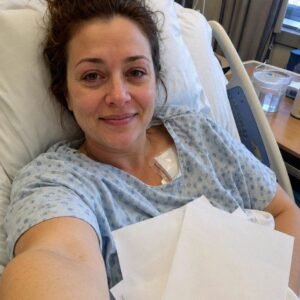
Even in the final weeks, when getting out of bed took everything she had, she would ask me whether I was eating properly. She would ask my brother Robert if he was keeping up with his bills. She would ask if Dad had remembered his blood pressure medication. She was lying in a hospital bed with an IV in her arm and she was still taking attendance, still keeping track, still holding our family together from the inside out the way she always had.
I used to stand in the doorway of her room and watch her and think: she is the strongest person I have ever known.
She died on a Tuesday in November. The house smelled like antiseptic and the lavender lotion she used, and people came and said the things people say — that she wasn’t in pain anymore, that time would help, that she had been so brave. I nodded at all of it. Time didn’t help. It just made the quiet louder.
Three months after we buried her, Dad called Robert and me and asked us to come over.
When we walked in, Mom’s coat was still hanging by the front door. Her slippers were still tucked under the edge of the couch. The space where the funeral flowers had sat felt like a gap in the room’s teeth.
My Aunt Laura was sitting next to my father on the sofa. Mom’s younger sister. She had her hands folded in her lap and her knees pressed together, and her eyes were the particular shade of red that comes from crying that happened a while ago, not recently. She looked like someone who had been rehearsing something.
I remember thinking: why is she here?
Dad cleared his throat and said he wanted to be honest with us. That he didn’t want secrets. Those exact words. He said he didn’t want secrets, and Laura reached over and took his hand, and he let her, and I watched it happen and still didn’t understand what I was seeing.
“Laura and I are together,” he said.
The room tilted. I waited for something to follow that sentence that would make it make sense. Nothing did.
Laura spoke quickly, the way people do when they’ve prepared what they’re going to say but still aren’t sure it will land. She said they hadn’t planned it. She said grief does things to people. She said they had leaned on each other, that shared loss had brought them close, that one thing had led to another.
My brother stood up. “It’s been three months,” he said.
“I know how it sounds,” Dad replied. “But losing your mother taught me that life is short.”
I wanted to stand up and tell him that she was the one who had lost her life. That he was still here. That it was a strange kind of lesson to take from watching your wife of thirty-plus years die by degrees while your children sat in hospital waiting rooms.
I didn’t say any of it. I sat there.
Laura told us they were getting married.
Robert walked out of the room.
That night, he called me and said none of it felt right. I told him it was grief. I said people do strange things when they’re in pain. I’m not sure which one of us I was trying to convince.
The next several weeks moved quickly and quietly. No engagement party. No announcements to wider family. Just paperwork and appointments and soft conversations that stopped when Robert or I entered the room.
Laura tried to bring me in. She asked if I wanted to help choose flowers, if I’d like to see the venue. I said no every time, politely, in the way that means please stop asking. Dad pulled me aside once and asked if I was okay with everything. I hesitated, then nodded. His shoulders dropped with relief — the specific relief of a person who has just been let off a hook they were very much hoping to escape.
The invitation arrived six weeks later. Small ceremony. Close family only. I stood at the kitchen counter holding it and noticed that my mother’s name appeared nowhere. No acknowledgment of her. No mention of how recently she had died. Just a date, a venue, and the names of two people who had apparently decided that three months was long enough.
I went anyway.
I stood in that room surrounded by soft music and champagne and people smiling, and I told myself the thing I had been telling myself for weeks — that this was just grief, that two broken people had found comfort in each other, that my mother would have wanted everyone to be happy.
Then Robert walked in late, jacket half-fastened, eyes too wide.
He grabbed my arm.
“Claire. We need to talk. Right now.”
He pulled me through the reception and almost out the door before I dug in and made him stop.
“You missed the whole ceremony,” I said. “What is going on?”
He glanced back over his shoulder at the room full of guests. “I almost didn’t come. I was told not to.”
“Told by who?”
“Mom.”
I stared at him. “That’s not funny.”
“I’m not joking. Listen to me.” He ran his hand through his hair. “A lawyer called me this morning. I almost ignored it. He knew Mom’s full name. He knew the exact date she died. He said she had instructed him to contact me specifically when Dad remarried — specifically when he married Laura.”
The noise of the reception came through the doors behind us, muffled and bright and completely wrong for the moment.
“She found out,” Robert said.
“Found out what?”
He reached inside his jacket and produced an envelope. Cream-colored, thick, sealed. He held it the way you hold something you’re not sure you should have.
“She wrote this when she already knew she was dying. She gave it to the lawyer and told him to wait for the right moment.”
I looked at the envelope. “What’s in it?”
“The truth about Dad.”
I laughed at that — a short, disbelieving sound. “Dad stayed. He was there every single day. He never left.”
“That’s what she thought too,” my brother said quietly. “For a long time.”
He looked at me steadily. “Do you remember how Laura started coming around more when Mom got sick? She said she wanted to help.”
“She did help.”
“And Dad always made sure she stayed. Always insisted. Think about how often she was there when Mom wasn’t feeling well — when Mom was resting, when Mom was asleep.”
I didn’t answer.
“Read it,” I said.
“Not here.” He pressed the envelope into my hands. “Once you know, you won’t be able to un-know it.”
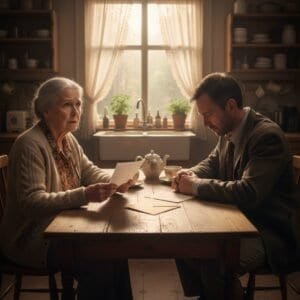
We found an empty side room off the main hall — spare chairs, a coat rack, a window cracked open to let in cold air. Robert closed the door behind us. The music was a faint pulse through the wall.
He broke the seal with hands that weren’t entirely steady.
“She wrote it knowing she wouldn’t be there to explain herself,” he said. Then he began to read.
My sweet children. If you’re reading this, I was right about what I feared. And it means I didn’t live long enough to protect you from it myself.
I pressed my hand to my mouth.
I didn’t tell you while I was alive because I didn’t want my last months to be about fighting. I was already exhausted. I was already in so much pain. I wanted the time I had left to be about love — not about uncovering what was being done to me in the dark.
Robert’s voice stayed level. Barely.
I found out by accident. Messages I wasn’t supposed to see. Dates that didn’t line up with explanations I’d been given. Money that moved in small, careful amounts, the way money moves when someone believes you’re not well enough to notice.
My hands were cold.
At first I told myself I was wrong. That illness was making me suspicious. That fear was distorting what I saw. But the truth doesn’t disappear simply because you’re too tired to face it.
I gave him one opportunity to be honest. I asked him calmly. I told him I wasn’t angry — I just needed to know the truth.
He told me I was imagining things. That the medication was affecting my thinking. That I should rest and stop worrying.
Robert’s voice caught slightly on the next line.
I believed him. Because when you have loved someone for decades, you learn to doubt yourself before you doubt them. That is what love does, and that is what he used against me.
The room was completely silent except for his voice and the faint sound of music through the wall.
But I kept watching. Quietly. The way I always did. And that is when I understood something that was worse than the affair.
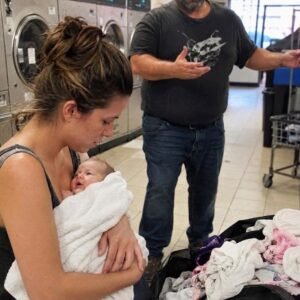
The child everyone assumes belongs to someone else — he is your father’s son.
“No,” I said.
Robert nodded without looking up.
Once I understood that, the rest made sense. Why he stayed. Why he never left. Why he performed the role of devoted husband so carefully, year after year. It wasn’t love that kept him here. It was security. What I had built. What he stood to lose if he walked away.
He was waiting. Both of them were. They were waiting for me to die so they could have each other openly and inherit everything I spent my life building.
I was on my feet without knowing I’d stood up.
Robert held up a hand and kept reading.
I did not confront them. I did not make a scene. I had neither the energy nor the desire to spend whatever time I had left in a war. Instead, I did the only thing that was still entirely within my power.
I rewrote my will. Quietly. Legally. Everything — the house, the savings, all of it — goes to you both. Your father receives nothing. Laura receives nothing.
I am sorry I couldn’t protect you from this while I was alive. But I have done what I could from here.
I love you more than I ever found the right words for.
— Mom
The door opened. Dad’s voice came through it.
“Claire? You okay in here?”
Robert folded the letter calmly and slid it into the envelope.
“We’ll be right out,” I said.
The door closed. Robert and I looked at each other across the small room for a long moment.
Then we walked back into the reception together.
Dad saw us immediately and smiled — the comfortable, relieved smile of a man who thinks the difficult part is over.
“There you are. I was getting worried.”
“We need to talk,” I said.
His smile shifted slightly. “Can it wait? They’re about to cut the—”
“No.”
The people nearest to us went quiet. Laura turned from a conversation she’d been having and looked at me carefully.
Robert stepped forward. “Mom knew. About all of it.”
Dad’s expression arranged itself into something reasonable and patient — the face he used when he thought one of us was being emotional. “Knew what, exactly?”
I held up the envelope. “About you and Laura. About the child. About why you stayed.”
Laura said his name in a low voice.
Dad let out a short, dismissive laugh. “You’re confused. You’ve been through a lot and—”
“You get nothing,” I said.
The laugh stopped.
“She rewrote the will. Months before she died. Everything she built goes to Robert and me. You were never going to get any of it.”
Dad’s face went the color of old paper. He turned to Laura. “You said it was handled. You told me—”
“I didn’t tell you anything,” Laura said. She took one step back from him. Then another.
I looked at both of them standing there in their wedding clothes in the middle of the room they’d been so certain was the beginning of their future.
“This wedding didn’t give you what you thought it would,” I said. “It just made everything she wrote in that letter true.”
Robert and I walked out.
Months later, Laura left him. Turns out the thing they had built together couldn’t hold its own weight once there was nothing left to wait for.
My mother never raised her voice in those final months. She never accused anyone. She lay in that bed and asked about our meals and our bills and our father’s medication, and the whole time she was quietly, carefully making sure that the people who had betrayed her while she was dying would find nothing waiting for them when she was gone.
She didn’t fight them.
She outlasted them.
And she did it in the most her way possible — not with rage, but with paperwork, and patience, and a letter in a cream envelope handed to a lawyer who knew exactly when to make a phone call.
I keep her slippers. They’re still under the edge of the couch where she left them.
Some things, I’m not ready to move yet.