I thought the hardest part of this year was watching my teenage daughter try to be brave while I went through chemo. Then one phone call from her school turned our whole life inside out.
My daughter Maddie is 15, and for most of her life it’s been just the two of us.
Her father, Marcus, was declared dead when she was four. Car accident on a rain-slick highway outside town. Closed casket. A police officer at my kitchen table saying, “I’m so sorry.” A death certificate I signed through a fog so thick I could barely read my own name.
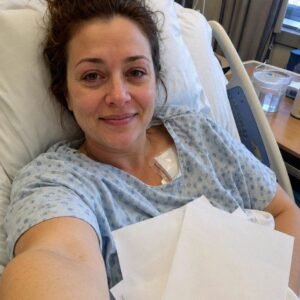
A few weeks ago, my hair started coming out in clumps from chemo. So I cut it short, wrapped scarves around my head, and tried to act like it didn’t matter.
Then one afternoon Maddie came home, dropped her backpack by the door, and held out a box.
“I got you something,” she said.
“From where?”
“Open it.”
I looked up. “Maddie… how?”
She reached up and pushed back her hood. Her hair was gone.
I stood up so fast my chair scraped the floor. “What did you do?”
“I sold some of it, and gave the rest to the stylist at the salon. She made the wig for you.” She swallowed. “I knew we couldn’t afford one. And I know you say it’s just hair, but I know you miss feeling like yourself.”
I crossed the kitchen and pulled her into me so hard she made a small sound.
She pulled back just enough to look at me. “You’re my mom.”
That was it. I cried, full-on, ugly, helpless crying.
The next morning, she went to school and I went to chemo. It was a bad session, the kind where even the ride home feels impossible. By the time I got inside, I was so weak I had to sit on the edge of my bed just to take off my shoes.
That was when my phone rang.
It was the school.
“Ms. Reyes? I need you to come to school immediately,” Maddie’s history teacher said.
“Why? Is Maddie okay?”
A pause. “She’s safe. But there are police officers here, and they need to speak with you both.”
Every part of me went cold. “Police? Why would police be with my daughter?”
“I think you need to hear it in person.”
The drive is a blur. Red lights, my hands gripping the wheel, ten minutes of imagining every terrible possibility.
The principal’s office door was open. Three officers were inside. Maddie sat in a chair by the wall with red eyes and both hands clenched in her lap.
I went straight to her. “Are you hurt?”
She grabbed me. “No.”
“Then what is this?”
One officer stepped forward. “Ma’am, do you know what your daughter found today?”
“No idea what you’re talking about.”
He sighed. “Then you need to hear the truth.”
He explained that Maddie, doing a school project on local nonprofits, had pulled public financial records for a youth sports foundation my late husband used to volunteer for — the same foundation that ran the community center where Marcus coached little league before he died. Buried in an old digitized filing cabinet scan, she’d found a document with her father’s name on it, dated eight months after his supposed death.
“That’s impossible,” I whispered. “He died in 2015.”
“That’s what we thought too,” the officer said. “Until we cross-referenced it. Ma’am, we don’t believe your husband died in that accident. We believe the accident was staged, or at minimum, misidentified. Your husband had started collecting evidence that donation money meant for underprivileged kids at that community center was being diverted into private accounts. He may have gotten too close.”
Maddie made a small, awful sound beside me. I grabbed her hand harder.
The officer slid a page toward me. Not a birth certificate with another woman’s name — thank God, I don’t think I could have survived that too. A trust document. Maddie’s name was on it. So was Marcus’s. Money placed in an account for her the week she was born, quietly drained and rerouted through shell accounts linked to the community center over the years.
“Your daughter is the legal beneficiary of a trust tied to land donated to that center,” the officer said. “Your husband found out it was being emptied. That’s what he was trying to stop.”
Maddie blinked hard. “So this is about money?”
“About money, fraud, and whoever covered it up. Your father knew you were at the center of it.”
He handed me an envelope. My hands were shaking before I even opened it, because I recognized the handwriting.
For Rachel and Maddie, if this is ever found.
Inside: If you’re reading this, I couldn’t come back safely. I never left by choice. I found proof that Maddie’s trust was being stolen and protected by people with real influence here. If it becomes impossible to stay hidden, go to Cedar Hollow. Green house past the diner. Ask for Tomás. He knows what I couldn’t put in writing. Tell Maddie I loved her every single day I was gone. — Marcus.
I couldn’t finish reading it the first time through.
“He was alive?” Maddie whispered.
“I don’t know what he is now,” I said honestly.
That night, we packed one bag. I sat down twice just folding clothes, adrenaline doing strange things to a body already exhausted from chemo. At one point I saw Maddie carefully tucking the wig she’d made me into the bag so it wouldn’t get crushed.
“After today, you’re still worried about my wig?” I asked.
She managed a weak smile. “Obviously.”
“We may not like what we find tomorrow,” I said.
“I know.”
“We may find out your father made choices I don’t understand.”
“I know. But we go together.”
That got the first real expression out of her since the office. She leaned into my shoulder. “Always.”
By morning we’d be driving toward a green house past a diner in a town I’d never heard of, toward a man named Tomás who might know why Marcus vanished, toward answers tied to Maddie, to me, and to a life I thought had been buried eleven years ago.
What I didn’t know yet: someone had already knocked on Tomás’s door before sunrise.
And he had let them in.