My daughter Laurie died on a Tuesday.
She was fourteen years old, and she drowned in the river behind Riverside Park pulling a six-year-old boy she had never met back to the bank.
The boy lived.
Laurie didn’t.
I have replayed that sentence every single morning for eleven weeks. The boy lived. Laurie didn’t.
I am a nurse. I have held dying strangers’ hands and stayed calm and said the right things. I have trained myself not to fall apart.
But nothing — nothing in twenty-two years of nursing — prepared me for identifying my own daughter’s body.
We live in Atlanta. We have lived here since Laurie was three, in the same yellow house on Clement Street with the rose bushes she helped me plant the summer she turned seven.
She used to come out every morning before school and check if anything new had bloomed.
The roses are still blooming.
I can’t look at them.
After the funeral, people brought casseroles and flowers and sat with me and said things like “she was so brave” and “what an extraordinary girl” and I smiled because that’s what you do.
But when everyone left, I sat in her bedroom on the edge of her bed and I felt completely, utterly hollow.
Laurie’s school — Pemberton Middle — held a small assembly in her honor. Her English teacher, Ms. Carver, spoke. I wasn’t there. I couldn’t go.
I heard it was beautiful. I heard half the students cried.
I sent a thank-you card because that’s what you do.
Time moved strangely. Eleven weeks felt like eleven years and also like eleven minutes.
I went back to work too soon. My supervisor gently suggested I take more leave. I went back home and sat in the kitchen and stared at the wall.
Then, on a Thursday afternoon in late October, my doorbell rang.
I wasn’t expecting anyone.
I wiped my hands on a dish towel and walked to the front door and opened it.
Ms. Carver was standing on my porch.
She was a small woman, maybe sixty, with silver hair and reading glasses pushed up onto her forehead. I recognized her from the photos the school had sent after the assembly.
She was holding a manila envelope against her chest with both hands, the way you hold something fragile.
Her eyes were red at the edges.
“Mrs. Hollis,” she said. “I’m so sorry to come without calling. I wasn’t sure you’d answer the phone.”
She was right. I probably wouldn’t have.
“I found something,” she said. “I’ve been going back and forth about whether to bring it. But I kept thinking — if this were my daughter — I would want to know.”
I stepped aside and let her in.
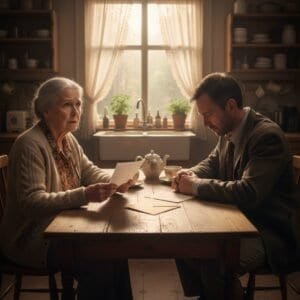
We sat at the kitchen table. She placed the envelope between us and smoothed the edge of it with her thumb, like she was buying herself a moment.
“Laurie was in my advanced writing class,” she said. “She was gifted. Genuinely gifted. The kind of student you get once every ten years.”
I nodded. I already knew this. Laurie had wanted to be a journalist. She kept a notebook. She was always writing things down.
“Back in September, I gave the class an assignment,” Ms. Carver said. “It was called ‘A Letter You’ll Never Send.’ The idea was to write something honest. Something they might never say out loud.”
She pressed her fingertips flat against the envelope.
“Most of the kids wrote to celebrities. To friends they’d drifted from. A few wrote to grandparents who had passed.”
She paused.
“Laurie wrote to you.”
The kitchen went very quiet.
“I didn’t read it until after,” Ms. Carver said. “After she — after everything. I was collecting old assignments to return to families and I found it in her folder and I read it and I had to sit down.”
Her voice broke on the last word.
“I’ve been carrying it for six weeks,” she said. “I didn’t know if I was doing the right thing by keeping it. But I also didn’t know if I was doing the right thing by bringing it.”
She slid the envelope across the table toward me.
“Whatever you decide to do with it is yours,” she said. “But she wrote it to you. It belongs to you.”
I looked at the envelope.
I could see Laurie’s handwriting on the front — just the word Mom, in her looping cursive, the way she always wrote it, with the M slightly larger than the rest.
Ms. Carver stood up quietly.
“I’ll let myself out,” she said. “Take all the time you need.”
I heard the front door close.
I sat alone in the kitchen with the envelope in front of me.
My hands were shaking.
I had spent eleven weeks trying to understand how my daughter had made a decision in three seconds that most adults would never make in a lifetime. How she had seen a child go under and not calculated the risk, not weighed the outcome, not hesitated.
Just gone in.
I had asked myself a thousand times what was in her that made her do that.
And now there was an envelope on my kitchen table with her handwriting on it, and something inside me was terrified.
Not of grief.
I was already drowning in grief.
I was terrified of something else entirely.
That she had known, somehow, who she was going to be.
That she had already made peace with something I had never seen.
I reached for the envelope.
My fingers touched the edge of it.
And then I stopped.
Because I noticed something I hadn’t seen before.
In the bottom right corner of the envelope, in smaller letters, Laurie had written one more line.
Don’t be sad, Mom. I already knew you’d be okay.
I couldn’t breathe.
I pressed my hand flat against the words.
And then, very slowly, I began to open it.