I raised Nadia alone from the time she was six years old.
Her father left on a Tuesday in February. Didn’t take much. Just his boots, his guitar, and whatever he told himself justified walking out on a child who still slept with a nightlight.
I worked as a dental receptionist in Birmingham for sixteen years. Same practice. Same desk. Same view of the car park through a smudged window.
It was enough. Barely, but enough.
Nadia never complained. Not once. Not about the secondhand school uniforms, the holidays we couldn’t take, the birthday parties where I’d bake instead of buy. She just got on with it. That was who she was.
She was quiet in the way that deep water is quiet. You don’t realize how much is moving underneath until something breaks the surface.
When she was sixteen, she got a job at a café on the high street. Saturday mornings, Sunday afternoons. I told her she didn’t have to. She said she wanted the independence. I believed her.
Then at seventeen, she picked up a second job. Evenings at a supermarket two bus rides away. She told me it was saving for a laptop for university. That made sense. I didn’t ask more questions.
By the time she was eighteen and her A-levels were finished, she was working three jobs. The café. The supermarket. And something she described vaguely as “admin work” for a local charity on Wednesday mornings.
I told her she was doing too much.
She said, “Mum, I’m fine. I just like staying busy.”
I was tired enough myself that I let it go.
Last month, her university place was confirmed. Sheffield. Psychology. She’d worked so hard for it that I cried before she did when the letter came.
I started planning. Thinking about what she’d need. Bed linen. A good winter coat. A second-hand mini fridge I’d seen listed online.
She kept telling me not to worry about the cost.
I thought she was just being kind.
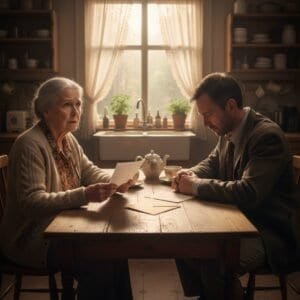
The night before she was due to leave, I sat on the edge of her bed while she finished packing. Her room looked stripped. Strange. Like a person had been carefully removed from a space and only the outline remained.
“Are you scared?” I asked her.
She folded a jumper and didn’t look up right away. When she did, her eyes were soft in a way that made my chest ache.
“No,” she said. “I’m ready.”
She slept. I didn’t.
I lay in the dark and thought about six-year-old Nadia asking me if Daddy was going to come back. I thought about the school play where she forgot her lines and just stood there smiling until the audience laughed with her, not at her. I thought about every small version of her that had quietly become this woman I was somehow supposed to let walk out the door in the morning.
At half past seven, we loaded her things into my car.
At half past eight, my phone rang.
I didn’t recognize the number. Birmingham area code, but not one I knew.
Nadia was carrying a box to the boot. I stepped back into the kitchen and answered.
“Is this Carol Pemberton?” A woman’s voice. Professional, but warm.
“Yes.”
“My name is Diane Osei. I’m the manager at Westside Community Pantry. Nadia works — worked — with us on Wednesday mornings.”
I didn’t say anything. I was already trying to understand why this woman was calling me.
“I hope I’m not overstepping,” she said. “But Nadia’s leaving today for university, and she made me promise not to say anything to you before she went. I’ve been going back and forth all week.”
My hand tightened around the phone.
“What do you mean?”
There was a pause. Not an uncomfortable one. The kind where someone is choosing their words carefully because they matter.
“Carol, Nadia didn’t come to us to do admin work. She came to us eighteen months ago and asked if she could set up a direct donation arrangement. Regular, monthly.”
I sat down in the kitchen chair.
“She told us she wanted it to go specifically to emergency food parcels for single-parent families with young children. She was very specific about that.”
The room felt smaller.
“She said she’d been one of those children once and she knew what it felt like when a parent tried to hide the worry from you. She didn’t want other kids growing up not knowing why their mum looked tired.”
I opened my mouth. Nothing came out.
“Over eighteen months, your daughter donated just over four thousand pounds to this pantry, Carol. Every month without fail. The third Saturday. Like clockwork.”
Four thousand pounds.
Three jobs. Two years. Four thousand pounds.
While I had been at my same desk, looking at my same car park, telling myself that barely enough was enough — she had been quietly building something else entirely. Not for herself. For children she would never meet. For mothers sitting in kitchens like this one, too proud and too tired to say out loud what they needed.
“She didn’t want you to know because—” Diane stopped.
“Because what?” My voice didn’t sound like my own.
“Because she said you’d try to stop her. She said you’d say she was doing too much. That she needed to save for herself.”
She was right. That is exactly what I would have said.
“I’m only calling because I felt you deserved to know who your daughter is. Not just who she’s becoming. Who she already was.”
I heard the back door open. Nadia’s footsteps on the kitchen tiles.
“Mum? We should probably head off if we want to beat the—”
She stopped.
She saw my face.
And the expression that crossed hers — the way her eyes widened and her chin dropped slightly — told me that she already knew. She already knew exactly who was on the phone.
“Mum,” she said softly. “I told her not to.”
I looked at my daughter standing in the doorway with her car keys in her hand, her hair pulled back, wearing the coat I’d bought her two Christmases ago.
And I thought: I have been so busy trying to give her everything I could that I never once stopped to see what she was already giving.