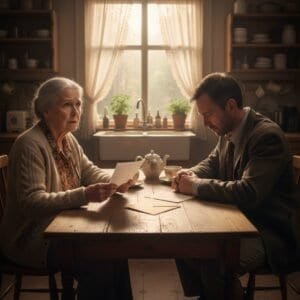
I almost didn’t go.
I’d packed my things the night before, then unpacked them, then packed them again at 4 a.m. while my husband slept.
Sixteen ceramic mugs. Eight hand-thrown bowls. A small lidded jar I’d spent three weekends on, the glaze a kind of deep blue-green that reminded me of Lake Michigan in October.
I loaded everything into cardboard boxes and drove to the Wicker Park Artisan Market just as the sun was coming up over Chicago.
I’d never done one of these before.
I was fifty-one years old and I had never once sold a single thing I’d made with my hands.
The woman at the registration table smiled at my name badge and pointed me toward my spot — table twenty-two, right at the end of the second row.
I started setting up next to a man with a professional banner, adjustable lighting, and a wireless card reader mounted on a custom stand. His pottery was beautiful. Perfectly symmetrical. The kind of work that wins prizes.
He glanced at my table once and looked away.
On my other side was a woman selling handmade jewelry. She had a velvet display case and a ring light. She took one look at my hand-lettered price tags — printed at home on cardstock, slightly crooked — and said something to the man across the aisle.
They both laughed.
Not loudly. Not cruelly. Just the kind of quiet laugh that means they think you don’t notice.
I noticed.
I finished arranging my mugs and sat down on my folding chair and told myself to breathe.
I’d taken up pottery three years ago, six weeks after my daughter Reese was diagnosed. Something to do with my hands while she was in treatment. Something that wasn’t sitting in hospital waiting rooms scrolling through statistics I didn’t want to read.
My instructor, a retired woman named Carol, told me I had a feel for the clay. I didn’t know what that meant at the time. I just knew that for two hours every Thursday evening, I wasn’t thinking about port catheters or blood counts.
Reese was fine now. Nineteen and studying marine biology in Savannah. She was the one who had pushed me to sign up for the market.
“Mom, people will love your stuff,” she said over the phone last month. “Stop hiding it in the garage.”
I thought about her when the first hour passed and no one stopped at my table.
Vendors up the row were making sales. I could hear the little chime sounds from their card readers. The man with the professional banner had a small line.
A woman picked up one of my mugs, turned it over, set it back down.
Two teenagers photographed the blue-green jar and walked on.
By 10 a.m. I had sold nothing.
The jewelry woman came back from a coffee run and handed the banner man a cup. She looked at my table — the careful arrangement I’d been adjusting all morning — and said, loud enough for me to hear, “She’s going to pack up by noon.”
He didn’t disagree.
I stood up and pretended to straighten something on my tablecloth.
I had driven forty minutes in the dark to be here. I had practiced talking about my work in the mirror the night before like a complete fool. I had rehearsed sentences like “the glaze is food-safe” and “each piece is one of a kind” until they stopped feeling ridiculous.
And I had sat here for three hours while people walked past me like I was part of the furniture.
I was considering whether to start packing my boxes when I saw her.
She was moving through the market the way someone does when they know every person in the room. Stopping here, nodding there, saying something that made a vendor laugh. She had a clipboard and a lanyard and the particular walk of someone who built something and watched over it.
I found out later her name was Donna Kowalski. She’d started the Wicker Park Artisan Market eleven years ago out of a church parking lot with twelve vendors and a borrowed folding table.
Now it ran four Saturdays a year and drew over two thousand visitors.
She stopped at table twenty-one. Then she moved to table twenty-two.
She picked up one of my mugs.
Not the way browsers do — quick, evaluating, already moving on. She held it. Turned it slowly. Ran her thumb along the inside of the handle where I’d left a slight ridge, intentional, the way Carol had taught me.
She set it down and picked up the blue-green jar.
She held it for a long time.
Then she looked at me.
“How long have you been throwing?”
“Three years,” I said. “About three years.”
She nodded slowly. “Self-taught?”
“I have an instructor. Had. She retired last spring.”
She turned the jar over and looked at the bottom where I’d pressed my initials into the clay before firing. A small habit. Something Carol had told me to start doing.
“These pieces have real character,” she said. Quiet, matter-of-fact. Not the kind of thing you say to be kind.
The banner man had stopped pretending to organize his display. The jewelry woman had gone very still.
Donna set the jar down and straightened up and looked along the row.
And then she did something I wasn’t expecting.
She turned to face the vendors around her — not the customers, not the crowd, but the vendors — and she raised her voice just enough.
“Can I get everyone’s attention for a moment?”
The conversations dropped. The card readers went quiet. A dozen faces turned toward her.
She put her hand on my table.
“I want to talk about what this market was built for,” she said. “And I want to start right here.”
The banner man looked at the ground. The jewelry woman’s smile had completely disappeared.
And Donna Kowalski kept talking.
I stood there with my hands at my sides, my sixteen crooked price tags, my slightly asymmetrical mugs, and the blue-green jar that had taken me three weekends — and I could not move.
Because what she said next was something I will never, as long as I live, forget.