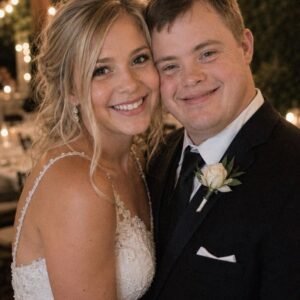
For fifteen years, my ex-wife told our children I had abandoned them, while I kept a garage full of returned mail and canceled-visit records proving otherwise, never quite finding a way to make that truth reach the two people who mattered most. At my son’s wedding, he finally said it himself, in front of three hundred witnesses, before I ever had the chance to.
Renata and I married young, twenty-four and twenty-six, and had Caden two years later, followed by Ruby three years after that. The marriage was difficult almost from the beginning, in ways I’ve spent years trying to understand more honestly than I did at the time — genuine incompatibility, financial stress, and, I’ll fully own my share of it, my own immaturity and poor communication during those early years of parenthood.
We divorced when Caden was seven and Ruby was five, a process that turned unexpectedly, brutally contentious. Renata’s lawyer painted a version of our marriage and my parenting that bore only partial resemblance to reality, and the custody battle that followed drained both of us financially and emotionally in ways that left permanent scars on everyone involved, including, most tragically, two young children who deserved better from both their parents.
I lost the custody fight, granted only limited, supervised visitation, a outcome I’ve never fully understood the full reasoning behind, given by a family court system that, in my admittedly biased experience, seemed more interested in resolving the case efficiently than in fully investigating either parent’s actual fitness.
What followed was fifteen years of a pattern I documented obsessively, almost compulsively, in a growing collection of boxes in my garage, because some part of me always believed, even in my darkest moments of doubt, that this documentation would someday matter.
I sent birthday cards every single year, for both children, that came back marked return to sender, unopened, in handwriting I eventually recognized as Renata’s own. I showed up for scheduled supervised visits that were canceled, again and again, always with some new last-minute excuse — a sudden illness, a scheduling conflict, once, memorably, “inclement weather” on a day with clear blue skies I documented with a photograph, because by then I’d learned to document everything.
I hired three different family law attorneys over those fifteen years, each one attempting to enforce the original custody agreement through the court system, each attempt eventually collapsing under the weight of legal fees I could no longer sustain while also, somehow, trying to build any semblance of a stable adult life for myself.
Each legal attempt followed a similar, exhausting pattern. An initial period of hope, as a new attorney reviewed the case and expressed confidence that the documented pattern of canceled visits and returned mail constituted a clear, actionable violation of the custody agreement. A filing, a hearing date, and then, almost invariably, some combination of procedural delay, a sympathetic judge inclined toward minimal disruption to the children’s “established routine” — routine that had been established, in no small part, by Renata’s own pattern of interference — and mounting legal fees that eventually made continuing the fight financially impossible. By the third attempt, when Caden was fourteen, I had genuinely run out of both money and, if I’m honest, a certain kind of hope I’d been rationing carefully for years.
Renata told the children, consistently and apparently convincingly, that I had simply stopped showing up, that I had chosen some undefined new life over continued involvement with them. I have no way of knowing exactly what specific version of events she constructed across those fifteen years, but I know its effects — two children who grew into adults believing their father had abandoned them by choice, a belief I had no meaningful way to counter from the outside of a relationship Renata controlled completely.
I kept every canceled-visit notification, every returned card, every piece of documentation from three separate legal attempts, boxed carefully in my garage, not entirely sure what I was preserving them for, beyond some stubborn, perhaps naive hope that someday, somehow, the truth might find its way to the people who needed to hear it most.
Caden reached out three years ago, entirely unexpectedly, twenty-two years old by then, having discovered a small collection of my old letters and cards while helping his mother move out of a storage unit she’d maintained for years, apparently forgetting, or perhaps never fully realizing, that the unopened envelopes she’d stashed away told a considerably different story than the one she’d told her children.
That first contact was tentative, careful, both of us navigating fifteen years of accumulated distance and misunderstanding with obvious caution. We met for coffee, awkward and overly polite, both of us clearly working from incomplete information about the other’s life across the missing years.
Slowly, over the following months, we rebuilt something — not the relationship we might have had without fifteen years of interruption, but something real nonetheless, built carefully on small, consistent interactions rather than any attempt to simply pretend the lost years hadn’t happened.
Ruby has remained more distant, understandably wary given the depth of the story she grew up believing, though Caden tells me she’s begun asking her own questions in recent months, questions I hope, eventually, might lead somewhere similar to where Caden and I have arrived.
I’ve tried, across these past three years, to be patient with Ruby’s distance in a way that occasionally costs me more than I let on to Caden. There have been moments, watching my son slowly rebuild trust with me, when I’ve felt a specific, aching grief about my daughter’s continued absence, a grief I’ve tried carefully not to weaponize into pressure on Caden to somehow force his sister toward a reconciliation she isn’t ready for on her own timeline. Fifteen years of one narrative doesn’t unravel simply because a brother finds it convincing. Ruby deserves the same careful, self-directed process of discovery that Caden went through, on whatever timeline actually works for her, even if that timeline tests my patience in ways I try hard not to show either of them.
When Caden got engaged last year, I genuinely wasn’t certain I’d be invited to the wedding at all. Renata made clear, through careful, indirect messages relayed via Caden, that my attendance would be “complicated,” language I understood to mean she preferred I stay away entirely, though Caden, to his credit, insisted the choice was his to make, not hers.
I attended, sitting quietly at a back table, genuinely grateful simply to witness my son’s wedding day at all, having long since made peace with the likelihood that I’d remain a peripheral, complicated presence in his life rather than a fully restored father.
During the reception, following the traditional toasts, Caden took the microphone for his own groom’s remarks, thanking his mother warmly and specifically for years of steady, difficult single parenting, an acknowledgment I felt no resentment toward whatsoever, understanding fully that Renata had, whatever else was true, actually shown up every single day for our children in ways I’d been prevented from doing.
Then he paused, and I watched something shift in his posture, a decision visibly settling into place.
“There’s something else I need to say tonight,” he told the assembled three hundred guests, his voice steady despite visible nerves. “About my father.”
I watched Renata’s face, several tables away, go completely white.
“For most of my childhood,” Caden continued, “I believed my dad chose to disappear from my life. I believed it because it was the story I was told, consistently, for fifteen years, and I had no reason at the time to question it.”
The reception hall had gone very quiet.
“Three years ago, I found boxes of returned mail. Birthday cards, addressed to me and my sister, marked return to sender in handwriting I recognized. I found records of scheduled visits, canceled again and again, always with some new excuse. I found legal documentation of three separate attempts to enforce a custody agreement that kept somehow, mysteriously, falling apart.”
I sat frozen at my back table, my heart hammering somewhere in my throat, having no idea this speech was coming, no idea my son had prepared to say any of this in front of three hundred wedding guests.
“I’m not telling you this tonight to hurt my mother, who I love and who worked incredibly hard raising my sister and me largely alone,” Caden continued, his voice steady but clearly emotional. “I’m telling you this because my father sat quietly in the back of this room tonight, genuinely unsure if he was even welcome, after fifteen years of trying to reach two children who were told he didn’t want them. And I think, finally, on the happiest day of my life, he deserves to hear, in front of everyone who matters to me, that I know the truth now. That I see him. That I’m sorry it took me twenty-five years to find it.”
I don’t remember standing up. I remember Caden’s eyes finding mine across that reception hall, and I remember crossing the distance between us on legs that felt entirely unfamiliar, and I remember my son pulling me into an embrace in front of three hundred people, both of us crying in a way that felt like fifteen years finally, publicly, breaking open.
Renata left the reception shortly after, understandably overwhelmed, and Caden has since told me their relationship weathered a difficult few months of conversation and reckoning following that night, conversations I’ve deliberately stayed out of, understanding that whatever accounting needs to happen between my son and his mother belongs to the two of them, not to me.
Caden has shared with me, in careful, general terms rather than specific detail, that those conversations with his mother eventually revealed a version of events even more complicated than the simple binary of “abandoned versus prevented” that had defined his understanding for fifteen years — a mother genuinely, if misguidedly, convinced during the worst of our divorce that limiting contact was protecting her children from a father she’d talked herself into believing was more harmful than he actually was, a conviction that calcified over the years into something closer to a settled family narrative than an actively reconsidered judgment. I don’t offer that context to excuse fifteen years of returned mail. I offer it because Caden has asked me to hold space for the complexity of his mother’s motivations alongside the very real harm those motivations caused, and I’ve tried, imperfectly but genuinely, to do exactly that.
Ruby approached me for the first time in fifteen years at the very end of that reception, quiet and visibly uncertain, and simply said, “I think I owe you a longer conversation than I’m ready to have tonight. But I’m ready to start having it.”
We’ve had coffee twice since. It’s slow, careful, exactly as tentative as my rebuilding process with Caden was three years ago. I don’t expect it to move quickly, and I’ve made peace with that pace, understanding that fifteen years of a carefully constructed absence doesn’t undo itself in a handful of conversations, however sincere.
I still have those boxes in my garage. I haven’t thrown them away, and I don’t think I will, not because I need the evidence any longer, but because they represent fifteen years of a father who kept showing up, in the only ways still available to him, even when showing up meant nothing more than a card that would come back unopened.
I’ve started, slowly, going through those boxes with Caden over the past few months, an unexpectedly healing process for both of us. He’s asked to keep several of the returned cards himself, particularly the ones from his early childhood, birthdays five, six, and seven, years he has almost no independent memory of but has told me he wants physical proof existed, evidence that his father had, in fact, been trying to reach him even in years too young to remember clearly on his own. We’ve spent several evenings sorting through that documentation together, him asking careful questions, me answering as honestly and completely as I can manage, both of us slowly reconstructing a shared understanding of fifteen years that had, until recently, existed as two entirely separate, contradictory narratives.
My son said, at the end of that wedding night, something I’ve turned over in my mind countless times since. “I spent fifteen years believing you gave up on me. I understand now that you never once did. I’m sorry it took a wedding and three hundred witnesses for me to finally say that out loud, but I needed everyone who matters to me to hear it, not just you.”
I told him, holding him in that reception hall doorway while the band started playing again behind us, that the timing had never once mattered less to me than the simple, overdue fact of the truth finally, fully, publicly arriving, fifteen years late and worth every single one of them.