I saw her during the second hymn.
She sat alone in the back pew, not crying, not praying — just watching. Her dress was gray, not black, and her expression was entirely unreadable. I didn’t know her. And in a church full of people Richard and I had built our life around, that meant something.
Gina was gripping my hand tight in the front row. Alex sat beside her with his jaw set exactly the way his father’s used to be. I kept my eyes forward through most of the service, but when the final prayer ended and the pews began to clear, I moved toward the back before I could talk myself out of it.
Gina noticed. “Where are you going?”
“Bathroom,” I said.
“I’ll come with you.”
As we passed the last pew, the woman stood.
“Julia?” she said — too loud. Heads turned. Someone stopped mid-hug.
Gina’s hand left mine. “How does she know your name?”
The woman flinched and lowered her voice. “Please. I’m sorry. It’s — hospice.”
That one word split the air clean in half.
Richard and I met when we were twenty years old. I was wearing a green sweater that day, and he told me it matched my eyes. I rolled them so hard I nearly missed my bus. He was clever and patient and infuriatingly kind, and I fell in love with him before I had time to think about it clearly.
We married at twenty-two. We raised two children in a house with mismatched chairs and a leaky faucet we never got around to fixing. Richard made pancakes on Sunday mornings. I organized the spice rack alphabetically even though he could never remember where anything went. For thirty-eight years, I believed we were genuinely, steadily happy.
Then something shifted.
Richard became quiet in a way that felt different from his usual silences — like a darkness had settled behind his eyes and decided to stay. I’d wake up to find him on the couch in his office with the door locked, telling me it was work stress. He stopped asking how my day was. Some nights I’d sit on the other side of that locked door with my hand pressed against the wood, saying his name into the gap at the bottom, and he wouldn’t answer.
I thought he was depressed. I begged him to talk to me.
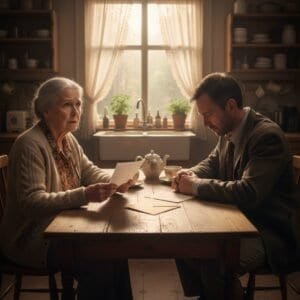
One evening, just after dinner, he sat down at our kitchen table — the one where we’d celebrated every birthday and every burnt casserole and Gina’s catastrophic attempts at baking — and said it.
“Julia, I cheated on you.”
I stared at him. “What?”
“I’ve been seeing someone else. I’m sorry.”
He didn’t cry. He didn’t even look at me.
A week later, I asked for a divorce. He didn’t fight it. Didn’t beg, didn’t call. It was clean and bloodless and brutal, and it was the last real conversation we had for five years.
Five years passed. I rebuilt quietly — lunch dates with friends, holidays with the kids, rooms rearranged to feel less like him. I stopped asking questions. I stopped hoping for answers. I told myself I had moved on.
Then Gina called.
“Mom. It was a heart attack. They said it happened fast.”
I didn’t cry. I just sat on the edge of the bed, listening to the silence on the other end. She told me there would be a service at the old church on Saturday. I said yes without fully understanding why. Maybe to prove to myself that I had healed. Maybe because some part of me hadn’t.
After the service, I found the woman waiting.
“I don’t believe we’ve met,” I said.
“No. We haven’t.” She turned toward me. “I’m Charlotte. I was with him at the end. Hospice.” She paused. “And you need to know what your husband did for you.”
“Richard had cancer,” she said. “Pancreatic. Stage four. He refused all treatment. He didn’t want anyone to see him that way.”
My stomach turned. “He told me he was cheating on me.”
“I know.”
I stepped back. “You knew?”
“He said you would stay,” Charlotte said quietly. “And he couldn’t bear what staying would do to you.”
Her fingers tightened on the strap of her purse. She reached in and produced a single folded page — hospital letterhead, creased as though it had been handled many times. Typed in clean ink at the top, a line that made my name look foreign to me:
DO NOT CONTACT JULIA UNDER ANY CIRCUMSTANCES.
The date beside it was five years old. His signature sat at the bottom like a final decision.
She held out a sealed envelope. “He asked me to give you this. He said if you ever came.”
I didn’t open it at the church.
I went home, changed out of my dress, and made tea just to keep my hands moving. Then I went out to the back porch and sat on the old bench we’d never replaced and looked out at the garden we’d once planted together. The hydrangeas had come back.
I held the envelope for a long time before I opened it. His handwriting hadn’t changed.
Julia,
I didn’t touch anyone else, my love. I promise. There was no affair. I got the diagnosis, and I knew what it would do to you.
You would have stayed. You would have fed me soup and cleaned up after me and watched me fade, and it would have taken you with me.
You gave me your whole life. I couldn’t ask you to give me more.
I needed you to live. I needed you to hate me more than you loved me, just long enough to walk away.
I’m sorry. I’m so sorry. But if you’re reading this, it means I got my wish. That you’re still here.
That you lived.
I loved you until the end.
— Richard
I sat with the letter in my lap while the words swam in and out of focus. My hand was over my mouth. I didn’t cry right away. I just breathed — slow and shallow — until the porch light buzzed and flickered on, as if even the house didn’t know what to do with this.
The next morning I called Gina and Alex and asked them to come over. I didn’t explain. I just put the envelope in the center of the kitchen table when they arrived and told them to read it.
Gina’s hand went to her mouth. Alex’s jaw tightened. He was the first to speak.
“He let us believe he was a monster.”
“He was dying,” I said. “And he made sure none of us ever saw it.”
“He thought he was saving you,” Gina said, wiping her face.
“Maybe.” I let that sit for a moment. “But he stole my choice. And he let me carry the shame for five years.”
The silence that followed didn’t feel holy. It felt earned.
“But maybe it worked,” I said, after a while.
We didn’t say much after that. I put food together and we ate at the table that had seen every important thing that had ever happened to our family, and the quiet between us felt full rather than empty.
A week later, Alex came back alone.
He held another envelope. “Dad updated his will,” he said. “Charlotte helped him finalize it.”
I opened it carefully, expecting legal language, bracing for more questions.
What fell out was a deed.
The lake cabin. The one we’d taken the kids to every summer when they were small — the place with the leaky roof and the pine tree out front with the old swing still hanging from it. We used to call it ours. I hadn’t been there in years.
“He put it in your name,” Alex said. “Fully.”
A small sticky note was attached to the corner of the deed. Faded yellow. Handwriting I knew by heart.
Keep the porch light on, my love.
Do it in case the kids come back. And in case you want to watch the water again.
I’ll be there. Just not where you can see.
I read it once. Then again.
Outside, the wind came up. A single leaf dragged across the kitchen window and held there, as though it was trying to stay.
I looked at my son. He watched me the way Richard used to when he didn’t know how to fix something — just patient and present and waiting.
“He left,” I said quietly, “so I could keep the light on.”
Alex’s voice cracked. “You did, Mom.”
And for the first time in five years, I let myself believe it.
The grief that moved through me then was different from what I had carried before — cleaner somehow, and unbearably tender. Not the cold, hardened weight of betrayal. Something that knew it had been loved, even when the love had put on a cruel disguise to do its work.
I folded the sticky note carefully and held it in my palm.
He had needed me to hate him enough to live.
And I had.