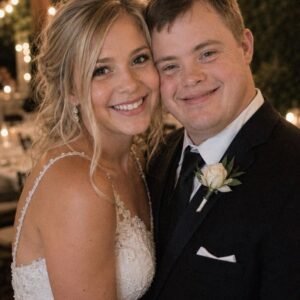
My husband is 29 years older than me.
I knew what people thought when they saw us together. I saw it in the glances at the grocery store. I heard it in the careful pauses when I told people his name was Gerald and that he was 71.
We met in Nashville, at a fundraiser for the children’s hospital where I worked as a pediatric occupational therapist. He was on the donor board. I was pouring coffee into a paper cup and trying not to spill it on my only nice blazer.
He came up beside me and said, “You look like someone who’s been on their feet since six this morning.”
I said, “Seven, actually.”
We talked for three hours.
That was nine years ago. We married eighteen months after that night, in a small ceremony in his backyard with string lights and forty people who genuinely loved us both.
I was 33. He was 62.
I won’t pretend it was always easy. Gerald had two adult children from his first marriage — his daughter Pamela, who was two years older than me, and his son Drew, who tolerated me the way you tolerate a long flight.
Pamela never hid how she felt.
The first Thanksgiving, she referred to me as “the situation” when she thought I was still in the kitchen. Gerald confronted her quietly, and she cried, and then nothing really changed.
I kept showing up anyway. I passed the green bean casserole. I asked about her kids. I sent birthday cards.
Because I loved her father. Completely and without apology.
Four years ago, Gerald had a minor stroke. Nothing catastrophic, but enough to slow him down. He sold his business consulting firm and retired fully. We moved to a quieter neighborhood on the east side of Nashville, a brick house on a tree-lined street with a porch swing we actually used.
He recovered well. Better than the doctors expected.
But something shifted in the family after that.
Pamela started calling more. At first I thought it was concern for her father. Then I noticed she only called when I wasn’t home. Gerald would mention it casually — “Pamela rang while you were at the clinic” — and I would nod and not ask too many questions.
Three months ago, she visited for a long weekend.
She and Gerald spent a lot of time in his study with the door closed.
When I asked him about it afterward, he took my hand and said, “She worries. Let her worry. It doesn’t change anything between us.”
I believed him.
I still believe him.
But this afternoon, something happened that I haven’t stopped thinking about.
I was home alone. Gerald was at his Tuesday cardiology check-up. I was grading continuing education notes on the couch when the doorbell rang.
A woman stood on the porch.
She looked to be in her mid-fifties. Dark coat. Hair pulled back tightly. She was holding a manila envelope against her chest with both hands, like she was trying to decide whether to give it to me or take it back to wherever she came from.
I didn’t recognize her.
“Can I help you?” I said.
She didn’t smile.
“Are you Diane? Gerald Whitmore’s wife?”
“Yes,” I said slowly.
She exhaled through her nose.
“My name is Carol Hess. I was Gerald’s personal attorney for eleven years. I retired last spring.” She paused. “I debated whether to come here. I want you to know that. I went back and forth about this for weeks.”
My hand tightened on the door frame.
“But I think you have a right to know what’s inside this.”
She held out the envelope.
I took it. It was heavier than I expected.
“I’m not here to cause harm,” she said. “I’m here because I watched something happen from the inside for a long time and I couldn’t stay quiet anymore.”
“What kind of something?” I asked.
She looked past me, just briefly, into the hallway.
“After Gerald’s stroke, his children approached me about his estate. That’s normal. What wasn’t normal was what they asked me to help them do.” She pressed her lips together. “I declined. And shortly after that, Gerald let me go. He said it was a cost-cutting decision. It wasn’t.”
My chest felt tight.
“What’s in the envelope?” I asked.
“Documents,” she said. “Correspondence. And a copy of an amendment that was filed eight months ago without your knowledge.”
The street was completely quiet behind her.
A car passed slowly.
A neighbor’s dog barked once and stopped.
“I could lose my retired license for being here,” she said. “I want you to understand that I came anyway.”
She turned and walked back down the porch steps toward a grey sedan parked at the curb.
I stood there holding the envelope.
I looked down at it.
My name was written on the front in handwriting I didn’t recognize.
I heard Gerald’s car turn into the driveway at the side of the house.
I had maybe forty seconds before he came through the back door.
My hands were already pulling at the metal clasp.