I have been called a lot of things in my life. Stubborn. Too sensitive. Too quiet for my own good. But I never once thought the word “liar” would follow me through a family dinner, spoken loud enough for twelve people to hear it.
My name is Carolyn. I’m a school librarian in Nashville, Tennessee, and I have been married to my husband, Greg, for almost nine years.
For most of those nine years, his mother, Diane, has made it her quiet mission to make me feel small.
It started with little things. A comment about how I pronounced a word. A joke at Christmas about how I didn’t know how to make proper biscuits. The way she would look at Greg and then look at me, like she was still waiting for him to come to his senses.
Greg always defended her. “That’s just how she is, Caro. She doesn’t mean anything by it.”
I believed him, for a long time.
But this past Thanksgiving changed everything.
We were at Diane’s house in Brentwood, the big colonial with the wraparound porch that she always made sure to mention had been in the family for three generations. There were twelve of us around the table. Greg’s sister, Patricia. His uncle Harold and his wife. Two cousins with their husbands. And Diane, sitting at the head of the table like she always did, with that tight smile she wore when she was just about ready to say something.
The food had barely been touched when she put down her fork.
“I think it’s time we talked about the property,” she said.
The room went very quiet.
Greg’s grandfather had passed away in the spring. He had left behind a small piece of land just outside of Hendersonville — nothing grand, maybe four acres with an old barn on it — but it had been in the family for decades. In his will, he had left it to Greg.
But there was something else in that will.
A handwritten addendum, attached separately, that stated the land should also belong to me. By name. Carolyn Margaret Hess. The old man had written it himself, apparently, and signed it in front of his lawyer.
Diane had contested it from the moment the will was read. She claimed the addendum was coerced. That I had gotten close to her father-in-law in the final months of his life specifically to manipulate him.
And at that Thanksgiving table, with everyone watching, she said it out loud.
“We all know why Gerald added her name to that document,” she said, not even looking at me. “She spent all those months driving him to his appointments, bringing him casseroles, making herself indispensable. He was ninety-one years old and his mind was going. She knew exactly what she was doing.”
I felt the blood leave my face.
“Diane—” Greg started.
“I’m sorry, Greg, but it needs to be said. Your wife inserted herself into my father-in-law’s final months and took advantage of a vulnerable old man. That land does not belong to her. It belongs to this family.”
Patricia looked down at her plate. Harold cleared his throat. The cousins said nothing.
And I sat there, completely still, while the woman dismantled nine years of my life in front of everyone who was supposed to be my family.
I didn’t cry. I didn’t raise my voice. I thanked everyone for dinner, got up from the table, and walked outside to the porch.
Greg came out ten minutes later. He looked exhausted and guilty and confused all at once.
“She’s upset about the land, Caro. She didn’t mean—”
“She meant every word,” I said.
We drove home in silence.
The truth was, I had helped Gerald. Not because of any will or any land. Because he was a lonely old man who had lost his wife two years earlier and whose own family called him on his birthday and not much else. He loved crossword puzzles and old Westerns and he called me “the librarian” even after nine years of knowing my actual name, and somehow that always made me smile.
I brought him soup because he was sick. I drove him to his cardiologist because Greg was traveling and Patricia lived forty minutes away and nobody else offered. I sat with him on his back porch and let him talk about his wife, June, for hours.
I never once thought about that land.
I hadn’t even known my name was in the will until the lawyer read it.
For three days after Thanksgiving, I barely left the house. Greg was quiet and careful around me in a way that made my stomach hurt. I could tell he didn’t fully believe his mother. But I could also tell he didn’t fully disbelieve her either.
That was the part that broke me.
And then, on the third day, there was a knock at the door.
It was our neighbor, Ruth. She’s in her mid-seventies, a retired teacher, with silver hair and a directness about her that I have always admired. She and Gerald had been close — they’d lived on the same street for over thirty years.
She was holding a small wooden box.
Her expression was serious in a way that stopped me cold.
“Carolyn,” she said, “I need you to come inside and sit down. I’ve been holding onto something that Gerald gave me before he passed. He told me to wait until after the will was settled, and then give it to you directly. Not to Greg. Not to Diane. To you.”
My hands were shaking as I stepped back to let her in.
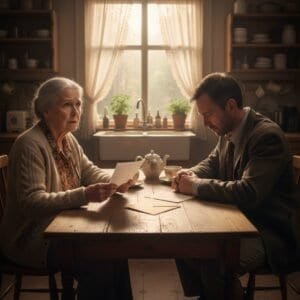
We sat at the kitchen table, and she placed the box in front of me.
“He gave me this in August,” she said quietly. “He knew there would be trouble. He told me he knew exactly what he was doing when he added your name, and he wanted to make sure you had proof of why.”
I stared at the box.
“What’s inside?” I whispered.
Ruth folded her hands in her lap.
“Letters. Recordings. And something he wrote himself, in his own hand, three months before he died — witnessed and dated and signed in front of two people who are still very much alive.”
She looked at me steadily.
“He documented everything, Carolyn. He documented exactly who you are to him, and why. And he documented some other things too — things about this family that I don’t think you know yet.”
She reached over and unlatched the small brass clasp on the front of the box.
“He said when the time came, you’d be the only one strong enough to deal with what’s inside.”