I had been planning this surgery for four months.
Not because I wanted it — nobody wants to be put under general anesthesia and wheeled into a room full of strangers in scrubs. But the cyst had been growing for the better part of a year, and my doctor had finally used the word necessary, and so I’d spent four months building the scaffolding around it. Childcare arrangements. Backup plans. Lists on the refrigerator. Emergency contacts written on index cards and taped to the inside of the kitchen cabinet.
My parents were the plan. Carol and Dennis Bennett, retired, eleven minutes from my house, grandparents to Noah and Lily since the days each of them came home from the hospital. They had promised. My mother had said, without hesitation, of course we’ll be there, Rachel, what kind of question is that.
Noah was nine. Lily had just turned six.
I kissed them both before I left for the hospital at six in the morning. Noah was still half-asleep, his hair pressed flat on one side. Lily grabbed my hand and said, will you bring me something? I told her I’d bring her a popsicle. She said it had to be purple. I told her I’d do my best.
My parents pulled into the driveway as I was backing out. I watched them in the rearview mirror — my mother waving, my father already heading for the front door — and I let out a breath I hadn’t realized I’d been holding.
They were there. Everything was fine.
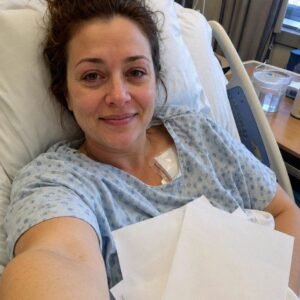
I came out of anesthesia in pieces.
First the sounds — the beeping, the low hum of voices, someone saying my name from somewhere above me. Then the light. Then the weight of my own body, heavy and unfamiliar, like I’d been returned to it slightly wrong. There was pain beneath my ribs, dull and deep, and I lay still for a long time before I trusted myself to move.
When I reached for my phone on the bedside table, my hands were still clumsy from the anesthesia. The screen lit up.
Fourteen missed calls. All from the same number.
Eleanor Grant lived two houses down from me. She was seventy-one, widowed, the kind of neighbor who remembered your children’s birthdays and left tomatoes from her garden on your porch in August. She had my number because I’d given it to her years ago — just in case.
I pressed call.
She picked up on the first ring.
“Rachel, thank goodness.” Her voice was shaking. “Your parents drove away around 11:30. A few minutes after, I looked out and saw Noah and Lily sitting on the porch alone. Lily was crying so hard she could barely breathe.”
My whole body went cold. The pain beneath my ribs seemed to narrow and sharpen.
“Noah was holding onto her,” Eleanor said quietly. “Holding onto her like he was trying to protect her from something. I brought them inside and gave them lunch. He told me his grandfather said they’d only be gone an hour. Rachel — it’s been three.”
I thanked her. I told her I’d call right back. I hung up and sat there in the hospital bed for a moment, staring at the wall, doing the kind of breathing you do when you’re trying to keep yourself level.
Then I called my mother.
She answered on the third ring, her voice bright and easy.
“Oh, sweetheart! How did surgery go?”
“Where are my children?”
A brief pause. Then a small, almost irritated exhale. “I guess Eleanor called.”
“Where are my children, Mom.”
“Rachel, calm down. Your father had to drive Megan to her salon appointment. She finally got an opening with Ricardo — you know how impossible his schedule is. The kids were sleeping when we left. We were only going to be an hour.”
“They were not asleep.” My voice came out flat and very quiet, which happened sometimes when I was past the point of shouting. “They were sitting alone on the concrete porch. Lily was screaming.”
I heard my mother shift. When she spoke again, her tone had moved from breezy to something harder, something that carried the particular weight of a woman who had already decided she was not wrong.
“Your sister needed us more,” she said. “She had a hair appointment.”
I hung up.
I was discharged at five o’clock.
Eleanor brought Noah and Lily to me in the hospital parking lot because I’d asked her if she minded waiting, and she’d said of course not, honey, take all the time you need. Noah walked out holding Lily’s hand. When he saw me, his face did something complicated — relief and something older than relief, something no nine-year-old should have learned yet.
Lily ran to me and I held her as carefully as I could, one arm protecting my right side, the other wrapped around her small back.
“You’re okay,” she said into my neck. It wasn’t a question. She was telling herself.
“I’m okay,” I said. “I’ve got you.”
On the drive home, Noah sat in the back seat and looked out the window and didn’t say much. But at a red light, he said quietly, “Grandpa said an hour.”
“I know, buddy.”
“It was four hours, Mom.”
“I know.”
He didn’t say anything else. He turned back to the window. I kept my eyes on the road and breathed through the pain still sitting under my ribs and thought about the four months I’d spent building a plan around people who had just taught my son, in a single afternoon, that a promise from a grandparent was worth approximately nothing.
That night, after the children were bathed and fed and finally asleep — Lily curled tight against her stuffed rabbit, Noah with his lamp still on and a book open on his chest — I sat at the kitchen table with a cup of tea gone cold and opened Instagram.
My sister’s post had gone up at 10:48 that morning.
A photo of Megan in a salon chair, fresh foils in her hair, grinning at the camera. My mother’s arm was around her shoulder.
Mom saved me today! Best mom ever!
The post had sixty-three likes. My mother had commented a red heart.
I sat with that for a long time.
Then I got up, found the manila folder in the kitchen drawer, and made three phone calls.
The first was to a locksmith, who came at seven and changed every lock in the house. I stood in the hallway in my surgical binder and watched him work and felt something settling in me — not anger exactly, but something quieter and more permanent than anger.
The second call was to my pediatrician’s office, where I updated the emergency contact list. My parents’ names came off. Eleanor Grant’s went on.
The third call was to my attorney.
The will had been written three years ago, at a time when I still believed that family, by definition, showed up. I had my answer now on what that word meant to the people I came from. I spent an hour on the phone while the locksmith finished up, and by nine o’clock the document reflected a version of the world I actually lived in rather than the one I’d spent years pretending was true.
I didn’t call my mother back that night.
I didn’t call my father either.
My mother called me four days later. She led with I think you’re overreacting, which was a sentence I had heard so many times in my life that it had lost its power to land. She said Megan’s appointment had been booked for weeks. She said the kids were old enough to sit on a porch. She said I had always been too sensitive.
I let her finish.
Then I told her, very calmly, that the locks had been changed and her key no longer worked, that she was no longer listed anywhere as an emergency contact for my children, and that I needed some time before I was ready to have any further conversation with her.
She went silent.
“Rachel,” she said finally. “Don’t be dramatic.”
“I’m not,” I said. “I’m just done rearranging the truth to make everyone comfortable.”
I hung up and went to go make Lily’s breakfast.
Eleanor Grant came over that Sunday with a casserole and a pot of chrysanthemums for the porch. She sat at my kitchen table and drank coffee while Noah and Lily did a puzzle on the living room floor, and she didn’t ask me any questions about my family or what I was going to do next.
She just said, “You’re doing a good job, honey.”
I hadn’t realized how badly I needed someone to say that until she said it.
Some people are family because you share blood. Some people are family because they look out your window and see a child who needs someone and they don’t hesitate for a single second.
I knew which kind I wanted around my kids.
I knew exactly which kind I was going to protect them from.