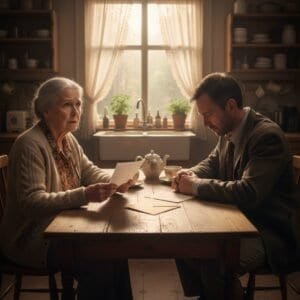
My husband left on a Sunday morning in October.
There was no screaming, no thrown dishes, no dramatic unraveling. Just a conversation at the kitchen table that was over in less than twenty minutes, and by the following morning there was a suitcase by the front door and then no suitcase, and then no him. Jane was five years old and had her father’s eyes and was still young enough that she accepted the explanation I gave her — Daddy lives somewhere else now — without pushing on it too hard.
She would push on it later, when she was older, in the quiet ways that children do when they’ve learned that some doors in a house are better left unlocked. But at five she just looked at me over her cereal bowl and nodded, and I held myself together long enough to get her to the bus stop, and then I sat down on the front step alone and let myself feel the full weight of what our life had just become.
Just the two of us. That was the whole equation now.
The first year was the hardest because I still believed it would get easier.
I worked days at a small medical office — scheduling, filing, answering phones, the kind of work that is invisible when it’s done well. It paid enough to cover rent and groceries and the electricity bill, and not much else. So I picked up night shifts. Cleaning offices after hours. Stocking shelves at a grocery store two nights a week. A short stretch of weekend waitressing that I quit after three months because the tips didn’t justify the childcare cost.
I told myself it was temporary. That I was in a difficult season and seasons change.
The season didn’t change so much as I changed inside it. I got better at the math of scarcity — which bill could wait a week, which couldn’t, where to find the small gaps and leverage them. I got better at sleeping in short installments and waking up without an alarm and pushing through the particular gray exhaustion of a body that is being asked to do more than it was designed to sustain.
What I didn’t get better at was pretending it wasn’t hard. So I stopped pretending and just did it instead, which turned out to be more efficient.
Jane grew up in that house of careful math and long hours, and she absorbed something from it that I never taught her directly. She became, without my asking, the kind of child who did her homework at the kitchen table without being reminded and put her dishes in the sink without being told and said thank you for things she had every right to simply expect. When she was nine she started making her own lunch for school because she noticed I was tired in the mornings. She never mentioned it. She just started doing it.
I noticed. I never said anything either. We had our own language by then, built out of the small practical kindnesses of two people who understand they are in something together.
When Jane got into college, I was sitting at the kitchen table going through the mail when she came downstairs and handed me the printed acceptance letter without a word. I read it twice. Then I looked up at her standing in the kitchen doorway in her socks and her old sweatshirt, and I smiled the way you smile when something you hoped for so hard it frightened you actually arrives.
We’ll figure it out, I told her.
What I didn’t say, because she didn’t need to carry it, was that I had absolutely no idea how.
The tuition number was not a number our life had a category for. I ran the figures every way I could and arrived at the same conclusion each time — there was a gap, significant and stubborn, that financial aid and Jane’s small scholarship didn’t cover. I lay awake for several nights looking at the ceiling and having the same circular conversation with myself, and at the end of it I arrived at the only answer available.
I sold the car.
It was a twelve-year-old sedan with a replaced transmission and a passenger window that stuck in cold weather, but it was mine and it was paid off and when I handed over the keys I felt something leave with it that was harder to name than transportation. I started taking the bus. When the bus route didn’t reach where I needed to go, I walked.
I picked up more night shifts. The office cleaning work expanded — a second building, then a third. Some weeks I came home at five in the morning, showered, changed, and went directly back out the door. I stopped counting the hours because the counting made it feel impossible and I needed it to feel like something I was simply doing, one day at a time, one payment at a time, without looking too far ahead.
Jane never complained. I want to be precise about this, because it mattered to me more than she knew. She had a part-time job her first year and two jobs her second. She studied late and woke early and called me every Sunday evening from her dorm room, and in four years of Sunday calls she never once said this is too hard or I don’t think I can or maybe I should just. She just kept going, in the same quiet, resolute way she’d been going since she was nine years old making sandwiches in the kitchen because she’d noticed I was tired.
I kept going too. Because she was the point. Every early morning and every late night and every walk to the bus stop in the rain — all of it was pointed directly at her future, and that made it not easy, but bearable. There is a difference.
Four years passed the way hard years do — slowly in the living of them, and then suddenly, looking back, all at once. And then we were three days from graduation and I was sitting at the kitchen table on a Thursday evening, going through the last of the bills, calculating whether the final payment had cleared, feeling the particular exhaustion of a long thing that is almost finished.
My phone buzzed on the table.
Unknown number. I almost let it go — I was tired, and unknown numbers rarely brought anything worth answering for. But something made me pick it up. Some instinct I couldn’t name.
Hello?
A brief pause. Professional, measured.
Is this Jane’s mother? This is the Dean’s office at the university. I’m sorry to call in the evening. It’s about your daughter.
The kitchen contracted around me. Every tired, careful, managed thing I had built over four years compressed into a single second of pure fear.
What happened? My voice came out smaller than I intended. Is she okay? What happened to my daughter?
Ma’am, please don’t be alarmed, the voice said, and I heard something in it shift — not urgency, but something warmer, more deliberate. Jane is perfectly fine. She asked us not to tell you until now.
I pressed my hand flat against the table.
We’re calling because we wanted you to hear it from us before the ceremony. Another pause, and I could tell this was a call the person on the other end had been looking forward to making. Your daughter has been selected as this year’s graduation speaker. She’s valedictorian, ma’am. She has the highest academic record in her class.
I didn’t speak.
She also wanted you to know, the voice continued, that she’s been awarded a full fellowship for her graduate program. Full funding. She said — and I’m reading her note here — she said to tell you that you can stop working the night shifts now.
The kitchen was very quiet. Outside the window the neighborhood was doing its ordinary Thursday evening things, and I sat at the table where I had eaten a thousand meals and paid a thousand bills and held myself together through more hard nights than I could count, and I put my face in my hands.
I didn’t cry right away. I just sat there for a moment, in the strange stillness of a long weight being lifted, feeling the shape of what four years had built.
She had known. All along, she had been watching, and working, and carrying her own quiet version of the same determination I thought only I was carrying, and she had done it without leaning on me, without letting me see the cost, because she understood — the way she had understood at nine years old with a sandwich in her hands — that the most loving thing she could do was not add to what I was already holding.
When I finally cried it wasn’t from sadness or relief exactly. It was from the overwhelming, humbling recognition of being known by the person you love most.
Three days later I sat in the third row of that auditorium, in a dress I’d bought secondhand and altered myself, and I watched my daughter walk to the podium in her cap and gown. She found my face in the crowd before she began, the way she always had, and she smiled at me — not the performed smile of a ceremony but the real one, the private one, the one that was just for me.
And then she began to speak, and the room went still to listen.
I had sold a car and walked in the rain and slept in pieces for four years and I would do every single day of it again without hesitation.
She was always the point.
She always had been.