Title: A Woman Paid Me to Pose as Her Husband to Claim Her Grandmother’s Fortune – But at the Will Reading, She Left Me Something That Stopped My Heart Cold
A woman paid me to marry her on paper so her dying grandmother would leave her the family fortune. My father was sick, and I was running out of options to save him, so I agreed. I told myself it was just a role to play. Then her grandmother passed, the will was read, and what I received shook me to my core.
Let me tell you the kind of man I was before any of this happened.
I was the guy running Shakespeare monologues in a diner restroom between shifts, reeking of coffee and cooking oil. The guy driving forty minutes to unpaid community theater because the stage was the only place he still felt like himself. The guy sitting at his father’s hospital bedside twice a week, watching the bills stack up and swearing that _everything was going to be okay._
A decent man stuck in an impossible situation. That’s exactly how Claire found me.
> I was the guy running Shakespeare monologues in a diner restroom between shifts.
***
She walked into the diner on a Wednesday, sat in my section, and ordered black coffee she barely touched. She watched me work for about twenty minutes before she said a word, and I assumed she was gearing up to complain about something.
Instead, she pushed a business card across the table and said, ‘I need a husband.’
I laughed. She didn’t.
‘Sit down for five minutes,’ she said. ‘Please.’
She explained. Her grandmother, Mrs. Rosemund, was dying and had written a condition into her will years ago: _Claire had to be married to inherit._
> _’I need a husband.’_
Claire was 32, single, and had apparently never taken that clause seriously until she was staring down the reality of losing an enormous fortune.
‘How large?’ I asked.
She told me.
I kept my face neutral and pressed my thumbnail into my palm under the table.
‘I’ll pay you $1,000 a week,’ she offered. ‘We stage a courtship, a wedding, spend a few months playing the happy couple. Once the inheritance comes through, we divorce quietly and go our separate ways. Nobody gets hurt.’
‘Mrs. Rosemund gets hurt,’ I said.
> ‘I’ll pay you $1,000 a week.’
Claire looked at me like I’d said something foolish. ‘She’s dying, Tyler. She wants to die happy. We’d be doing her a favor with your acting skills.’
I should have walked away right then. I know that.
Then I went home that night and found three new hospital bills stuffed in the mailbox.
I called Claire the next morning.
***
We built our story the way you’d build a character for a play. Two weekends rehearsing how we met, how I proposed, the small details couples carry without thinking.
> I should have walked away right then.
Claire was efficient and precise throughout, treating the whole thing like a project with a hard deadline.
The wedding was entirely her production. Flowers I couldn’t name, a venue I couldn’t afford to park near, a guest list full of people who shook my hand and said, ‘Claire’s told us so much about you.’
I smiled and said, ‘All good things, I hope,’ and they laughed and moved on.
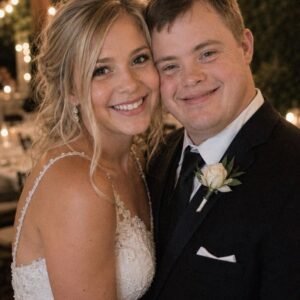
Mrs. Rosemund sat in the front row wearing a pale blue dress and cried through the entire ceremony. Not politely, not dabbing at the corner of her eye. The full, quiet kind that rises from somewhere deep and real.
> The wedding was entirely her production.
When it was over, she caught my hand as I passed.
‘You look at her like she’s the only person in the room,’ she said. ‘That’s all I ever wanted for her.’
> ‘Claire deserves every good thing, Mrs. Rosemund.’
She smiled and let me go. I spent the next ten minutes in the reception bathroom staring at my reflection, trying to find the version of myself I still recognized.
***
The arrangement was supposed to be simple. Sunday dinners, sitting with Mrs. Rosemund while Claire ran errands, smiling in photographs, the usual.
> The arrangement was supposed to be simple.
What I hadn’t counted on was Mrs. Rosemund herself.
She was extraordinary. Sharp, funny, completely unsentimental about her own approaching end, which somehow made her easier to sit with than most healthy people I knew.
The first Sunday I sat with her alone, she asked what I actually did for a living. I told her I managed real estate properties, which was the story Claire and I had agreed on. Professional enough to be convincing, boring enough not to invite too many questions.
Mrs. Rosemund nodded slowly. ‘And do you enjoy it?’
‘It pays well,’ I said.
> What I hadn’t counted on was Mrs. Rosemund herself.
She smiled like that was the most honest answer I could have given. Then she shifted the subject entirely and started telling me about her late husband George, and somehow an hour slipped by before I noticed.
After that, I stopped watching the clock when I was with her.
She told me about raising Claire after her parents died when Claire was nine, how grief makes some children angry and some children silent and Claire had been both at once, a combination that was exhausting and heartbreaking in equal measure.
She had always hoped Claire would find someone patient enough to outlast the walls.
> I stopped watching the clock when I was with her.
I fixed her broken radio simply because she had mentioned once that she missed the sound of it. I pushed her wheelchair out to the garden on Sunday afternoons even after Claire had already gone home and no one was around. I did it because Mrs. Rosemund loved that garden and couldn’t get there on her own.
It never crossed my mind that someone was paying attention.
***
Mrs. Rosemund passed away on a Tuesday morning in October. After the funeral, her attorney gathered everyone for the will reading. Claire sat beside me in a cream blazer, looking like someone about to close a deal. I sat there knowing this was my final performance.
The attorney read through the bequests and arrived at the primary estate.
> It never crossed my mind that someone was paying attention.
He cleared his throat.
He said Claire’s name.
He said she had inherited NOTHING.
Claire’s composure lasted about four seconds. Then she announced, loudly and clearly, that there had to be a mistake. That her grandmother had promised. That she had met every single condition. Her voice climbed in a way I’d never heard from her before, all that precision cracking straight down the middle, and I sat very still and stared at the table.
Then the attorney turned to me.
> ‘Mrs. Rosemund left something specifically for you, Mr. Tyler.’
He slid a wooden box across the table.
> She had inherited NOTHING.
I opened it. On top sat an envelope with my name written in careful, slightly unsteady cursive. I read the letter right there at the table, and by the third line I had to stop and start over because my mind refused to take it in.
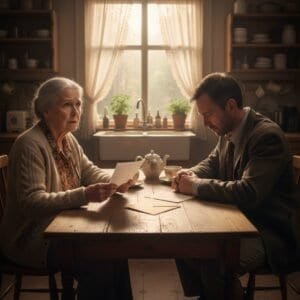
_’Tyler. I know you’re an actor my granddaughter hired to play her husband. I’ve known since the very beginning. I suspected the moment you fixed my radio without being asked. People who want something from you don’t fix your radio. At the bottom of this box, you’ll find what you truly need. I hope it gives your father the fighting chance he deserves. Now read the rest carefully, because I’m going to ask something of you. There is a man named Freddie. His address is in this envelope. Visit him alone, and tell no one. He will give you the rest of what you need to know.’_
I looked up.
> ‘_I know you’re an actor my granddaughter hired to play her husband.’_
Claire was watching me with an expression caught somewhere between fury and fear. ‘What does it say? Tyler. What’s in that box?’
> ‘Give me a minute.’
I kept reading.
***
At the bottom of the box was a document. A fully funded medical trust. My father’s name on the cover page, his transplant team, the hospital, the procedure. Every number I had been losing sleep over for two years, covered entirely.
My hands were trembling by the time I reached the final page.
> At the bottom of the box was a document.
I sat in that conference room holding a dead woman’s impossible generosity and thought about every hospital visit, every bill spread across that kitchen counter, and every time I had told my father things would be fine while quietly believing otherwise.
Claire grabbed my arm. ‘Tell me what’s in there.’
> ‘It’s personal.’
‘We had an agreement, Tyler.’
‘We did, Claire. And I held up my end.’
> I sat in that conference room holding a dead woman’s impossible generosity.
I closed the box and left. She followed me to the parking lot, her voice rising as I walked. Eventually she ran out of words and stood in the gray October air staring at me with something that might have been desperation buried beneath all the anger.
‘Is there anything left for me?’ she asked. ‘Anything at all.’
‘Go home, Claire,’ I said. ‘I’ll call you.’
***
Freddie was sixty, reading glasses on a chain, the unhurried manner of someone who had seen everything at least twice. He handed me tea I hadn’t asked for and told me Mrs. Rosemund had taken a liking to me from the third Sunday.
> ‘Is there anything left for me?’
‘Said you listened like you meant it,’ he told me.
‘I did,’ I replied.
> ‘She figured.’
The envelope he gave me laid out the rest. Claire could still inherit everything, but only if she demonstrated something genuine. Not paperwork. Proof that she valued people more than what people could give her. Mrs. Rosemund had left that determination entirely to me, with a quiet faith in both of us that I wasn’t sure either of us had earned.
I sat in my car in the dark for a long time afterward. I could walk away with the trust, with everything she had given me, and nobody could blame me. The NDA cut both ways. I owed Claire nothing beyond what we had agreed.
> Claire could still inherit everything, but only if she demonstrated something genuine.
But I kept returning to one line in Mrs. Rosemund’s letter.
_’Claire is not the woman she’s been acting like. I raised her. I know what’s underneath. I just need someone patient enough to outlast the walls.’_
I called Claire.
***
What followed wasn’t a transformation. It was slow and awkward, which is what real change looks like up close.
Three weeks into my father’s treatment, Claire showed up at the hospital uninvited, carrying two coffees, standing uncertain in the doorway like she wasn’t sure she belonged there.
> I kept returning to one line in Mrs. Rosemund’s letter.
My father waved her straight in, because he has always been better with people than I am. She sat with us for two hours and didn’t perform. She just sat there.
When my father made her laugh with a story about my first school play, I caught the exact moment it happened, loose and unguarded, nothing calculated about it.
Claire came back the following week. And the week after that.
I watched her from across the room when she didn’t know I was looking, and I saw exactly what Mrs. Rosemund had described. The person beneath the performance. Claire was a decent woman in an impossible situation too. She’d just been too frightened to admit it until there was nothing left to protect.
> I caught the exact moment it happened.
***
The night she told me she loved me, we were sitting on my apartment floor eating takeout because the table was buried under my father’s medical paperwork. She said it softly, without any buildup, like something she’d been carrying too long.
‘I don’t care about the money,’ she whispered. ‘Whatever Grandma left you, whatever she wrote in that note, that’s not why I’m telling you this. I’m telling you because I can’t keep it inside any longer.’
She held my gaze when she said it. No angle, no agenda. Just her.
I set down my food and reached over to the side table, where two envelopes had been sitting untouched for six weeks.
‘Your grandmother left you a message,’ I told her. ‘I’ve been waiting for the right moment.’
> ‘I’m telling you because I can’t keep it inside any longer.’
Claire read both letters slowly. I watched her face move through things I had no names for, watched her press the back of her hand against her mouth near the end.
By the time she finished the second one, she was crying the way I’d seen her grandmother cry at our wedding, full and quiet, and I understood then that it was no coincidence.
Some things run straight through families whether you invite them to or not.
‘She knew,’ Claire said finally.
> ‘From the beginning.’
‘And she still.’ She stopped. Tried again. ‘She still hoped I would.’
‘She always believed you would,’ I said quietly. ‘She just needed you to get there on your own.’
> I understood then that it was no coincidence.
Claire looked at me across the takeout containers and the paperwork and the mess of a life we’d stumbled into together and whispered, ‘I’m sorry. For what I asked you to do. For what I put you through. For what I put her through.’
‘I know.’
> ‘I mean it, Tyler.’
‘I know that too. I’ve been watching you mean things for about two months now.’
She laughed, wet and unsteady.
‘So what happens now?’
> ‘I’ve been watching you mean things for about two months now.’
I thought about a diner on a Wednesday. A business card slid across a table. A woman who needed a husband and a man who needed a miracle. And a grandmother who had seen all of it clearly from the very start.
‘Now you get your inheritance,’ I replied. ‘And then we figure out the rest.’
***
Claire received it three weeks later. She sat in that same conference room in a different blazer, and this time she didn’t look like someone closing a deal. She looked like someone who had walked a very long way to reach somewhere and was finally letting herself stop.
> Claire received it three weeks later.
On the drive home, she was quiet for a long stretch.
Then she said, ‘She wasn’t crying at our wedding because she got what she wanted. She was crying because she hoped I would.’
I didn’t say anything. I just reached over and took her hand, and she let me, and we drove home through the ordinary streets of an ordinary afternoon.
We were just two people who began by deceiving a dying old woman and somehow became the most real thing in each other’s lives.
> We were just two people who began by deceiving a dying old woman.