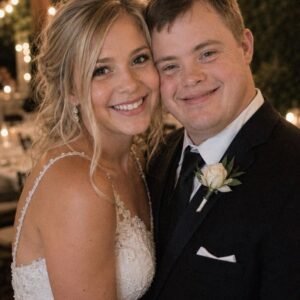
My brother had been dead for less than an hour when my mother demanded that his blind wife hand over his financial papers.
Then my sister-in-law turned toward me, pressed a sealed envelope into my hands, and whispered, “Whatever happens, don’t let her read this first.”
Two days earlier, I had been sitting alone at my kitchen table, surrounded by old family photographs.
The house was unusually quiet that Sunday afternoon. It was the kind of silence that allowed old memories to rise without warning.
A shoebox sat open in front of me. I had been sorting the pictures into small piles by year, though I kept losing track of what I was doing.
My coffee had gone cold long before I noticed.
Near the bottom of the box, I found a faded photograph of my brother, Ed, when he was seven years old.
He was standing beside a little girl in a yellow dress. Her hand was wrapped tightly around his, and her face was turned toward him even though she could not see him.
The girl was Lily.
I smiled and ran my thumb over the edge of the photograph.
“You always were the gentle one,” I whispered.
I could still remember the first time Ed brought Lily home.
He had walked into our dining room with the confidence of a child introducing someone important.
“Mom, Dad, this is Lily,” he announced. “She’s my best friend. She can’t see us, so we have to be extra kind with our voices.”
My mother, Diane, gave him a tight smile.
“That’s very sweet, Edward,” she said. “But friends like that can be a lot of work.”
Ed had not understood what she meant.
At the time, neither had I.
A few weeks later, our families met at a neighborhood barbecue. That was when Lily’s adoptive parents told us her story.
Her biological mother had abandoned her shortly after birth. Lily had been adopted when she was only days old and raised by two people who loved her fiercely.
Ed stood nearby while they spoke.
He was nine years old, but something about that story settled deep inside him.
That night, after everyone had gone home, he came into my bedroom.
“I’m never leaving her behind,” he said.
I looked up from my book.
“Ed, you’re nine.”
“It doesn’t matter.”
He meant it.
Through middle school and high school, Ed walked Lily home every afternoon. He described movies to her in quiet whispers, helped her navigate crowded hallways, and never allowed anyone to treat her as helpless.
When they announced their engagement after graduation, I cried harder than Lily did.
Ed looked happier than I had ever seen him.
Our mother did not share his happiness.
I found the photograph from their engagement dinner and felt my chest tighten.
Mom was smiling brightly in the picture, but I remembered what she had said when we were alone in the kitchen that night.
“He’s throwing away his future, Alice.”
“Mom, please.”
“A blind wife?” she continued. “Who is going to take care of her when he can’t?”
“She takes care of herself.”
“I’m only being practical.”
Our father had stood nearby, saying nothing.
He often did that.
He was not cruel the way our mother could be. But his silence made space for her cruelty, and over the years, that silence became its own kind of betrayal.
I placed the engagement photo aside and reached for a more recent picture.
It had been taken the previous Christmas.
Ed was standing beside Lily near their fireplace. He was smiling, but he looked thinner than I remembered.
I had not noticed at the time.
During the final year of his life, Ed had slowly pulled away from our parents.
He skipped Easter dinner.
He canceled Mom’s birthday celebration.
He stopped answering some of Dad’s calls.
Whenever I asked what was wrong, he gave me the same easy smile.
Once, Lily mentioned that he had a doctor’s appointment.
“What kind of appointment?” I asked.
“Just a checkup,” Ed said. “You worry too much.”
I believed him.
I had always believed him.
On Tuesday afternoon, my phone rang while the photographs were still scattered across my kitchen table.
Lily’s name appeared on the screen.
The moment I answered, I heard panic in her breathing.
“Alice.”
Her voice broke around my name.
“Ed collapsed. They’re taking him into surgery. Please come.”
The drive to the hospital passed in flashes of red lights, sharp turns, and prayers I could barely form.
By the time I reached the surgical waiting area, Lily was sitting alone.
Her white cane rested across her knees. Both hands were wrapped around it as though it were the only solid thing left in the world.
I hurried toward her and sat beside her.
“I’m here,” I said, taking her hand. “I came as fast as I could.”
Her fingers were freezing.
“Have they told you anything?”
“Only that they took him into surgery,” she answered. “That was two hours ago.”
We waited.
Minutes became hours.
The clock on the wall seemed louder than every other sound in the room.
Around the fourth hour, I tried to speak, though I no longer remember what I said.
Lily gave me a small smile.
It was not a hopeful smile.
It was the expression of someone who had already imagined this moment many times and had finally reached it.
“Alice,” she said softly, “you’ve always been a good sister.”
Something in her voice frightened me.
She sounded as though she were saying goodbye to more than Ed.
Ten hours after the surgery began, the surgeon walked into the waiting room.
I knew before he spoke.
I saw it in the way he held his shoulders and folded his hands in front of him.
“I’m very sorry,” he said. “We did everything we could.”
My legs went numb.
For one strange moment, I heard myself thanking him.
Lily did not move.
Her face remained still, but tears began slipping silently down her cheeks.
I reached for my phone to call our parents, but the names on the screen blurred together.
My thumb would not cooperate.
Then Lily touched my sleeve.
“Alice,” she said. “We need to talk before your mother gets here.”
“Not now.”
My voice came out broken.
“Please, Lily. I can’t do this right now.”
“It has to be now.”
“He just died.”
“I know.”
Her voice cracked, but she forced herself to continue.
“Ed made me promise. He said that if anything happened, you were the first person I had to tell.”
My hand tightened around the phone.
“Tell me what?”
Lily turned her face toward me.
“Your family never understood why he chose me.”
The bright hospital lights seemed to press down around us.
“What are you talking about?”
“He wanted you to know the truth.”
For a moment, I thought she meant Ed’s estate.
The house.
The insurance.
The savings accounts our mother would undoubtedly ask about the moment she arrived.
“If this is about money, I don’t care,” I said quickly. “The house and the accounts belong to you. I don’t want anything.”
“It isn’t about money,” Lily replied. “Not exactly.”
“Then what is it?”
“It’s going to break your heart.”
Her hand moved toward her bag.
She searched carefully inside and pulled out a thick envelope. It was sealed with dark wax, and a hospital chaplain’s mark had been pressed into the center.
She placed it in my palm.
“You need to hear the truth from Ed,” she said. “Not from a lawyer. And not through your mother’s version of what happened.”
The envelope felt heavier than paper should have felt.
“What’s inside?”
“When you finish reading it, you’ll understand why Ed lied to everyone he loved for the last eighteen months.”
Before I could ask another question, quick footsteps echoed down the corridor.
My parents had arrived.
Mom’s eyes were red and swollen, but within seconds, her attention moved from my face to the envelope in Lily’s hands.
“What is that?” she demanded.
“It’s private,” Lily said.
“Nothing involving my son is private from me.”
Dad reached toward Mom’s arm as though he might stop her.
He did not.
“Mom,” I said, “Ed died less than an hour ago.”
“And already she’s pulling you aside with paperwork,” Mom replied. “Alice, open your eyes.”
She turned toward Lily.
Her voice trembled with grief, but every word was cold and deliberate.
“Whatever Ed left behind belongs with his real family.”
Lily went completely still.
Mom continued.
“You can barely manage your own life, sweetheart. We would never abandon you, but the house, the insurance, and the accounts need to be handled by someone capable.”
“Stop,” I said.
“I’m trying to protect her.”
“No, you’re not.”
“Someone has to think clearly,” Mom snapped. “Ed would never want her overwhelmed by bills, property, and legal documents.”
I looked at my father.
I waited for him to say something.
He lowered his eyes.
That was when I realized my mother’s words were not simply the confused thoughts of a grieving parent.
They had discussed this before.
Perhaps many times.
They had expected Ed to die someday and had already decided that Lily would be too weak to keep what belonged to her.
Lily did not defend herself.
She held the envelope toward me with both hands.
“Read it before you make any decisions,” she said. “Please.”
I took her arm and guided her away from my parents.
We walked down the corridor and entered the small hospital chapel.
The room was dim and quiet. Soft light fell through stained glass and across the wooden benches.
We sat beside each other.
My hands were shaking too badly to open the envelope, so I placed it in my lap.
“Tell me first,” I said. “Say it out loud.”
Lily lowered her head.
“If I tell you, you may always wonder whether I changed his words.”
She nodded toward the envelope.
“He wanted you to hear it from him.”
I broke the seal.
The first thing I saw was the date printed at the top of the page.
Eighteen months earlier.
My mind immediately returned to every strange moment I had ignored.
The missed holidays.
The canceled dinners.
The doctor’s appointment he had dismissed as routine.
Every time he smiled and told me he was fine.
None of it had been true.
Ed had not been pulling away from us because he stopped caring.
He had been preparing to leave us.
Inside the envelope were medical reports, legal documents, insurance forms, trust papers, and property records.
At first, it appeared to be a carefully organized estate file.
Then I found a letter written in Ed’s unmistakable handwriting.
The moment I unfolded it, everything else disappeared.
Ed wrote that eighteen months earlier, a cardiologist had told him his heart condition was far worse than anyone realized.
The doctor could not promise him how much time remained.
Weeks.
Months.
Perhaps a few years if he was fortunate.
Ed had asked one question.
“What do I need to do before I’m gone?”
According to the letter, the doctor thought he meant medical treatment.
He did not.
Ed was thinking about Lily.
He wrote about how our mother had always treated Lily as a responsibility rather than a person.
He remembered every quiet insult, every judgmental comment, and every suggestion that Lily could not survive without him.
He knew exactly what would happen if he died without preparing.
Our mother would move quickly.
She would present herself as helpful.
She would offer to manage the estate.
Then she would slowly take control of Lily’s house, money, and decisions while convincing everyone she was doing it out of love.
So Ed spent the following year making sure no one could remove Lily from the life they had built together.
He rewrote his insurance policies.
He established a protected trust.
He transferred ownership documents.
He changed beneficiaries.
He appointed an independent attorney and financial manager who had no connection to our family.
He prepared every detail so Lily would never be forced out of her home or pressured into surrendering what was hers.
Then I reached the final paragraph.
Ed had written:
“I did not marry Lily because I was dying.
“I married her because I loved her long before I knew death was coming.
“But once I learned the truth about my heart, I made a decision. I would not allow death to decide what happened to her after I was gone.”
I lowered the letter.
Lily sat beside me, crying without making a sound.
“He knew?” I whispered.
She nodded.
“For eighteen months?”
“Yes.”
“Why didn’t he tell me?”
“He wanted to.”
“Then why didn’t he?”
“Because he knew you would try to bring your parents back into his life. You would believe they deserved a chance to help.”
She paused.
“And Ed believed your mother would use his illness to take control before he had finished protecting everything.”
I wanted to argue.
I wanted to defend my parents.
But only minutes earlier, my mother had demanded the documents before Ed’s body had even left the operating floor.
He had known her better than I wanted to admit.
I folded the letter carefully and returned to the waiting room with Lily beside me.
Mom was already speaking on her phone.
“Has anyone located his will?” she asked someone. “What about the insurance documents?”
She glanced around as if hospital staff might be hiding them from her.
“We need a lawyer here tonight,” she continued. “Someone has to make sure nothing disappears.”
Then she saw me.
“Good,” she said. “Tell Lily to give us the paperwork. She cannot manage a house, much less an estate.”
I stepped between her and my father.
“Put the phone down.”
Mom stared at me.
“You need to hear what Ed wrote.”
I read the letter aloud.
I told them about his diagnosis.
I told them about the eighteen months he had spent preparing.
I explained the trust, the insurance changes, the protected ownership, and the attorney he had appointed.
With every sentence, Mom’s expression became harder.
When I finished, she crossed her arms.
“She manipulated him.”
Lily flinched.
“A dying man,” Mom continued. “She knew he was vulnerable, and she let him cut his family out.”
“Did you know he was dying?” I asked.
Mom blinked.
“Do not twist this.”
“Did you know about one cardiology appointment? One prescription? One test?”
“We would have helped if he had told us.”
“Would you?”
My voice shook, but I did not stop.
“Did either of you notice he was losing weight? Did you ask why he missed Easter? Did you ask why he stopped coming to dinner?”
Dad lowered his head.
“I should have asked more questions,” he said quietly.
Mom turned toward him.
“Don’t start.”
But Dad looked at Lily instead.
“I let myself believe he was fine because it was easier,” he said. “I failed him.”
His voice broke.
“And I failed you.”
Mom stared at him as though he had betrayed her.
I held Ed’s letter against my chest.
“He couldn’t tell you,” I said. “He already knew what you would do after he was gone.”
“That is not fair.”
“You proved him right within an hour.”
Mom’s eyes flashed.
“Do not speak to me that way. I am your mother.”
“And Lily is my sister.”
The words came out before I had time to think about them.
But once I said them, I knew they were true.
“Ed made sure she would remain part of this family,” I continued. “I’m going to make sure of it too.”
Mom’s face tightened.
“If she tries to keep everything, I’ll take her to court.”
“Then you’ll see me there.”
“You would choose her over your own mother?”
“No,” I said. “I’m choosing Ed’s final wishes over your greed.”
The waiting room went silent.
Mom looked at Dad, expecting him to defend her.
For once, he did not.
She picked up her purse and walked away.
Several weeks later, I went to Ed and Lily’s house to help sort through his study.
Grief lived in every room.
His jacket still hung beside the door.
A half-finished cup of coffee had left a faint ring on his desk.
One of his books was open beside the couch, the corner of the page folded down.
Lily and I worked slowly.
Some objects made us laugh.
Others left us crying so hard we had to stop.
We found an old paperback Ed had read so many times that the cover was nearly detached.
We found a birthday card he had written but never had the chance to give Lily.
We found receipts, tools, photographs, and ordinary pieces of a life neither of us was ready to pack away.
Near the back of his desk drawer, I discovered a small notebook.
The cover was worn, and several pages were bent.
Inside, Ed had written simple reminders in his hurried handwriting.
Pick up milk.
Call Alice.
Fix the porch step.
Schedule the furnace inspection.
Most of the entries were ordinary.
Then I turned a page and found one sentence written by itself.
Make sure Lily never feels alone.
There was no date beside it.
No explanation.
Just those five words.
I handed the notebook to Lily.
She traced her fingertips slowly across the indentation made by Ed’s pen.
“He wrote things down so he wouldn’t forget,” she whispered.
I swallowed the ache rising in my throat.
“No,” I said softly. “He wrote down the things he refused to fail.”
Later that evening, I found one of my favorite photographs on Ed’s desk.
It showed the two of us as children, standing beside Lily in her yellow dress.
Ed was holding her hand.
Just as he had promised when he was nine years old, he had never left her behind.
I carried the photograph home and placed it in the old shoebox on my kitchen table.
It belonged with the rest of our family story.
A story that had never truly been about blindness, duty, or sacrifice.
It had been about a boy who made a promise before he was old enough to understand how much it would cost him.
And a man who kept that promise until his final breath.
“He didn’t leave me alone,” Lily said when I called her that night.
“No,” I answered, wiping tears from my face. “He never left you behind.”
I looked at the photograph one more time.
“And neither will I.”