For sixty-two years, I believed Benjamin had died in Vietnam.
Then, on what would have been his eightieth birthday, a stranger with Benjamin’s blue eyes placed a small blue box beside my red carnations and said, “I promised him this would reach you.”
My hands began to shake before I even touched the lid.
Inside lay a silver ring and a faded photograph of Benjamin and me beneath the old willow tree behind our high school. I was eighteen, wearing the yellow dress he loved. His arms were around my waist.
On the back, in his handwriting, were seven words I had carried in my heart for most of my life.
Isobel, I will come home to you.
I looked up at the stranger.
“Who are you?”
“My name is Edward,” he said. “Benjamin is my father.”
The café seemed to disappear around me.
“My Benjamin died in Vietnam.”
“He was declared missing and later presumed dead,” Edward replied. “But he survived.”
The words struck me harder than grief ever had.
Benjamin and I met during our final year of high school. We spent afternoons beneath the willow planning a farmhouse, children, and a life we were certain would begin after graduation.
Then he was drafted.
The night before he left, we stayed beneath that tree until sunrise. My hands would not stop trembling, so he held them between his own.
“No matter how long it takes,” he whispered, “I’ll come home to you.”
A year later, his mother came to my door in tears. Benjamin had been declared missing in action. Months after that, another notice arrived saying he was presumed dead.
I never married.
People sometimes assumed I had wasted my life waiting for a man who would never return. They were wrong. I poured my love into other people’s children. I volunteered in hospitals, read to children in hospice, and became the dependable aunt, neighbor, and friend who always showed up.
Still, every year on Benjamin’s birthday, I carried red carnations to the willow and left them beneath its branches.
Edward explained that Benjamin had suffered a serious head injury during the war. His memory had been badly damaged. By the time his identity and records were corrected, his mother had died, her old address led nowhere, and the life he once knew had already vanished.
Later, dementia took even more.
“He forgot me?” I asked.
“He forgot most of his life before the injury,” Edward said gently. “But not every feeling.”
He told me he had recently moved Benjamin into full-time care. While clearing a locked drawer, he found the blue box. When Benjamin saw it, he became agitated and said one sentence during a rare clear moment.
“Belle must have the box.”
Only Benjamin had ever called me Belle.
“Is he alive?”
“Yes.”
“Then take me to him.”
During the drive, Edward told me Benjamin had married the nurse who helped him recover after the war. The truth hurt, but I could not resent a woman who had cared for the wounded man Benjamin became.
“Did he love her?” I asked.
“Yes.”
“Then I’m grateful to her.”
The words were painful, which was how I knew they were honest.
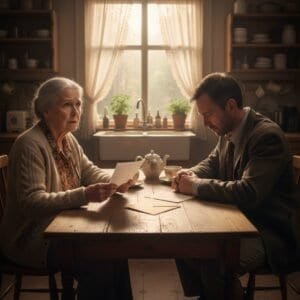
Outside Benjamin’s room, a staff member warned me that he might not recognize me.
For sixty-two years, he had remained eighteen in my memory—dark hair, warm hands, crooked smile.
Behind that door sat an eighty-year-old stranger.
Benjamin turned toward me from his wheelchair. His hair was white and his body frail, but his eyes were still blue.
My heart knew him immediately.
He did not know me.
“Are you one of the nurses?” he asked politely.
“No. My name is Isobel.”
“Isobel,” he repeated, without recognition.
I opened the blue box and showed him the ring.
“Pretty,” he said.
I asked about the willow and the yellow dress. His fingers began tapping the blanket, and the staff member ended the visit before he became distressed.
In the hallway, I leaned against the wall while my niece Wren held me.
“He came back,” I whispered, “but the part of him that knew me didn’t.”
Edward apologized.
“Can I visit again?” I asked.
He stared at me. “You still want to?”
“I don’t know what I want. But I’m not ready to leave.”
I returned two days later, then twice the next week.
I stopped asking Benjamin to remember me. Instead, I read beside him. Sometimes he listened. Sometimes he slept. Once, he called me by his late wife’s name.
The mistake hurt, but I did not correct him.
“I keep losing people,” he said quietly. “In my mind and for real.”
“Then I’ll keep introducing myself.”
Little by little, we built something smaller than the life we had once imagined, but still real.
One afternoon, he interrupted my reading.
“That fellow talks too much.”
“You talked all night once,” I said.
“Did I?”
“Under a willow tree.”
“Then I was probably trying to impress a girl.”
“You were.”
“Did it work?”
“For more than sixty years.”
He smiled, even though he did not understand why I was crying.
Several weeks later, Edward arranged a short outing to the willow.
I placed a red carnation in Benjamin’s hand and knelt beside his wheelchair.
“We sat here until sunrise once,” I said. “You held both my hands because they were shaking. You promised you would come home.”
His breathing changed.
He touched the small dimple in his chin and looked directly into my eyes.
“Belle?”
I covered my mouth.
“You remember me?”
The fog lifted for one impossible moment.
“You wore yellow,” he said.
I laughed through my tears. “It was the ugliest dress I owned.”
“You were beautiful.”
I slipped my hand beneath his.
“You came back.”
He studied my face.
“No,” he whispered. “I think you came and found me.”
The clarity faded minutes later, but it was enough. I had heard my name in his voice again.
After that day, we stopped trying to recover the life the war had stolen. I read to him, sat beside him, and held his hand without demanding that he understand why.
One afternoon, he asked whether I had been lonely.
“Sometimes.”
“Because of me?”
“Not only because of you.”
I told him about the children I had comforted, the families I had helped, and the life I had created.
“Loving you gave me more love than one life knew what to do with,” I said. “So I gave it away.”
Months later, Edward called before dawn.
“I think it’s time.”
Benjamin lay in bed with Edward on one side and me on the other. A red carnation stood near the window. As sunrise approached, Benjamin opened his eyes.
He looked at Edward.
“My boy.”
Then he turned toward me and reached weakly across the blanket. I caught his hand.
“Still shaking,” he whispered.
“Only a little.”
“Sunrise?”
“Yes.”
“Did I make it home?”
I pressed his hand to my cheek.
“You did, Benjamin.”
His eyes settled on mine.
“Belle.”
“I’m here.”
He smiled, and his fingers slowly relaxed inside mine.
At his funeral, Edward asked me to sit with the family.
“My mother gave him a life after the war,” he said. “You carried the love he had before it.”
Weeks later, Edward and Wren met me beneath the willow. Inside the blue box were the ring and a new photograph of Benjamin and me beneath the tree.
I placed the ring on a chain near my heart.
Then I divided the carnations—one for Edward, one for Wren, and one for me.
For the first time in sixty-two years, I did not leave the flowers and walk away alone.
I had spent my life believing Benjamin never came home.
In the end, he returned long enough to keep his promise—and to leave me the family I thought I would never have.