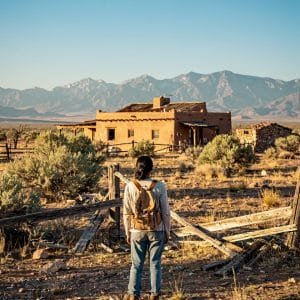
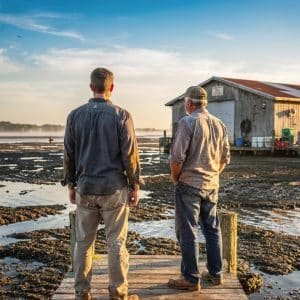
My name is James Calloway and I was twenty-two years old, four weeks into sleeping in a 2007 Hyundai Sonata with a broken air conditioning and a backseat that folded down into something that was technically flat, when I bought forty-four acres of abandoned blueberry farm in Hammonton, New Jersey for thirty-six dollars.
The situation with my apartment had resolved itself in the way of situations that involve two names on a lease and one of them stopping payment — gradually and then suddenly, with me holding the bag and the lease and the landlord’s patience exhausted. My former roommate was in Philadelphia with no forwarding address and no legal obligation that was practical to pursue and I was in my car in a library parking lot in South Jersey with thirty-six dollars and a phone that was three days from losing its service.
My grandfather, Raymond Calloway, was sixty-nine years old and lived in Marlton, forty minutes from Hammonton. He had been my primary family since my parents’ divorce when I was eight — not formally, not legally, just actually, the way some people become primary family through presence and reliability rather than paperwork.
I called him from the library.
“Grandpa,” I said. “I need a favor.”
“What do you need?” No preamble. No how are you first. Just what do you need.
I told him about the listing.
I told him about the thirty-six dollars.
I told him I needed a ride to an auction in Hammonton the following morning because I did not have enough gas.
He was quiet for a moment.
“Hammonton,” he said.
“Yes sir.”
Another moment of quiet.
“Your grandmother and I picked blueberries in Hammonton when we were nineteen,” he said.
I had not known that.
“I’ll pick you up at eight,” he said.
My grandmother, Eleanor Calloway, had died four years earlier after a marriage of forty-seven years. My grandfather had not recovered from this in the specific way of people who have organized their lives completely around another person and find, when that person is gone, that the organizing principle is gone with them. He functioned. He was present. He was Raymond Calloway in every observable way. But there was something underneath all of it that was the specific quality of someone going through motions that used to mean something and are working to mean something again.
He picked me up at eight.
He drove to Hammonton without speaking, which was not unusual for my grandfather, who believed that silence was not the absence of communication but a form of it.
The auction room was a county meeting room with folding chairs and a projector and the specific atmosphere of a place where impersonal transactions are conducted in plain language. My grandfather sat beside me and looked at the projector screen when the parcels appeared and said nothing throughout.
Parcel 6C. Forty-four acres of agricultural land in Atlantic County, New Jersey, outside Hammonton. Farmhouse — 1940s construction, condition derelict. Cold storage building — condition requiring assessment. Well on property. No utilities. Blueberry cultivation — high-bush varieties, operation ceased approximately ten years prior. Delinquent taxes: nine thousand dollars, assumed by purchaser. Opening bid: thirty-six dollars.
I raised my hand.
The auctioneer looked at me.
My grandfather looked at the screen.
“Any advance on thirty-six?”
The room was quiet.
“Sold.”
My grandfather put his hand on my shoulder.
That was all.
He drove us to the property that afternoon. The access road ran through South Jersey pine barrens before opening onto the farm — the farmhouse first, low and weathered, and then the blueberry rows, which were unlike anything I had expected.
Ten years of untended high-bush blueberry plants had done what high-bush blueberry plants do without management — they had grown. The rows were still visible as organizational structure, but the plants themselves had exceeded their original height and spread into each other and created a kind of dense productive chaos that was, I would later understand, both a challenge and an asset.
My grandfather got out of the truck and walked to the edge of the first row.
He stood there for a long time.
I stood beside him.
The blueberry plants were as tall as we were.
He reached out and touched the nearest branch — the dry November wood, the small brown buds that would become next year’s fruit.
His eyes were wet.
“Your grandmother would have loved this,” he said.
He said it quietly, to himself more than to me.
I did not speak.
“We picked here for two summers,” he said. “When we were nineteen and twenty. Before we were married. She liked the picking — she said it was the most honest work she’d ever done.” He was quiet. “I haven’t thought about those summers in a long time.”
He looked at the rows.
“She would have wanted you to have this,” he said.
I didn’t understand what he meant.
I understood later.
My grandfather came every weekend.
He came with his truck and his tools and the specific knowledge of a man who had grown up in South Jersey in the era when everyone knew someone who farmed. He helped me assess and repair and rebuild with the patience of a man who had been building and repairing things for fifty years and for whom the work itself was its own purpose.
The farmhouse was our first priority — livable before winter, which we achieved in six weeks. The cold storage building was the second — the refrigeration was gone but the structure was sound, a concrete block building with good insulation that could be updated.
Three months in, working on the cold storage building’s interior wall — cleaning decades of accumulated grime from the concrete block to assess the surface — my grandfather’s brush stopped.
He stood very still.
I looked at where he was looking.
On the back wall of the cold storage building, at approximately shoulder height, carved into the concrete block with what must have been a nail or a key — the kind of carving that takes time and intention — was a name.
Eleanor.
And beside the name, a date. The summer sixty-three years ago.
My grandfather put his hand on the wall.
He stood there for a long time.
I did not speak.
He traced the letters with his fingers — the name he had said ten thousand times in forty-seven years of marriage, carved into a concrete block in a cold storage building on a blueberry farm in Hammonton, New Jersey, sixty-three years ago by a nineteen-year-old girl who would become his wife.
She had been here.
In this building. In this farm. Sixty-three years before I bought it for thirty-six dollars at a county auction.
She had carved her name.
I will not try to describe what my grandfather’s face looked like in that moment because I do not have the language for it. I will say that he stood at that wall for a long time and that the quality of his stillness was different from any stillness I had seen from him in the four years since Eleanor died.
When he finally turned, his expression had changed.
Not grief — not exactly. Something more like recognition. Like arriving somewhere he had been trying to get back to.
“She was here,” he said.
“Yes,” I said.
He looked at me.
“You bought her farm,” he said.
I had not known it was her farm.
Neither had he.
We sat outside the cold storage building in the November South Jersey afternoon and he told me what he remembered of those two summers — the picking, the heat, the rows that had seemed to go on forever, the nineteen-year-old girl who had been fast at the work and had laughed at everything and who had carved her name in the wall of the cold storage building one afternoon when the foreman wasn’t watching.
“She showed me the carving,” he said. “That summer. She said she wanted to leave a mark somewhere that would last.”
He looked at the cold storage building.
“Sixty-three years,” he said.
“It lasted,” I said.
He was quiet.
Then he said: “I think I’m going to come here more often.”
He has.
He comes four days a week now.
He knows these forty-four acres better than I do — the specific drainage of each row, the varieties that produce best, the cold storage repairs that needed doing and that he has overseen with the authority of a man who has found his purpose again.
Eleanor’s name is still on the wall.
I have not painted over it.
I will not paint over it.
My grandfather touches it when he passes it, the way you touch something to remind yourself it’s real.
Forty-four acres in Hammonton, New Jersey.
Thirty-six dollars.
Sixty-three years.
Some things find the right person eventually.