My name is Claire Reeves and I was thirty-one years old, three hundred and sixty-seven days sober, and in possession of fifty-seven dollars when I bought twenty-two acres of abandoned saffron farm in Whitman County, Washington, outside Pullman.
I want to tell you something about three hundred and sixty-seven days sober that I think is important for understanding what came after: it is not a fixed state. It is a daily practice — not in the way that phrase has become cliché but in the literal sense, that each day requires a choice and that the choice is made again the following day regardless of how many times it has been made before.
Three hundred and sixty-seven days is a long time and not a long time simultaneously.
I had spent the three years before the three hundred and sixty-seven days in a relationship with alcohol that I will not describe in detail because the detail is less important than the outcome, which was that at twenty-eight I had lost my job as a wine buyer for a Seattle restaurant group — the specific irony of which I have since learned to find darkly funny — my apartment, and very nearly something more significant that I will also not describe in detail because it belongs to the category of things that were close enough to change how I thought about close.
I had gotten sober through the AA program in Seattle and had met my sponsor Linda at my second meeting, when she had sat beside me and said nothing for the entire meeting and then afterward had handed me her card and said, “Call me when it gets hard. It’s going to get hard.”
It had gotten hard. I had called. She had answered.
Nineteen years of her own sobriety had given Linda a specific quality — not serenity exactly, which is a word that suggests the absence of struggle, but something more like the ease of someone who has struggled enough to stop fighting the struggle and has started, instead, working with it.
We met every Thursday at a coffee shop in the University District and I told her how the week had gone and she listened and asked questions and said the things that needed saying.
On a Thursday in October I showed her a listing on my phone.
I had been in Pullman for six months — I had come back to my hometown after getting sober because Seattle had too many of the wrong associations and Pullman had my mother’s house and a room I could afford and a community college where I was taking agriculture courses because I had decided, in the way of people who have survived something significant and are looking for what comes next, that I wanted to do something that grew.
Parcel 11A. Twenty-two acres of agricultural land in Whitman County, Washington, outside Pullman. Stone farmhouse — condition requiring assessment. Processing room — attached stone structure, door locked, contents unknown. Irrigation system — drip irrigation, collapsed in sections. Saffron cultivation — Crocus sativus, operation ceased approximately seven years prior, bulb status unknown. Delinquent taxes: eleven thousand dollars, assumed by purchaser. Opening bid: fifty-seven dollars.
Linda read it.
“Saffron,” she said. The way she said it was not dismissal — it was the specific tone of someone encountering an unexpected thing.
“Most valuable spice in the world by weight,” I said. “More expensive than gold per ounce. Eastern Washington has the climate — the hot dry summers, the cold winters. The bulb status is listed as unknown but saffron crocus bulbs can remain dormant in the ground for years. The listing doesn’t say they’re gone. It says they’re unknown.”
Linda looked at me.
“You’ve researched this,” she said.
“For two weeks,” I said.
“You have fifty-seven dollars.”
“That’s the opening bid.”
She was quiet for a moment — the specific quiet of someone making a decision.
“A year ago,” she said, “you couldn’t get through a Thursday without a drink.”
“I know.”
“Now you want to buy a saffron farm.”
“Yes.”
She finished her coffee in the way of someone who has reached the end of an internal deliberation.
“I’ll drive you,” she said.
The auction was the following Tuesday at the Whitman County courthouse in Colfax. Linda drove her Subaru, which she had owned for eleven years and maintained with the same methodical care she brought to everything. She wore her Thursday clothes — she made no distinction between the auction and our regular meeting in terms of what the day required of her, which was characteristic.
Parcel 11A came up mid-morning.
The county clerk described it. Twenty-two acres. Stone farmhouse. Locked processing room, contents unknown. Collapsed irrigation. Saffron operation ceased seven years ago. Bulb status unknown. Opening bid fifty-seven dollars.
I raised my hand.
The clerk looked at me.
“Any advance on fifty-seven?”
The room was quiet.
“Sold.”
Linda drove to the property.
The access road ran through Palouse farmland — the rolling hills of the wheat country, the specific geography of eastern Washington that is simultaneously flat and undulating — before turning down a long driveway to the stone farmhouse.
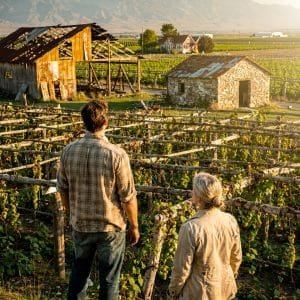
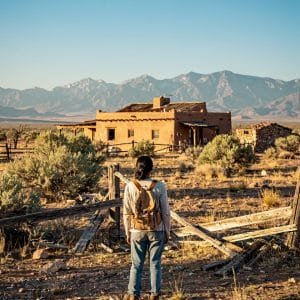
The farmhouse was substantial — two stories of basalt stone construction, the kind of building that takes a long time to build and lasts for a very long time after. The processing room was attached on the north side — same stone construction, a single door with a padlock that had rusted shut over seven years of weather.
The field behind the farmhouse was what I had come to see.
Linda and I walked to the edge of it.
It looked like an overgrown field — weeds, seven years of volunteer grass and forb growth covering whatever was beneath.
I crouched down.
I pushed aside the surface growth near the field’s edge.
Beneath the weeds, emerging from the soil in the thin October light, were crocus leaves.
Thousands of them.
The Crocus sativus bulbs — planted by whoever had farmed this land before the abandonment, dormant through seven years of neglect — had not died.
They had waited.
They were coming up.
Linda crouched beside me.
She looked at the emerging leaves for a long moment.
“They’re there,” she said.
“They’re there,” I said.
She was quiet.
Then she said: “They came back.”
“Saffron crocus are persistent,” I said. “The bulbs reproduce underground even without cultivation. Seven years of dormancy and they’re still producing corms, still coming up in October the way they’re supposed to.”
Linda looked at me.
“You came back too,” she said.
I did not say anything.
She stood up.
“Let’s look at the farmhouse,” she said.
The farmhouse was structurally sound — the stone had done what stone does, which is remain solid while the wood components around it aged and required attention. The interior needed work — plaster, floors, the kitchen that had been updated at some point in the 1980s and had not been updated since — but the bones were there and they were good bones.
The processing room door took a locksmith from Colfax three days to get open — the padlock mechanism had corroded internally and had to be drilled rather than picked.
Three months after the auction, Linda and I were there when the locksmith finally got the door open.
The processing room was exactly as it had been left seven years earlier.
A stone room, perhaps twelve by sixteen feet, with a low ceiling and a north-facing window that provided the cool diffuse light appropriate for saffron processing. Along the south wall, wooden shelving held equipment — drying racks, the small tools of saffron harvest, containers of various sizes.
On the central work table, left there seven years ago when the farm had been abandoned, was an object that neither Linda nor I had expected.
A wooden box, the size of a shoebox, with a handwritten label.
The label said: For whoever comes next.
Inside the box was money — forty-four thousand dollars in banded bills, dry and intact.
And a letter.
The letter was from a woman named Yuki Tanaka.
She wrote that she had planted the first saffron corms in 1998 and had farmed the twenty-two acres for twenty years, developing cultivation techniques specifically adapted to the Palouse climate. She wrote that she had retired not because the farm had failed but because she had no children and no one to pass it to and her body had stopped being able to do the work.
She wrote that she had locked the processing room and put the money in the box and left the letter because she believed, with the specific faith of someone who has spent twenty years watching things come back from dormancy, that the right person would come eventually.
She wrote: The bulbs will come back. They always come back — that is their nature, to return when the conditions are right. Whoever you are, the conditions were right for you to be here. Use what I have left on the farm. The corms will do the rest. They have been waiting. — Y.T.
Linda read it over my shoulder.
She was quiet for a long time.
Then she said: “She knew someone would come.”
“Yes,” I said.
“She was patient.”
“Twenty years of saffron teaches you patience,” I said.
Linda looked at me.
“So does sobriety,” she said.
The back taxes were paid the following week.
The irrigation was restored across four months.
The first harvest was the following October — three hundred and sixty-seven days after the auction, which was a coincidence I noticed and did not think was entirely a coincidence.
Saffron harvest is done by hand, flower by flower, the stigmas removed with care. It is slow, meditative work that requires presence and patience and the willingness to do a small thing carefully many thousands of times.
Linda harvested beside me.
We didn’t talk much.
We didn’t need to.
Three hundred and sixty-seven days.
The crocus came back.
I came back.
That, Linda said on the drive home, was the point.