My name is Maya Torres and I was nineteen years old, one week out of a three-week inpatient psychiatric stay, and in possession of twenty-seven dollars when I bought thirty-eight acres of abandoned sheep farm in the high desert outside Taos, New Mexico.
I am going to tell this honestly, which means telling the part that comes before the farm, because the farm doesn’t make sense without it and because I have spent enough time being careful about this particular story that the carefulness itself has started to feel like a kind of dishonesty.
I had reached a point, at nineteen, where I was not okay.
This is the simplest and most accurate way to say it. I had reached a point where the things I had been doing to manage what I was feeling had stopped working and had started making things worse, and I had reached a further point where the worse had become bad enough that I asked for help.
Asking for help was the hardest thing I had done in my life to that point. I say this not for sympathy but because it is true and because I think it matters — the asking is hard, and the hardness of it is not a character flaw, it is simply the nature of asking for something when you have spent years convincing yourself you should not need it.
I asked. I got help. I spent three weeks in a facility outside Santa Fe where the people were kind and the work was difficult and the outcome was that I came out the other side of it with tools I had not had before and a therapist named Dr. Reyes who I was going to continue seeing twice a week.
Dr. Reyes was direct and warm and honest in equal measure.
Six days before my discharge she asked me what I wanted to do when I got out.
Not what I was going to do — what I wanted to do.
I had not been asked that before. My life had been organized, for as long as I could clearly remember, around what was available rather than what was wanted, and the distinction had never seemed worth making.
“Work land,” I said, when I had thought about it honestly. “Something that grows. Something I can see change.”
She looked at me for a moment.
“Then find some,” she said.
I found the listing four days after discharge on a computer at the Taos Public Library, where I had gone because it was warm and had WiFi and because the specific comfort of libraries — their particular quality of being places where you are allowed to exist without explaining yourself — had been a reliable thing in my life.
Parcel 19B. Thirty-eight acres of high desert agricultural land outside Taos, Taos County, New Mexico. Adobe farmhouse — condition requiring assessment. Perimeter fencing collapsed in multiple sections. Well on property, condition unknown. No electrical service. No utility connections. Sheep pasture — grazing operation ceased approximately eight years prior. Stone outbuildings — two structures, condition varying. Delinquent taxes: nine thousand dollars, assumed by purchaser. Opening bid: twenty-seven dollars.
I called Dr. Reyes from the library phone.
I told her about the listing. I told her the opening bid. I told her what I had.
She was quiet for a moment.
“Go to the auction,” she said.
“The taxes are nine thousand dollars,” I said.
“I know,” she said. “Go to the auction.”
The auction was the following Tuesday at the Taos County courthouse. I borrowed a shirt from the sober living house where I was staying — a temporary housing arrangement Dr. Reyes had helped me access — and walked to the courthouse because I did not have bus fare after accounting for the twenty-seven dollars I needed to bid.
The auction room was small. The other parcels were a commercial lot in town and a vehicle. Parcel 19B was last.
The auctioneer described it. Thirty-eight acres. Adobe farmhouse. Collapsed fencing. Nine thousand in taxes. Eight years abandoned. Opening bid twenty-seven dollars.
I raised my hand.
“Any advance on twenty-seven?”
The man who had bid aggressively on the commercial lot looked at the description on his sheet and looked away.
“Sold.”
I walked to the property.
Four miles from the bus stop on a New Mexico October afternoon — the high desert air clear and cold at altitude, the Sangre de Cristo Mountains visible to the east, the sage and juniper covering the lower slopes in the way they have covered them for a very long time.
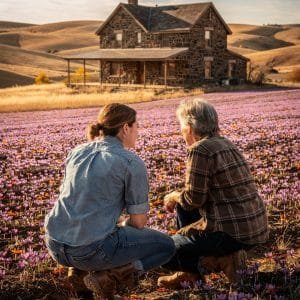
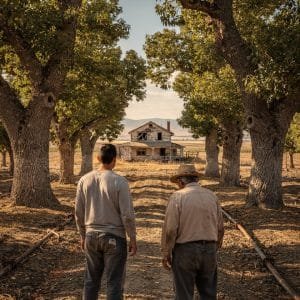
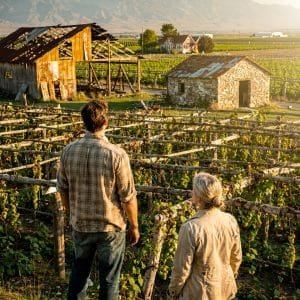
The farm came into view from a rise — thirty-eight acres of flat and gently sloping land, the adobe farmhouse at the near edge, low and substantial in the way of adobe construction that was built for the climate, the collapsed fence lines visible across the property, the two stone outbuildings behind the house, and beyond all of it the high desert opening toward the mountains.
I stood in the middle of the property for a long time.
The silence was the Taos silence — not empty, but full of things that were not human. Wind in the sage. A hawk somewhere above. The specific quality of high altitude light that makes everything look more itself.
I understood, standing there, that this was where I needed to be.
Not in the way of certainty about what came next. In the way of knowing that this was the right ground to stand on while figuring out what came next.
Dr. Reyes came the first weekend — she had offered, and I had accepted because I was wise enough, seven days out of the hospital, to accept help when it was offered sincerely. She walked the property with me and asked questions and helped me make the list of immediate priorities that the next months would work through.
She came back the second weekend with her truck loaded with supplies she had purchased and refused to let me reimburse, which I accepted with the specific grace of someone who is learning that receiving help is a skill that requires practice.
The work was what Dr. Reyes had prescribed — physical, visible, requiring presence. I rebuilt fence lines, which is meditative work, the kind that keeps the hands busy and leaves the mind free to work through things at its own pace. I assessed the farmhouse, which was structurally sound — adobe construction of the right age and quality is among the most durable building material in the Southwest, and this farmhouse had been well-built. I got the well running, which required a new pump and a day of very wet trial and error.
I was two months in when I started on the farmhouse interior.
The adobe walls needed replastering in sections — areas where moisture had gotten behind the plaster and caused it to fail. I was working on the interior of the east bedroom wall when my trowel, going deeper than the surface plaster to the base coat beneath, hit something solid.
Not the adobe. Something inside the adobe.
I cleared around it carefully.
A tin container — rectangular, approximately eight inches by five inches by three inches deep, the kind that might have held tobacco or coffee in an earlier era, sealed with what had been wax and had hardened into something more permanent over the decades.
I brought it outside.
I called Dr. Reyes.
She drove out that afternoon.
We opened it together at the kitchen table — the kitchen table I had salvaged from a Taos secondhand store and that was the first piece of furniture in the farmhouse that was mine.
Inside the tin were three things.
The first was money — old bills, dry and preserved in the tin, banded in a rubber band that had long since lost its elasticity but held its position. We counted: twenty-two thousand dollars.
The second was a small pouch — leather, worn soft with age — containing turquoise. Six pieces, rough-cut, the deep blue-green of New Mexico turquoise from the high desert mines. Dr. Reyes, who was from New Mexico and knew something about this, was quiet for a moment when she looked at them.
“These are old,” she said. “Good quality. The kind that don’t come out of the commercial mines anymore.”
The third was a folded piece of paper.
The handwriting was careful and old, in Spanish and English in alternating sections — the writer moving between languages the way people do when they are most comfortable in both.
The name at the bottom was Rosario Mendez.
She wrote that she had farmed this land for forty years with her husband and that he had died young and that she had continued alone for twenty years after. She wrote that she had put what she had saved in the wall because the wall was solid and she trusted it. She wrote that the turquoise had come from the land itself — found on the property over forty years of working it.
She wrote, in the English sections: This land is good land. It wants to be worked. Whoever finds this needed it or they would not have come here. Use it well. The desert will teach you the rest if you are willing to learn. — R.M.
Dr. Reyes read it quietly beside me.
I sat with it for a long time.
Twenty-seven dollars and three weeks out of a hospital and thirty-eight acres of New Mexico high desert.
Rosario Mendez had farmed it alone for twenty years.
I had the rest of my life.
The back taxes were paid the following week.
The farmhouse is replastered and warm.
The fence lines are rebuilt. Six sheep arrived in the spring — a small start, the right start — and the thirty-eight acres are working again for the first time in eight years.
Dr. Reyes comes on the first Saturday of every month.
She drinks coffee at the kitchen table and asks the questions that keep me honest.
The turquoise sits on the windowsill where the morning light finds it.
I am twenty-one years old.
I am exactly where I need to be.