My name is Lucas Reyes and I was twenty-five years old, sleeping in a 10×10 climate-controlled storage unit in a facility outside Stockton, California, when I bought thirty-one acres of abandoned walnut orchard in San Joaquin County for forty dollars.
The storage unit was Unit 47 at Valley Safe Storage on Eight Mile Road. It cost forty dollars a month — the same forty dollars, it would turn out, as the auction opening bid, a coincidence I have thought about more than is probably rational. It was climate-controlled, which mattered because October in the Central Valley is still warm and a non-climate-controlled unit would have been difficult. It was 10×10, which was enough space for a sleeping pad, a camping lantern, a folding chair, a box of clothes organized by type, and a small battery-powered radio that I kept tuned to the agricultural news channel because listening to the crop reports had given me something to pay attention to in the hours when paying attention was required.
The manager of Valley Safe Storage was a man named Earl Dunning — sixty-one, from Fresno originally, a man who had managed this facility for twelve years and who had, in those twelve years, developed an understanding of the situation of the people who used self-storage that was both practical and humane. He had noticed what I was doing in Unit 47 — he was not a man who missed things — and had not said anything, which was a form of kindness I recognized and did not take for granted.
I had lost my apartment, my job as a forklift operator at a Stockton distribution center, and most of my possessions in a six-week period the previous spring. The job had gone first — a workforce reduction, not performance-related, but the outcome was the same. The apartment had followed when the two months of savings I had ran out. The possessions had been sold in stages to extend the savings. What remained was what fit in Unit 47 and forty dollars.
The listing had been on the San Joaquin County surplus property site for three weeks with no bids.
I had found it on a library computer — the Stockton Public Library, which opened at nine and closed at eight and was, on the days when the storage facility felt smaller than it was, a reliable alternative.
Parcel 22A. Thirty-one acres of agricultural land in San Joaquin County, outside Lodi. Farmhouse — 1950s construction, condition derelict. Equipment shed — condition poor. Irrigation infrastructure — collapsed, requiring full replacement. Walnut orchard — California black walnut and English walnut varieties, operation ceased approximately eight years prior, trees unmanaged. Delinquent taxes: eight thousand dollars, assumed by purchaser. Opening bid: forty dollars.
I looked at the opening bid for a long time.
Forty dollars.
I had forty dollars.
Not approximately forty dollars. Not close to forty dollars. Forty dollars in two twenties in my wallet, which was the money I had set aside for the month’s storage unit fee.
I sat in the library for a long time.
Then I called the county office.
The listing had been up for three weeks. No bids. The auction closed the following morning at ten.
I called Earl from the library phone.
“Earl,” I said. “I need to ask you something.”
I explained the situation.
Earl was quiet for a moment.
“You’re going to use this month’s storage fee to bid on a walnut farm,” he said.
“Yes.”
“And if you win, you won’t be able to pay the storage fee.”
“Correct.”
“And if you don’t win, you’ll have forty dollars and nowhere to be.”
“Also correct.”
He was quiet again.
“I’ll drive you,” he said.
The auction was the following morning at the San Joaquin County courthouse in Stockton. Earl drove me in his truck, which was a 2004 Silverado that he had maintained with the specific care of a man who believes in taking care of what he has. He wore a clean shirt. I wore my best clothes from the box in Unit 47.
Parcel 22A came up at nine forty-five.
The auctioneer described it. Thirty-one acres. Derelict farmhouse. Collapsed irrigation. Eight thousand in taxes. Eight years since last operation. Opening bid forty dollars.
I raised my hand.
The auctioneer looked at me.
“Any advance on forty?”
A man in the back of the room looked at his phone. A contractor near the front shook his head slightly — not bidding, just noting something.
“Forty dollars going once. Twice.”
“Sold.”
Earl put his hand on the back of my chair.
That was all.
He drove me to the property that afternoon.
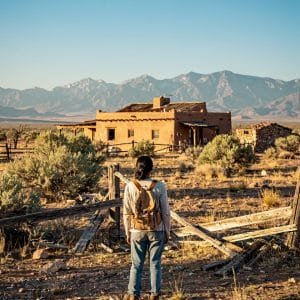
The access road ran through Lodi wine country before turning onto the agricultural land, and the orchard came into view as we came over a small rise — thirty-one acres of walnut trees, the canopy enormous and spreading in the way of trees that have been growing for decades without anyone telling them to stop, the orchard floor deep in shadow even in the October afternoon, the collapsed irrigation pipes visible at intervals between the rows.
Earl got out of the truck.
He stood at the edge of the orchard and looked at the trees.
“Those are old,” he said.
“English walnuts can live for a hundred years,” I said. “Some of these look older.”
He looked at the trunk nearest him — the massive gray bark, the spread of the canopy.
“I grew up in the Valley,” he said. “I know what walnut land is worth.”
He looked at me.
“You’re going to be okay,” he said.
It was the first time in two months that I had believed that might be true.
Six weeks of work followed — living in the farmhouse, which was sound despite its derelict appearance, and working the property with Earl beside me on weekends and occasional weekdays when the storage facility was quiet enough to leave in the care of the automated gate system.
The walnut trees were the revelation.
I had known they were old from the trunk diameter. What I had not fully understood was what old walnut trees represented in terms of value — the specific, irreplaceable value of trees that take decades to reach production maturity and that cannot be replicated by planting new ones and waiting. English walnuts of the age and size present in Parcel 22A were not just a crop. They were capital. Permanent, living capital that had been growing in this San Joaquin County soil since before I was born.
The collapsed irrigation was the primary challenge — without water, the trees were living on whatever the water table provided, which was sustaining them but not enabling production. I learned irrigation from a retired agricultural engineer named Patricia who Earl knew and who agreed to consult for a rate I could manage.
We were six weeks in, clearing the collapsed irrigation infrastructure from the orchard floor — pulling old pipes that had been in the ground since the 1970s — when my shovel caught.
The resistance was not the resistance of a root or a rock.
I cleared around it with my hands.
Metal. A flat surface. Buried intentionally — the soil above it was distinguishable from the surrounding soil in the way that disturbed and resettled soil is distinguishable from undisturbed soil.
Earl was twenty feet away.
“Earl,” I said.
He came over.
He looked at what I had uncovered.
“That’s been there a while,” he said.
We cleared it fully. A metal chest — approximately two feet by one foot by one foot, the kind of heavy gauge steel that was manufactured in the mid-twentieth century and that was built to last. No lock. Two latches that had seized with rust but freed with patient work.
Inside the chest were three things.
The first was money — banded bills, old and dry, preserved by the steel and the depth of the burial. We counted it three times. Fifty-eight thousand dollars.
The second was a leather pouch containing a collection of items I did not initially understand — small metal tags, stamped with numbers, attached to wire loops. Earl, who had grown up in the Valley and knew agricultural history, identified them immediately.
“Tree tags,” he said. “They used to tag individual trees when they were registered varieties. These are registration tags.” He turned one over. “These are from the 1940s.”
The third was a letter, handwritten on stationery that had been sealed in a wax paper envelope inside the chest, preserved.
The writer’s name was Harold Watanabe.
He wrote that he had planted the first trees in 1941 — the year before the internment, the year before everything changed. He wrote that he had come back to the farm after the war to find the trees still growing, which was more than he had found of much else. He wrote that he had farmed for thirty years more, until he could not, and that he had put what he had saved in the ground because the ground was what he trusted.
He wrote: These trees outlasted everything that tried to stop them. They will outlast you too, if you take care of them. Whoever finds this — take care of the trees. They have been waiting a long time for someone to tend them again. They are patient. Be patient with them. — H.W., 1975.
Earl read it over my shoulder.
We were both quiet for a long time.
I looked at the orchard — Harold Watanabe’s trees, planted in 1941, surviving what was asked of them, growing for eighty years through everything that had happened in those eighty years and waiting, patient as Harold had said, for someone to come back to them.
I had come back with forty dollars.
Earl put the letter carefully back in its wax paper envelope.
“That’s a good letter,” he said.
“Yes,” I said.
He looked at the trees.
“He would have been glad to know they’re still here,” he said.
“I think so too,” I said.
The back taxes were paid the following week.
The irrigation was restored in three months.
The first harvest was the following October — not full production, the trees responding to restored irrigation and care, but enough. Enough to establish the relationships with the walnut buyers that would grow in subsequent seasons. Enough to understand what Harold Watanabe had understood in 1941 when he planted the first trees in San Joaquin County soil.
Earl retired from Valley Safe Storage in January.
He manages the orchard now.
He comes every day.
He says it’s the best job he’s ever had.
I think Harold Watanabe would approve.