My name is Sarah Kowalski and I was twenty-seven years old, sixty-one days clean, and in possession of fifty-two dollars when I bought forty-five acres of abandoned peach orchard in the Texas Hill Country outside Fredericksburg.
I want to tell you something about sixty-one days clean because I think people who haven’t been there misunderstand what it means. It doesn’t mean you’re fixed. It doesn’t mean the thing that broke you has been repaired. It means you’ve had sixty-one days of choosing differently than you chose before, and that each of those days required a choice, and that you made it, and that you’re going to have to make it again tomorrow.
Sixty-one days felt, to me, like a different country.
I had been in a residential treatment program in San Antonio for ninety days. Before that I had been, for approximately three years, a person I didn’t recognize and don’t want to describe in detail here because she belongs to a chapter I have closed and locked and don’t intend to reopen for the purposes of this story. What I will say is that the three years cost me my apartment, my job, two significant friendships, and very nearly my life, and that the ninety days in treatment had been, in ways I was still understanding, the most important ninety days of my life.
My sponsor was a woman named Linda Reyes — sixty-two years old, twenty-eight years sober, a retired schoolteacher from Kerrville who had the specific quality of someone who has been through the worst of themselves and has come out the other side with patience for others who are doing the same. She said hard things without cruelty. She showed up when she said she would. She had given me her number the first week of treatment and had used it thirty-seven times since.
I had forty-seven dollars when the center discharged me. Five more in a jacket pocket. Fifty-two total.
I had a two-week reservation at a sober living house in Kerrville — a transitional housing program that cost two hundred dollars a week that Linda had helped me arrange and that was funded through a combination of a small recovery grant and money Linda had put in without telling me until after the fact.
The county listing for Parcel 11C appeared on my screen on a Thursday morning when I was sitting in the sober living house common room using the shared computer because I did not yet have a phone.
Forty-five acres of Hill Country agricultural land outside Fredericksburg. Derelict farmhouse, 1950s construction, condition poor. Smokehouse and equipment shed on property. Well, condition unknown. No utilities. Peach orchard — commercial production ceased approximately eleven years prior. Delinquent taxes: eleven thousand two hundred dollars, assumed by purchaser. Opening bid: fifty-two dollars.
I called Linda from the house phone.
She picked me up at noon.
We drove to a diner outside Kerrville that she liked and I showed her the listing on my phone.
She read it.
She looked at the photograph — forty-five acres of peach trees in late October, the leaves mostly down, the rows visible through eleven years of growth, the trees gnarled and heavy with neglected wood but standing, all of them standing.
“Opening bid fifty-two dollars,” I said.
“I can see that,” she said.
“The taxes are eleven thousand.”
“I can see that too.”
“I have fifty-two dollars.”
She set my phone down.
She looked at me the way she looked at me when she was deciding something.
“You know what I think?” she said.
“What?”
“I think land doesn’t care what you’ve been,” she said. “Land just cares what you do next.”
I looked at the photograph.
“I think if you go to that auction,” she said, “and if nobody else bids forty-two dollars on forty-five acres of Hill Country, and if you find yourself owning a broken-down peach orchard with eleven thousand dollars in back taxes and nowhere to live — I think that might be the first useful thing that’s happened to you in three years.”
She picked up her coffee.
“I’ll drive you,” she said.
The auction was on a Friday at the Gillespie County courthouse in Fredericksburg. Linda drove. I wore my best clothes, which were the clothes I had arrived at the treatment center in and had washed since. The room was small — a few contractors, a couple of Hill Country landowners, the general population of people who attend county auctions because they know what things are worth and are looking for discrepancies.
Parcel 11C came up.
The auctioneer described it without enthusiasm. Forty-five acres. Derelict structure. No utilities. Eleven thousand in taxes. Eleven years since commercial production. Opening bid fifty-two dollars.
The room was quiet.
I raised my hand.
“Fifty-two. Any advance?”
A man in the back looked up from his phone, considered, looked back down.
“Sold.”
Linda drove out with me that afternoon.
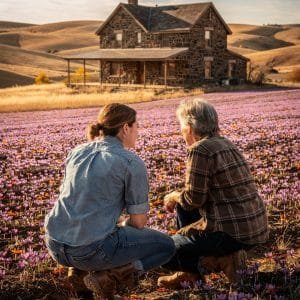
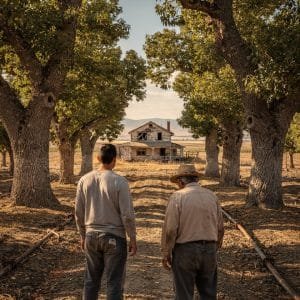
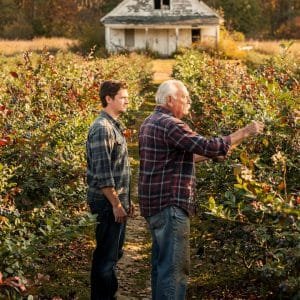
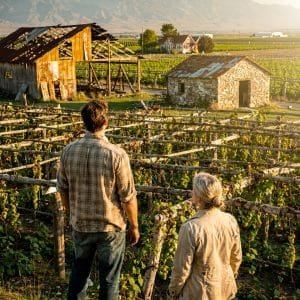
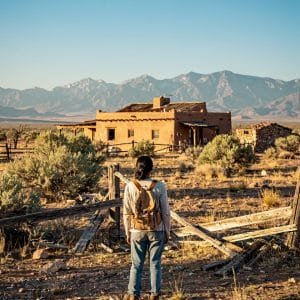
The access road wound through Hill Country cedar before opening onto the property — the farmhouse first, low and listing in the way of structures that have been making small concessions to gravity for years, and then the orchard, visible from the house as a slope of gnarled peach trees running south in imperfect rows that eleven years of growth had obscured but not erased.
Linda stood at the fence and looked at the trees.
“They’re alive,” she said. She sounded surprised.
“Peach trees are stubborn,” I said. “Cold hardy, drought tolerant. You can neglect them for years.”
“So are you,” she said. “That hasn’t always been a good thing.”
“Maybe it will be now,” I said.
She looked at me.
Then she nodded once — the specific nod of someone who has decided to believe something and means it.
Linda drove back to Kerrville that evening. I slept in the farmhouse — the east room was sound, the roof held, the October nights were cold but manageable with the sleeping bag from the sober living house that Linda had put in the back of her truck without asking me.
The months that followed were the first months in four years that I went to sleep tired from work rather than from the other thing. Linda came on weekends. I learned the property — the well needed a new pump, the irrigation was damaged but not beyond repair, the farmhouse was structurally sound beneath the cosmetic deterioration. I learned peach trees — their specific needs, their seasonal rhythms, the pruning that eleven years of neglect had made necessary and that I found, in practice, to be meditative in the way that precise physical work can be meditative.
I was five months in when the smokehouse floor gave way.
The smokehouse was a small stone structure on the north side of the property — perhaps twelve by fourteen feet, original to the 1950s farmstead, with a wood-plank floor laid over a shallow crawl space. I had been using it for tool storage and had been meaning to address the floor, which had soft spots I had noted and not yet dealt with.
On a March afternoon I stepped on the wrong spot.
The board gave way.
I dropped through it — not far, eighteen inches into the crawl space below — but far enough that when I got my bearings and found my flashlight I was looking at the crawl space from inside it.
And the crawl space was not empty.
In the far corner, against the stone foundation wall, wrapped in a tarp that had been secured with rope and further protected by a wooden crate that had been placed over it, was a package approximately the size of two shoeboxes.
I called Linda from the property.
“I fell through a floor,” I said.
“Are you hurt?”
“No. But Linda — there’s something down here.”
She drove out that evening.
We opened the package together in the fading March light outside the smokehouse, sitting on the ground because there was nowhere else to sit.
Inside the tarp was a metal document box, sealed with a combination lock whose combination — written in pencil on a piece of paper taped to the underside of the wooden crate — was 1952. The year, a search would later confirm, that the farmhouse had been built and the orchard planted.
Inside the box was money and a letter.
The money was forty-eight thousand dollars in banded hundreds, dry and intact.
The letter was written in 1993 — the year the box had apparently been sealed, based on a dated newspaper page that had been used as additional wrapping.
The writer’s name, given at the end, was Roy Tanner.
He wrote that he had farmed the orchard for forty-one years. He wrote that he had saved what he could because he did not trust banks after his father had lost everything in 1933 and that this distrust had shaped his financial habits for sixty years. He wrote that he had no children and that the farm would pass to the county when he was gone, as he understood it, and that he was putting what he had saved somewhere it would be found by whoever came next.
He wrote: I don’t know who you are. I know you bought something nobody else wanted and that probably means you needed it. Use this on the orchard. The trees are good trees if you treat them right. I planted them in 1952 and they’ve never let me down. Don’t let them down either. — R.T.
Linda read it over my shoulder.
She was quiet for a long time.
Then she said: “Land doesn’t care what you’ve been.”
“No,” I said. “It doesn’t.”
She put her hand on my arm.
I sat in a March Texas evening on forty-five acres that Roy Tanner had farmed for forty-one years and I thought about 1952 and sixty-one days and the specific arithmetic of what it costs to keep choosing differently.
The back taxes were paid the following week.
The orchard is in its second year of serious restoration.
Linda comes on Saturdays.
I am eight hundred and thirty-two days sober.
The peach trees, which are stubborn and do not care what you’ve been, bloomed in April for the first time in eleven years.
I stood in the rows in the Hill Country morning and let them.