My name is Jake Calloway and I was twenty-four years old, sleeping in a 2003 Dodge Ram with a cracked windshield and a heater that made a sound like it was considering quitting every time I turned it on, when I spent my last forty-one dollars on thirty-four acres of abandoned lavender farm in the Sequim Valley of Washington State.
I want to be honest about the decision because I have told this story enough times now that it has developed a shape that makes it sound more intentional than it was. The truth is simpler and less flattering: I had forty-one dollars and the opening bid was forty-one dollars and I had been sleeping in a truck for six weeks and the county surplus website had a photograph of thirty-four acres of purple and I needed something to point myself toward or I was going to stop pointing myself anywhere.
That was the decision. That was all of it.
I had worked landscaping for three years in the Port Angeles area — outdoor work, physical work, the kind that leaves you tired in a satisfying way and that I had been good at and that had been, until September, reliable. The company closed without warning on a Thursday. Paychecks for the previous two weeks were not honored. The owner was unreachable in the specific way of people who have decided that their obligations are optional.
I had been in the Dodge Ram since then.
Six weeks. Truck stop showers on the days I could afford the four dollars. The Sequim Public Library for WiFi and warmth during open hours. A rotation of parking lots — the Walmart, the rest stop on 101, the church lot on Bell Street where nobody asked questions if you were gone by seven in the morning. The specific arithmetic of a person who has no margin: gas calculated to the mile, food calculated to the calorie, every decision passing through the filter of what it cost.
My brother Danny was twenty-seven and lived in Sequim with his girlfriend in a two-bedroom apartment that had a couch he had offered and that I had declined because his girlfriend had not been enthusiastic about the offer and because I have a stubbornness about being a burden that has complicated my life on multiple occasions.
I found the listing on a Thursday morning on the Clallam County surplus property website.
Parcel 8B. Thirty-four acres of agricultural land in the Sequim Valley, two miles north of town. Farmhouse structure, estimated 1940s construction, partial foundation issues noted. Collapsed greenhouse on eastern portion of property. Well on property, condition unknown. No electrical service. Lavender cultivation — commercial production ceased approximately nine years prior, current condition unassessed. Delinquent property taxes: eight thousand one hundred dollars, assumed by purchaser. Opening bid: forty-one dollars.
One photograph.
Thirty-four acres of lavender in what appeared to be late summer bloom — overgrown, unpruned, the rows barely distinguishable under nine years of unchecked growth, but purple. Intensely, improbably purple.
I called Danny.
“There’s an abandoned lavender farm,” I said. “Thirty-four acres in the valley. Opening bid forty-one dollars.”
Silence.
“Cole,” he said.
“I have forty-one dollars.”
“The taxes are eight thousand.”
“Eight thousand one hundred.”
“You’re sleeping in your truck.”
“I know.”
A longer silence.
“Don’t do it,” he said.
“I’m going to do it,” I said.
“Cole—”
“It’s lavender, Danny. Lavender doesn’t die. It’s one of the hardest plants there is. Nine years abandoned and it’s still purple in the photograph.”
He exhaled slowly. “When’s the auction?”
It was that afternoon, at the Clallam County courthouse in Port Angeles. I wore my one clean flannel shirt and arrived twenty minutes early and sat in a folding chair while other parcels were dispensed with by people who had Carhartt jackets and clipboards and the general manner of people for whom county auctions were a regular professional activity.
Parcel 8B came up.
The auctioneer read the description without enthusiasm. Thirty-four acres. Collapsed greenhouse. No utilities. Eight thousand in taxes. Nine years since commercial production. Opening bid forty-one dollars.
The room was quiet.
I raised my hand.
“Forty-one. Any advance?”
Nobody moved.
“Sold.”
I signed papers at a folding table and walked out owning thirty-four acres of Sequim Valley lavender farm that nine years of abandonment had not managed to k.ill.
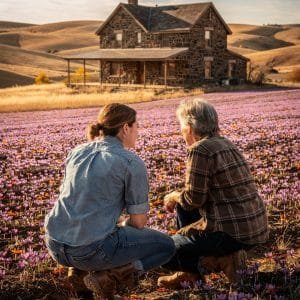
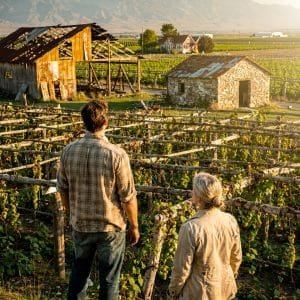
Danny drove out with me that afternoon. The access road ran along an irrigation canal before turning uphill to the property, and the farm came into view as we crested the rise — thirty-four acres of lavender rows running down both sides of a gentle slope, unpruned and overgrown and crowded with nine years of unchecked growth but alive, every plant alive, the late October light catching the dried purple heads in a way that made them look like they were waiting.
The farmhouse was worse than the photographs. The foundation issues noted in the listing were visible — the northeast corner had settled and the house listed slightly in that direction, giving it the appearance of something that had been leaning into the prevailing wind for so long it had forgotten how to stand straight. The greenhouse on the east side was completely collapsed — the aluminum frame had failed and the glass panels were in pieces on the ground, covered in moss and volunteer plants that had decided the collapsed structure was a reasonable place to grow.
Danny stood at the top of the slope looking at all of it.
“The greenhouse is completely gone,” he said.
“I can see that.”
“The house is leaning.”
“It’s been doing that for nine years. It’s still standing.”
He looked at the lavender. He was quiet for a moment.
“It really is still alive,” he said.
“Lavender is hard to k.ill,” I said. “Drought tolerant, pest resistant, the roots go deep. You can neglect it for years and it comes back. It wants to grow.”
He turned and looked at me.
“What are you going to do?” he said.
I looked at thirty-four acres of lavender that had been waiting for nine years for someone to come back to it.
“I’m going to bring it back,” I said.
He was quiet for a long moment.
Then he went to his truck and came back with two sleeping bags, a case of water, and a box of groceries he had stopped to buy on the way without telling me.
“Fine,” he said. “But this is genuinely insane and I want that on record.”
“Noted,” I said.
We slept in the farmhouse the first night — the east wing was stable enough, the sleeping bags were warm enough, and the specific satisfaction of lying in a building on land that was mine was worth the cold floor and the sound of the wind finding its way through the places where the siding had separated.
The work that followed was the most purposeful work I had done since losing the landscaping job. Danny came on weekends. I worked the farm during the days — clearing the overgrowth from the lavender rows, which was slow and physical and smelled extraordinary, the nine-year accumulation of dried lavender releasing as I worked through it. I learned the property — the well that needed a new pump, the irrigation system that was damaged in sections but largely intact, the farmhouse that needed specific and addressable repairs rather than the complete rebuild I had feared.
The lavender responded.
This is the thing about lavender that I had known professionally and understood differently once I was working it daily: it is not passive. It does not merely survive neglect — when the neglect is removed and the care begins, it responds with something that feels, if you are inclined to anthropomorphize, like gratitude. The pruning I did in the first weeks revealed healthy growth beneath the overgrowth. The irrigation I restored brought visible change within days.
The plants wanted to come back.
In week seven Danny and I were working on the farmhouse foundation — assessing the northeast corner settlement, trying to understand what had caused it and what could be done — when we found the root cellar.
It was not unusual for a 1940s farmhouse to have a root cellar. What was unusual was that this one had been sealed — the wooden access door in the foundation had been covered by a concrete block that had been mortared into place deliberately, in a way that was clearly intentional rather than accidental.
Danny and I looked at the sealed door for a while.
“That’s been there a long time,” Danny said.
“Yes,” I said.
“Should we—”
“Yes,” I said.
We broke the mortar with a cold chisel. It took two hours. The door beneath was original wood — old-growth fir, dry and intact despite the years, the kind of wood that was built to last and had.
Below the door was a root cellar approximately ten by twelve feet. Stone walls. Earthen floor. The smell of old earth and something else — dried lavender, years of it, the smell baked into the stone by decades of proximity to the farm above.
In the center of the floor, wrapped in canvas that had been treated with something that had preserved it against moisture, was a wooden chest approximately the size of a hope chest.
It was not locked.
Inside were three things.
The first was money — banded bills, old but intact, the bands crumbling to dust when I touched them but the bills themselves preserved by the canvas wrapping and the sealed cellar. We counted it three times. Sixty-two thousand dollars.
The second was a leather journal, handwritten, dating from 1947 through 1981 — thirty-four years of the farm’s operation recorded in the careful hand of a woman named Harriet Bloom, who had planted the original lavender in 1947 with cuttings she had brought from her mother’s garden in Oregon and who had operated the farm for thirty-four years alone after her husband’s early death.
The third was a letter, addressed to nobody, dated 1981 — the year the journal ended, the year, a brief search would later tell us, that Harriet Bloom had died.
The letter said: I have had thirty-four years on this land and the lavender has never failed me though I have sometimes failed it. Whoever comes next — the land chose you for a reason. The lavender wants to be tended. Tend it and it will give back more than you give. Use what I am leaving on the farm. That is what it is for. — H.B.
Danny read it over my shoulder.
We sat in the root cellar of a 1940s farmhouse on thirty-four acres of Sequim Valley for a long time without speaking.
The sixty-two thousand dollars paid the delinquent taxes and funded the first season of serious restoration — irrigation repair, greenhouse reconstruction, soil amendment, the infrastructure that a working lavender farm requires. I hired a lavender specialist named Carol from the WSU extension program who walked the rows and told me I had heritage varieties that commercial farms had largely abandoned and that had, if I was patient, significant market value.
Danny moved into the east wing of the farmhouse in December.
The first harvest was the following August — not full production, not yet, but enough. Enough to sell at the Sequim Lavender Festival, enough to establish relationships with three distilleries interested in lavender essential oil, enough to understand that Harriet Bloom had been right.
The lavender wanted to be tended.
I tend it.
Every morning in the growing season I walk the rows — thirty-four acres, the original varieties Harriet brought from her mother’s garden in Oregon, the heritage plants that commercial farming had left behind — and I think about a woman who farmed alone for thirty-four years and left what she had for whoever came next.
I came next.
I am trying to be worth the leaving.