My name is Daniel Marsh and I was twenty-eight years old when my restaurant failed, which is not an unusual thing to happen to a restaurant — the industry’s failure rate is what it is and I had known the statistics when I went in and had believed, with the specific confidence of someone who has not yet failed at something significant, that I would be an exception.
I was not an exception.
The restaurant was called Threshold. It was in Seattle’s Capitol Hill neighborhood, ninety seats, a menu organized around Pacific Northwest ingredients treated with the specific attention of a chef who had spent four years cooking in serious kitchens and had developed opinions about what food should do. My business partner was a man named Kevin who was better at the front of the house than anyone I had worked with and who had the investor relationships that made the opening possible.
Threshold opened in March and closed in September of the following year, eighteen months from the first service to the final one. The gradually part was the second year — the numbers that did not quite work despite everything we tried. The suddenly part was the Thursday morning Kevin and I sat across from each other with the bank statements and understood simultaneously that the math had run out.
Kevin said, when we signed the dissolution papers, that I had a problem with knowing when to quit.
He said it without cruelty — he was not a cruel man and he meant it as an observation rather than a criticism. He was probably right. I had stayed in the gradually part longer than the numbers warranted because I believed in what we were doing and because I had not yet developed the specific wisdom that distinguishes persistence from stubbornness.
I drove east from Seattle on a Thursday with no destination.
Just east. Through the Cascades and down into the Yakima Valley, which I knew from the ingredients — Yakima hops, Yakima apples, the specific agricultural geography of a valley that feeds a significant portion of what gets cooked and brewed in the Pacific Northwest.
I stopped in Ellensburg because I needed WiFi and the library was open.
The Yakima County surplus property listing was the third thing I found when I searched, without a clear purpose, for land in the county.
Parcel 7B. Fifty-two acres in the Yakima Valley, eight miles from Yakima proper. Farmhouse, derelict. Hop drying barn — structure collapsed in sections, foundation intact. Kilning house — stone construction, condition requiring assessment. Trellis system — original wood and wire, condition unassessed. Well on property. No utilities. Hop cultivation — Yakima Valley hop varieties, operation ceased approximately nine years prior. Delinquent taxes: ten thousand dollars, assumed by purchaser. Opening bid: forty-four dollars.
I had forty-four dollars.
I called the county office.
The auction closed the following day at two.
I drove to Yakima.
I was at the courthouse at noon, which was two hours early, which gave me time to sit in the parking lot and have the specific internal argument of a person deciding whether to do something inadvisable.
The argument resolved itself, as these arguments usually resolved themselves for me, in favor of doing the inadvisable thing.
Nobody bid against me.
Forty-four dollars.
Fifty-two acres of Yakima Valley.
I drove to the property that afternoon and parked at the road and got out and stood at the fence line.
The hop yard was the first thing that registered — the trellis system, which ran in rows across the flat valley land in the way of hop yards, with the specific geometry of something designed for a plant that grows vertically and requires infrastructure to do it. The trellises were old and weathered and the wire in sections had failed and the bines — the hop plants themselves — had covered everything in nine years of unpruned growth, climbing the trellises and then each other and then sprawling across the ground in the areas where the trellises had failed.
But they were alive.
All of them. Nine years of neglect and every plant alive, the rhizomes deep in the Yakima Valley soil, growing whether anyone tended them or not because hops, once established, do not give up.
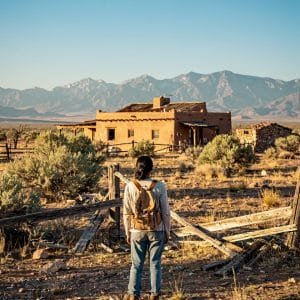
The collapsed drying barn was behind the hop yard — three of four walls standing, the roof failed and mostly on the ground inside, the stone kilning house adjacent and intact, its stone construction having outlasted the wood of the drying barn.
The farmhouse was functional, if barely.
I was looking at all of it when the pickup truck slowed.
Patricia Whitman was fifty-four years old and had grown up on the adjacent farm — her parents had grown hops there for thirty years and she had continued after them, running the operation herself for the past decade. She had watched the Whitman place — her late uncle’s farm — sit empty for nine years with the specific discomfort of a person who understands what productive land looks like when it is not being used.
She asked if I knew anything about hops.
I told her I knew how to use them.
She told me that was not the same thing.
I told her she was right and asked if she would show me the difference.
She pulled over.
What followed across four months was the second comprehensive education of my professional life — the first had been cooking school and four years of kitchen work, and this one was Patricia Whitman teaching me hop farming with the specific no-nonsense efficiency of someone who has been doing something for thirty years and has no patience for people who don’t pay attention.
I paid attention.
The hop bines, once the nine years of overgrowth was cleared and the trellis system was repaired in sections, revealed themselves to be exactly what Patricia had suspected — heritage varieties, the older Yakima types that the large commercial operations had largely replaced with higher-yield modern cultivars and that the craft brewing industry had been seeking for a decade.
The kilning house was the project I was most invested in because it was the building that the hops would ultimately move through — the drying and processing step that transforms harvested hop cones into the ingredient that brewers buy. Stone construction, original to the farm, it was intact and required restoration rather than rebuilding.
Patricia and I were working on the kilning house floor — the original wood planking, checking it for rot — when she pulled up a section near the east wall and found the strongbox.
It was recessed into the floor joists deliberately — a space had been cut between two joists and a metal box fitted into it, secured with two bolts that had seized with age and required a half-hour of work to free.
The box was locked with a combination lock.
The combination was on a paper tag tied to the bolt — four digits, the year, Patricia told me, that her uncle had built the kilning house.
Inside the box were two things.
The first was money — forty-one thousand dollars in banded bills, old but preserved by the metal box.
The second was a leather journal — small, pocket-sized, covering the years from when the hop farm had been at its peak through the final years before it was abandoned. The journal was not a personal diary but a farming record — specific, detailed, noting the varieties planted, the yields by year, the buyers, the prices, the agricultural knowledge of thirty years of Yakima Valley hop farming accumulated in the careful hand of Patricia’s uncle.
The final entry was dated the year the farm was abandoned.
It said: The farm is good. The soil is good. The varieties are right. I am not able to continue but the land doesn’t know that. Whoever comes next — the knowledge is here. Use it. The valley will do the rest.
Patricia read it standing in the kilning house.
She was quiet for a long time.
Then she said: “He always kept better records than anyone.”
I looked at the journal — thirty years of hop farming knowledge, preserved in a locked box for whoever came next.
I had been a chef for six years.
I had failed at a restaurant.
I had forty-four dollars and fifty-two acres and a leather journal full of everything I needed to know.
I looked at Patricia.
“Show me what the journal means in practice,” I said.
She almost smiled.
“Come back tomorrow,” she said. “Early.”
I came back the following morning.
I have come back every morning since.
The hop yard is in its second year of serious restoration.
Threshold, the Seattle restaurant that failed, had three craft brewery clients who bought hops from the Yakima Valley.
All three of them are now buying from me.
The kilning house is operational.
Patricia comes every day.
She says I have finally learned the difference between using hops and growing them.
I think she might be right.