My name is Dani Kowalski and I was twenty years old, sleeping under the Monroe Street Bridge in Spokane, Washington on the nights the House of Charity shelter was full, when I bought eighteen acres of abandoned mushroom farm in Bonner County, Idaho for twenty-two dollars.
I want to be precise about the bridge because I think precision matters here more than dignity does. The Monroe Street Bridge spans the Spokane River in the center of the city, and the space beneath its eastern approach is sheltered from rain by the bridge deck and protected on two sides by the concrete abutments and has been used by people who need shelter in exactly the way I was using it since before I arrived in Spokane and will be used by people in exactly the same way long after I left.
I had been there eleven days.
I was twenty years old and seven months out of Washington State foster care — the system had released me at eighteen into a transitional housing program that had lasted fourteen months, followed by a series of situations that had each lasted less long than the previous one, following the specific downward arithmetic of a person who has no family safety net and whose margin for error is therefore zero and who makes the errors that zero margin makes inevitable.
The shelter — House of Charity on West 2nd — was the resource I had identified as the most reliable in Spokane’s network, and it was reliable, in the way of resources that serve more people than their capacity was designed for. Full three nights out of five was the average. On the full nights, the bridge.
I had been told, by people who meant well, that I needed to be practical.
I understood what practical meant in their framework: smaller goals, more achievable steps, the specific modesty of expectation that the system teaches people who have been in it.
I had twenty-two dollars and a different idea about practical.
The listing appeared on the shelter’s computer — a shared station in the resource room that was available to residents during business hours — on a Thursday morning when I had arrived early to use it before the line formed.
Parcel 3B. Eighteen acres of agricultural land in Bonner County, Idaho, outside Sandpoint. Cabin structure — one room, estimated 1970s construction, condition derelict. Well on property. No electrical service. Specialty mushroom cultivation operation — growing tunnels, three structures, polypropylene construction, structural failure in central sections. Inoculation and processing equipment on site, condition unassessed. Delinquent taxes: six thousand dollars, assumed by purchaser. Opening bid: twenty-two dollars.
I had twenty-two dollars.
I read the listing three times.
Then I looked up specialty mushroom farming.
Shiitake. Oyster. Lion’s mane. The specific market data for specialty mushrooms in the Pacific Northwest — restaurants, farmers markets, food co-ops, the growing demand from the culinary community for locally sourced specialty varieties.
Growing tunnels were repairable. The inoculation equipment on site, if functional, represented significant startup capital.
The well was on the property.
The cabin was standing.
Eighteen acres.
I showed the listing to Donna, the shelter’s resource coordinator, who was sixty and had been doing this work for twenty-two years and who had the specific quality of someone who has seen a great many situations and who reserves judgment until she has enough information.
She read it carefully.
She asked about the taxes.
I told her about the twenty-two dollars.
She looked at me for a long time — the assessing look of someone who is deciding which category a situation belongs to.
Then she picked up her phone.
Marcus arrived twenty minutes later in a blue Silverado. He was forty-eight, a retired schoolteacher from Coeur d’Alene who had been volunteering as a driver for the shelter network for three years. He asked no questions about the destination. He drove.
The auction was at the Bonner County courthouse in Sandpoint. We arrived with twenty minutes to spare. The room was small — a county meeting room with folding chairs and a clerk who processed parcels with the efficiency of someone who has processed many.
Parcel 3B was third.
The clerk described it. Eighteen acres. Collapsed growing tunnels. Derelict cabin. Six thousand in taxes. Opening bid twenty-two dollars.
I raised my hand.
The clerk looked at me.
“Any advance on twenty-two?”
The room was quiet.
“Sold.”
Marcus drove me to the property.
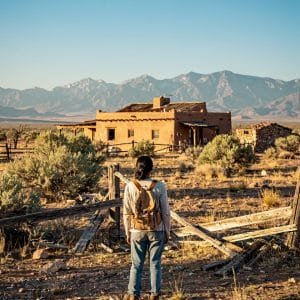
The access road was a two-track off a county road that wound through Idaho second-growth forest before opening onto the farm. The growing tunnels were the first thing visible — three long white polypropylene structures running parallel across a cleared area, each perhaps sixty feet long and twenty wide. Two of the three had failed in their centers, the polypropylene sheeting collapsed inward, the hooped metal frame bent but present. The third was damaged but largely intact.
The cabin was behind the tunnels — small, log construction, the chinking between the logs in need of attention but the structure standing. The well head was visible beside the cabin.
Marcus stood at the edge of the property and looked at the tunnels.
“I drove people to job interviews for three years,” he said. “Never drove anyone to a county auction.”
“How’d it compare?” I said.
He thought about it with the seriousness of a man who takes questions seriously.
“Better ending,” he said.
Marcus came back the following weekend. And the weekend after that. And the weekend after that. He had, in the way of people who find something that matters to them, located a purpose in the project that extended beyond driving — he was good with his hands and he had time and he had, it turned out, a specific knowledge of polypropylene construction from a home greenhouse project he had undertaken years earlier that was directly applicable to growing tunnel repair.
We repaired the tunnels across four weekends.
The third tunnel, the intact one, we cleared and assessed first — the interior was as it had been left, the growing beds still in place, the inoculation equipment along the south wall covered in dust but present.
I learned mushroom cultivation from the internet and from a mycologist named Carol at the University of Idaho extension who answered my emails with the patience of someone who believes in knowledge sharing as a fundamental good. I learned to read mycelium, to manage humidity, to inoculate substrate.
The cabin I lived in and repaired — the chinking first, the floor second, the small woodstove that became essential as the Sandpoint winter arrived.
Two months in, working on the first growing tunnel — clearing the collapsed center section to repair the frame — the floor of the tunnel gave way beneath my left foot.
Not the ground. A floor — boards, old and rotted, covering a space beneath.
I called Marcus.
He drove out that afternoon.
We cleared the boards carefully.
Below was a cellar.
Not large — perhaps ten by eight feet, dug into the hillside beneath the tunnel, lined with stone, accessed through the board floor that had been concealed beneath the growing beds. Dry, sealed by the stone and the tunnel above.
Inside the cellar were wooden shelves.
On the shelves were jars.
Hundreds of jars — glass canning jars, sealed, labeled in handwriting that was careful and specific.
Mushroom cultures.
Preserved mushroom cultures — mycelium strains, maintained in agar, sealed and labeled by species and date. The labels went back fifteen years. The most recent were six years old — the year the operation had ceased.
And on the bottom shelf, separate from the cultures, a metal box.
Inside the box — money and a letter.
The money was thirty-three thousand dollars.
The letter was from a woman named Helen Park.
She wrote that she had cultivated specialty mushrooms on this land for fifteen years and that the cultures on the shelves represented fifteen years of selecting and developing strains that were adapted to the specific conditions of the Sandpoint climate and soil — strains that were not available commercially, that she had developed herself through patient work.
She wrote that she had put the money in the box and the cultures on the shelves because she was ill and could not continue and because she did not want fifteen years of work to be lost.
She wrote: The cultures are more valuable than the money. Use both on the farm. The mycelium wants to grow — it always wants to grow. Give it what it needs and it will do the rest. Whoever you are, you found this because you needed it. I hope it’s enough. — H.P.
Marcus read it standing in the cellar with his flashlight.
He was quiet for a long time.
Then he said: “She saved the cultures.”
“Yes,” I said.
“For whoever came next.”
“Yes.”
He looked at the shelves — hundreds of jars of preserved mushroom cultures, fifteen years of patient work preserved in glass and agar and sealed against time.
“That’s a remarkable thing to do,” he said.
“Yes,” I said.
The back taxes were paid the following week.
The cultures — Helen Park’s fifteen years of adaptation work — were revived across the following months with Carol’s guidance. Of the strains on the shelves, the majority were viable. What they represented, once I understood what I had, was exactly what Helen Park had said: varieties adapted to the Sandpoint climate that were not available elsewhere, that the specialty mushroom market — the restaurants and co-ops and farmers markets of the Pacific Northwest — had not had access to.
The first harvest was in March.
Marcus left his volunteer driving work in April and came to work the farm full time.
He said it was the best decision he’d made in three years.
I think Helen Park would have found that a satisfying outcome.
I am twenty-two years old.
I have eighteen acres and a cellar full of someone’s patient work and a partner who drove me to an auction without asking why.
The mycelium is growing.
It always wants to grow.